
CyberEthics Practice Test
$69.00
- Buy to unlock unlimited access to all Quiz questions and Answers in this Quiz.
- After purchase you can print a PDF of the whole quiz at any point. The PDF will contain the questions and the correct answers.
About this Exam
A CyberEthics Certification exam is a specialized assessment designed to validate a candidate's mastery of the moral principles and legal frameworks governing the digital world. It is crafted for a diverse audience, including IT security professionals, compliance officers, data privacy managers, legal consultants, and system administrators. For anyone who makes decisions about data collection, system access, or digital communication, understanding the ethical implications of these actions is paramount. This exam ensures that you not only understand the "how" of technology but also the "should." By demonstrating a robust understanding of cyber ethics, you signal to employers your commitment to professional responsibility and regulatory compliance.
Ready to test your knowledge?
Buy Now to Access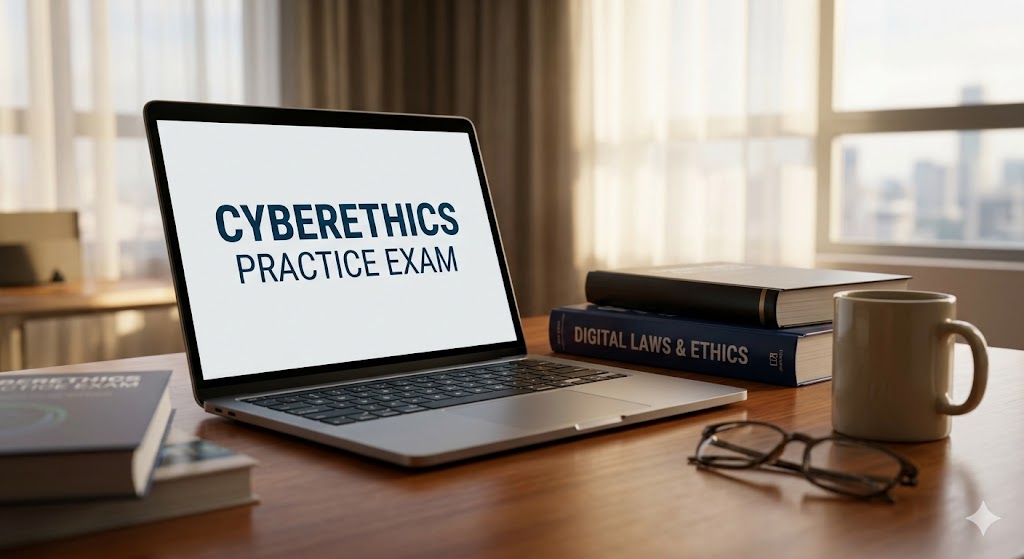
Additional Information
What the Course Entails and Exam Details
To succeed on a CyberEthics exam, candidates must master several distinct domains, merging the worlds of technology, law, and philosophy. A comprehensive study path and practice test would cover the following core areas:
Ethical Frameworks in Computing: Understanding classical ethical theories, such as Utilitarianism, Deontology, and Virtue Ethics, and their direct application to real-world technological dilemmas.
Data Privacy and Protection: A deep dive into global and regional laws and regulations, including the General Data Protection Regulation (GDPR), the California Consumer Privacy Act (CCPA), and relevant HIPAA standards.
Intellectual Property (IP) and Copyright: Distinguishing between different forms of IP protection, such as patents, copyrights, trademarks, and trade secrets, and understanding the ethical handling of open-source versus proprietary software.
Professional Codes of Conduct: Interpreting and applying established professional standards from organizations like the ACM (Association for Computing Machinery) and IEEE (Institute of Electrical and Electronics Engineers).
Cybercrime and Legal Implications: Analyzing the legal definitions of cybercrime, understanding the role of evidence, and recognizing the overlap between personal moral responsibility and official legal obligations, including the ethics of "whistleblowing."
Emerging Issues in Cyber Ethics: Evaluating the novel challenges presented by Artificial Intelligence (AI) and algorithm bias, Big Data and predictive analytics, social media data mining, and virtual/augmented reality (VR/AR).
What to Expect in the Final Exam
While the exact structure can vary, a final CyberEthics exam is typically composed of 60 to 100 questions. These are overwhelmingly presented in a multiple-choice or scenario-based format. Scenario-based questions test your ability to apply abstract concepts to specific, complex ethical dilemmas, requiring you to select the "best" course of action among several possibilities. The exam is usually a timed assessment, often lasting between 90 and 120 minutes. Due to the nuanced nature of ethics, the passing score is high, frequently ranging from 70% to 80%, to ensure candidates can reliably identify and navigate ethical conflicts.
How to Study and Exam Centers
Preparation for a CyberEthics exam should be methodical and application-focused. Effective study strategies include a domain-by-domain review of key concepts and legal definitions. Create detailed study cards for each ethical framework and regulatory standard.
However, the most effective tool is the use of comprehensive practice tests. Taking multiple practice exams under timed conditions builds mental stamina and allows you to become familiar with the way ethical dilemmas are framed in a testing environment. Critically analyze the answers you got wrong to identify underlying knowledge gaps or faulty reasoning.
CyberEthics exams are typically delivered through standardized professional testing centers or online proctoring portals. For official certifications, common options for testing include Pearson VUE, which has physical centers worldwide, and specialized online proctoring services (such as PSI), allowing you to take the exam from a secure home environment. Authorized academic institutions or professional organizations (like ISACA or TEEX) also offer and host ethical assessments.
Job Opportunities from the Course
A formal validation of your cyber ethics expertise significantly enhances your career prospects, qualifying you for leadership roles that focus on the intersection of technology and governance. Key job opportunities include:
Data Privacy Officer (DPO): Ensuring that an organization’s data collection, processing, and storage practices comply with all relevant legal and ethical standards.
Cybersecurity Ethical Analyst: A role focused on evaluating internal policies, software acquisitions, and data handling procedures through an ethical lens to prevent algorithmic bias or privacy violations.
Governance and Compliance Specialist: An official responsible for auditing an organization’s IT systems to ensure conformity with external regulatory bodies and internal codes of conduct.
IT Policy and Audit Manager: A leadership role that designs, implements, and enforces ethical IT practices across an enterprise, including incident response protocols.
Corporate Ethics & Compliance Director: A high-level position that oversees the ethical behavior of the entire corporation, with a particular focus on its digital footprint and data ethics.
Legal Technology Consultant: A legal professional who advises corporations on the nuanced application of digital law, privacy regulations, and emerging ethical issues in technology.
Frequently Asked Questions
Reviews
5.0
Based on 0 reviews
Leave a Review
No reviews yet. Be the first to review!