
Cybersecurity and Digital Forensics Practice Test
$69.00
- Buy to unlock unlimited access to all Quiz questions and Answers in this Quiz.
- After purchase you can print a PDF of the whole quiz at any point. The PDF will contain the questions and the correct answers.
About this Exam
Welcome to your comprehensive study guide for the fast-paced and crucial world of Cybersecurity and Digital Forensics. This comprehensive practice test is your gateway to validating a vital dual-skill set that is in immense demand globally. Designed for aspiring cybersecurity analysts, incident responders, law enforcement professionals, and existing IT professionals seeking a specialization, this practice exam simulates the rigorous knowledge and practical problem-solving challenges encountered in the field. It evaluates your fundamental understanding of digital security, threat detection, and the precise, legally defensible methods required to investigate and resolve digital incidents. If you're serious about protecting vital data and uncovering digital truths, this is the essential practice resource to ensure your readiness.
Ready to test your knowledge?
Buy Now to Access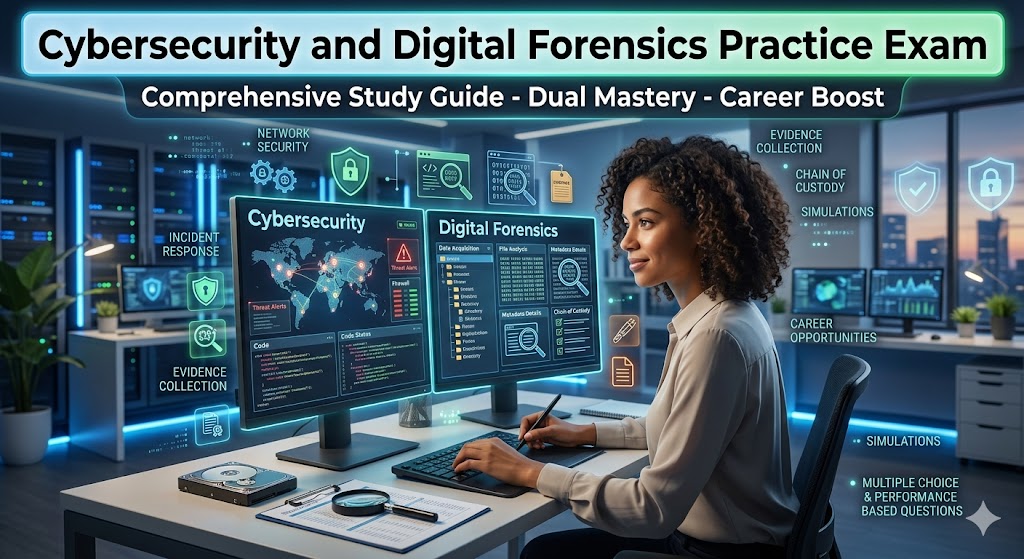
Additional Information
What the Course Entails and Exam Details
Our detailed study materials and this practice exam are meticulously structured around the key domains where cybersecurity and digital forensics intersect. Here's a look at the comprehensive topics covered:
Cybersecurity Fundamentals: Network security principles, encryption technologies, threat intelligence, and vulnerability assessment.
Digital Forensics Methodology: Understanding the forensic lifecycle—identification, preservation, acquisition, analysis, documentation, and presentation of evidence.
Incident Response: Standard procedures for detecting, containing, and eradicating cyber threats.
Data Acquisition and Analysis: Techniques for legally acquiring data from various systems and the critical analysis of file systems, registry keys, and log files.
Malware Analysis: Techniques for static and dynamic analysis of malicious software.
Legal and Ethical Considerations: Navigating the critical aspects of laws, regulations, privacy, and maintaining a verifiable chain of custody for all digital evidence.
This practice exam typically consists of multiple-choice questions, interspersed with interactive, performance-based scenarios and case studies to rigorously test your ability to apply theoretical concepts to real-world investigations. To reflect a strong level of proficiency suitable for advanced certification and job-readiness, our recommended practice passing score is 80% or higher, ensuring you are thoroughly prepared for the challenges of this critical field.
What to Expect in the Final Exam
As this is a practice exam, its primary goal is to simulate the difficulty and experience of real-world certification and professional placement tests. You should expect:
Diverse Question Types: A mix of multiple-choice, multiple-response, interactive data analysis challenges, and performance-based simulation questions that mirror actual scenarios.
Timed Conditions: The practice test is timed to reflect the typical duration of challenging industry exams, encouraging you to develop efficient problem-solving and time management skills. We recommend allocating a similar amount of time as you would for a proctored certification (e.g., 90-120 minutes) to create a realistic testing environment.
Immediate Feedback (in practice mode): Our platform often provides immediate scoring and detailed explanations for both correct and incorrect answers in study modes, allowing you to learn as you practice.
Progress Tracking: Track your scores across different domains to pinpoint your strengths and identify specific areas that need more focused study.
Focus and Accuracy: Ensure you read each question, prompt, and scenario detail meticulously, and fully understand what is being asked before attempting an answer or navigating a simulation. The accuracy of your reasoning and evidence handling is just as critical as the final answer in the professional world.
How to Study and Exam Centers
Effectively mastering this complex field requires a strategic and multifaceted study approach, leveraging both theoretical understanding and practical application.
Structured Study Guide: Utilize this guide and all associated materials. Dedicate specific time blocks to each major domain.
Hands-on Practice is Key: Don’t just read about tools and processes—use them. Set up safe, legal virtual environments to practice using both reputable cybersecurity tools (e.g., Wireshark, Metasploit, Nmap) and foundational digital forensics software (e.g., Autopsy, FTK Imager, various log analysis scripts).
Reputable Practice Tests: This comprehensive practice exam is designed to be a cornerstone of your preparation. Take it multiple times, treat each attempt as the real exam, and analyze your performance to guide your continued study.
Official Study Materials and Courses: Review recommended textbooks, whitepapers, and, if available, official certification training programs that map to the common domains covered. Many well-known certifications are highly relevant: CompTIA Security+, GIAC certifications (GCFE, GCFA, GCIH, etc.), EC-Council’s CHFI, and relevant SANS Institute training.
Taking the Exam:
This Practice Test: You can access this comprehensive practice test online, from the comfort of your own environment, via our dedicated learning portal. It's accessible 24/7, allowing you to fit your practice around your schedule.
Official Industry Certifications: While this practice test evaluates your skills, final, official industry certifications for cybersecurity and digital forensics often require testing through authorized centers. Organizations like CompTIA, GIAC, and EC-Council typically utilize highly secure third-party proctors, including well-known, specialized physical centers like Pearson VUE, which have facilities worldwide, or increasingly, via rigorous online proctoring services. To pursue an official certification after perfecting your skills with our practice test, you would register with the respective certification body and schedule your official, proctored exam at an authorized location or online.
Job Opportunities from the Course
Gaining foundational and practical knowledge in Cybersecurity and Digital Forensics, validated by rigorous study and practice tests, unlocks a diverse and rapidly growing array of high-impact career paths:
Cybersecurity Analyst: Monitor networks for threats, investigate security alerts, and implement security controls.
Incident Responder: Rapidly identify, contain, and remediate cyber incidents.
Digital Forensics Examiner: Legally acquire and analyze digital evidence for legal cases, corporate investigations, or law enforcement.
Information Security Engineer: Design and build secure networks and systems.
Penetration Tester: Legally probe systems to identify vulnerabilities and recommend security improvements.
Security Consultant: Advise organizations on their overall security posture, risk management, and compliance with forensic standards.
Cybercrime Investigator: Investigate large-scale cybercrimes and network intrusions, typically within law enforcement or government agencies.
Risk and Compliance Analyst: Evaluate adherence to security and privacy regulations and maintain internal policies.
eDiscovery Specialist: Manage digital information as evidence in legal proceedings, often working within legal or forensic departments.
Frequently Asked Questions
Reviews
5.0
Based on 0 reviews
Leave a Review
No reviews yet. Be the first to review!