
DAANCE Module 5 Office Anesthesia Emergencies Practice Test
$69.00
- Buy to unlock unlimited access to all Quiz questions and Answers in this Quiz.
- After purchase you can print a PDF of the whole quiz at any point. The PDF will contain the questions and the correct answers.
About this Exam
The DAANCE (Dental Anesthesia Assistant National Certification Examination) Module 5 practice test is designed as a crucial preparatory step for dental assistants pursuing authorization or certification in providing anesthesia in dental office settings. It focuses specifically on equipping candidates with the knowledge and confidence to recognize, assess, and manage critical office anesthesia emergencies.
Who is it for? This specific module and its corresponding practice exam are tailored for dental assistants who are either already involved in or aspire to assist with conscious sedation, moderate sedation, deep sedation, and general anesthesia procedures in the dental office environment. They seek specialized training to enhance patient safety and meet regulatory requirements.
Ready to test your knowledge?
Buy Now to Access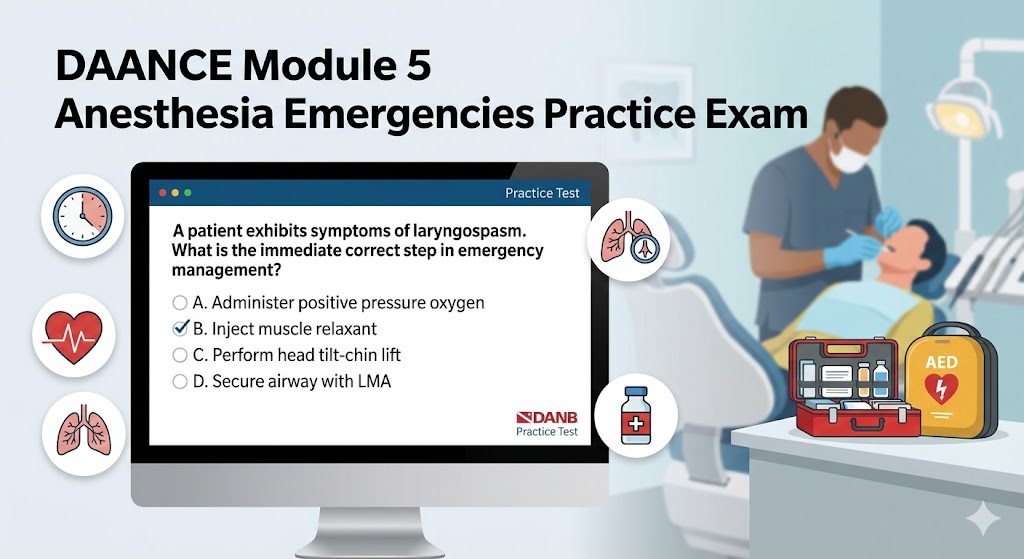
Additional Information
What the Course Entails and Exam Details
This segment of the broader DAANCE certification program delves deeply into the prevention and management of various life-threatening emergencies that can arise during anesthesia administration. The actual Module 5 exam and this practice tool cover a comprehensive curriculum that includes:
Recognition and assessment of office anesthesia emergencies, including cardiovascular (cardiac arrest, arrhythmias, acute coronary syndrome), respiratory (airway obstruction, bronchospasm, laryngospasm), allergic reactions (anaphylaxis), neurological (seizures), and other systemic crises (syncope, hypertensive crisis, stroke, diabetic emergencies). Comprehensive management strategies and protocols for each emergency, aligned with current evidence-based guidelines and Advanced Cardiovascular Life Support (ACLS) algorithms tailored for the dental setting. Understanding of pharmacology relevant to emergency situations, including emergency drug kits, dosages, administration routes, and monitoring of patient responses. Proper use and management of emergency equipment, such as airway adjuncts, oxygen delivery systems, defibrillators (AEDs), and monitoring devices. Team coordination and communication in an emergency scenario, emphasizing roles, responsibilities, and effective leadership within the dental anesthesia team.
The Module 5 content ensures that dental assistants possess a critical foundational understanding of physiology and pathophysiology related to emergency situations, enabling them to make swift and informed decisions under pressure.
What to Expect in the Final Exam
While the exact structure might vary slightly, the actual DAANCE Module 5 section within the full examination is typically composed of multiple-choice questions. It aims to evaluate candidates' understanding of the theory, concepts, and procedural steps involved in handling office-based anesthesia emergencies. Candidates can expect:
Multiple-choice questions: The majority, if not all, of the questions will likely follow a multiple-choice format, requiring the selection of the single best or most correct answer.
Timed conditions: The exam, and thus this practice test, is generally conducted within specific time limits, simulating the pressures of real-world scenarios and the actual examination.
Application of knowledge: Questions often presented in clinical vignette formats, requiring candidates to apply their knowledge to diagnose and determine appropriate management strategies for a given emergency scenario.
Focus on safety: A strong emphasis is placed on recognizing critical vital signs, utilizing correct protocols, and ensuring patient safety is paramount in every situation.
Details on the passing score, specific question count for the module, and full examination guidelines are provided by the certifying body, the Dental Assisting National Board (DANB).
How to Study and Exam Centers
Effective preparation for the DAANCE Module 5 exam requires a multifaceted approach:
Utilize Official Resources: Focus on official study guides and educational materials provided by DANB or accredited training providers. These are the most direct preparation tools for the exam content.
Master Core Concepts: Review physiology of life-threatening events, emergency protocols (ACLS), and drug pharmacology. Make detailed notes, particularly on recognizing early warning signs and step-by-step treatment algorithms.
Active Learning Techniques: Create flashcards for critical information like emergency drug dosages, algorithm steps, and recognition criteria. Implement spaced repetition to reinforce memory.
Practice Simulations: Rehearse responding to specific emergencies mentally or with a study partner. This builds mental resilience and helps develop a structured, rapid-response mindset.
Take Practice Exams: Utilize multiple practice tests to build test-taking endurance, become familiar with question formats, and identify areas of weakness for further study. Mimicking exam conditions during practice is essential.
Hands-on Training: Seek practical training opportunities in areas such as CPR, AED use, and potentially specialized anesthesia emergency courses tailored for dental professionals.
Taking the Exam: The actual DAANCE examination is administered by DANB and typically delivered at designated testing centers, often Pearson VUE locations, across the country. Candidates must register with DANB, pay the required fees, and then schedule their exam at a convenient testing facility. The specific location and scheduling options will be provided during the registration process.
Job Opportunities from the Course
Successful completion of the DAANCE certification, including Module 5 competency, opens doors to a variety of satisfying career paths with enhanced responsibilities and typically higher earning potential:
Certified Dental Anesthesia Assistant (CDAA): This primary certification validates a specialized skill set, allowing dental assistants to assist in deeper levels of sedation and anesthesia across diverse dental specialties.
Anesthesia Assistant in Oral and Maxillofacial Surgery: Highly sought-after roles in oral surgery practices, where deep sedation and general anesthesia are common for complex surgical procedures.
Dental Sedation Assistant: Opportunities in general dentistry or other specialized practices utilizing conscious or moderate sedation for anxious patients, pediatric dentistry, or lengthy procedures.
Hospital-Based Dental Surgery Assistant: Roles assisting in operating rooms for dental procedures that require a higher level of medical oversight and comprehensive anesthesia.
Dental Anesthesia Coordinator or Educator: Opportunities in academic or clinical settings, leading sedation team coordination or training future dental professionals.
Frequently Asked Questions
Reviews
5.0
Based on 0 reviews
Leave a Review
No reviews yet. Be the first to review!