
Dallas Police Exam 3 Practice
$69.00
- Buy to unlock unlimited access to all Quiz questions and Answers in this Quiz.
- After purchase you can print a PDF of the whole quiz at any point. The PDF will contain the questions and the correct answers.
About this Exam
The Dallas Police Exam 3 Practice is designed as the essential launching pad for dedicated individuals aspiring to join the ranks of the Dallas Police Department (DPD). This rigorous evaluation is not merely a formality; it is the primary academic gateway that assesses a candidate's foundational cognitive abilities, critical thinking, and communication skills required to excel in modern law enforcement. The DPD seeks recruits who possess a strong command of standard English, mathematical reasoning, and the ability to synthesize information quickly, all of which are thoroughly tested by this examination. This exam is meticulously crafted for serious applicants who meet the DPD's stringent initial qualifications and are ready to prove their aptitude for a challenging and rewarding career protecting the citizens of Dallas.
Ready to test your knowledge?
Buy Now to Access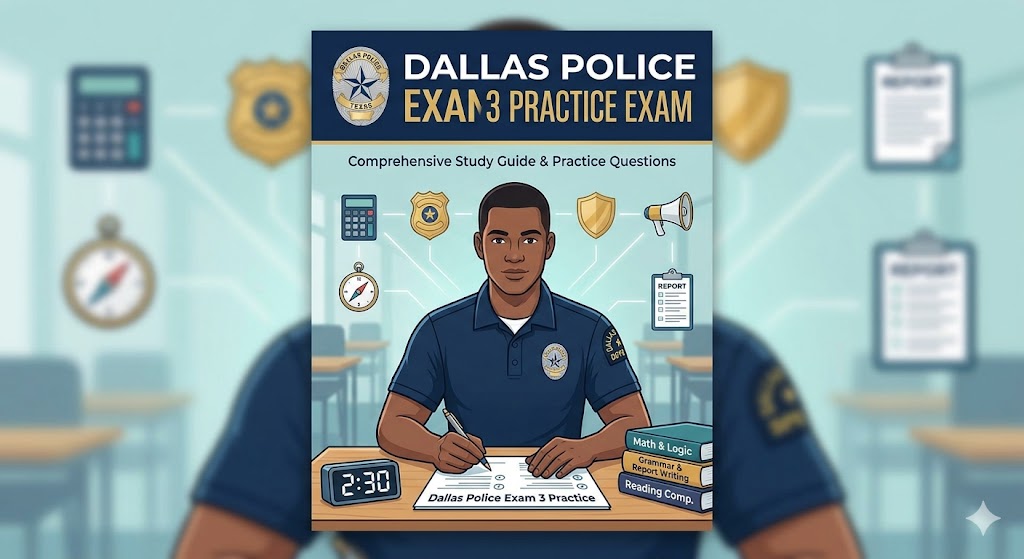
Additional Information
What the Course Entails and Exam Details
While the specific numerical designation "Exam 3" often refers to a particular version or subset within study systems, the core content you must master mirrors the actual Civil Service written entrance examination required by the City of Dallas.
This comprehensive exam focuses on four core cognitive domains:
Reading Comprehension: You will encounter long and short passages related to law enforcement, public safety scenarios, or general administrative materials. You must demonstrate the ability to identify main ideas, recall specific details, understand sequences of events, and draw logical conclusions based only on the information provided in the text.
Basic Arithmetic and Mathematical Reasoning: This section tests your fluency with fundamental mathematical operations. You must be proficient in addition, subtraction, multiplication, and division, as well as working with decimals, fractions, and percentages. Key components include solving "word problems" that require you to apply math to practical situations, such as calculating time, distance, ratios, and percentages, commonly encountered in police work.
Spelling, Grammar, and Word Usage: A significant portion of a police officer's duty involves documentation and report writing. This section evaluates your mastery of standard English conventions, including proper spelling, subject-verb agreement, verb tense, pronoun usage, and punctuation to ensure your written communication is clear, accurate, and professional.
Writing and Report Writing Skills: Beyond basic grammar, you may be required to synthesize information to construct a coherent written response or complete a mock incident report. This tests your capacity to organize facts, express ideas clearly, and adhere to a logical structure when documenting events.
What to Expect in the Final Exam
The actual Dallas Police Civil Service Entrance Examination is a structured, timed test administered in a controlled environment. The exam primarily utilizes a multiple-choice format for the cognitive and grammatical sections. You may be presented with four or five potential answers for each question, and you must select the single best response. If a writing component is included on your specific test date, you will be given a prompt and required to produce a handwritten or typed response.
To pass the examination and advance to the physical fitness assessment and background investigation, you must achieve a minimum score, which is typically 70%.
The time limit for the entire examination is generally approximately two hours and thirty minutes (2:30). This time must be managed carefully across all sections, especially if a written exercise is included. Strict rules apply during the examination: no electronic devices, reference materials, or unauthorized aides are allowed, and arriving late can disqualify you from testing.
How to Study and Exam Centers
Preparation is the absolute key to success on the Dallas Police Exam. Because the test evaluates basic cognitive aptitude rather than job-specific knowledge, successful study strategies focus on sharpening core academic skills and getting accustomed to the exam’s structure. We recommend a three-pronged approach:
Comprehensive Skill Review: Dedicate significant time to refreshing your knowledge in the four key areas. Utilize resources such as adult basic education books, online grammar tutorials (like Purdue OWL), math review websites (like Khan Academy) for algebra and word problem practice, and practice reading complex non-fiction texts to improve comprehension speed.
Simulated Practice Exams: Utilize high-quality Dallas Police Exam practice materials that simulate the actual testing experience. Focus on timing yourself strictly for each section to build the stamina and pacing necessary for the final 2.5-hour exam. Review both correct and incorrect answers to understand the underlying logic of the questions.
Report Writing Practice: For the writing section, practice outlining and writing short incident reports based on hypothetical scenarios. Focus on clarity, conciseness, and accuracy of factual presentation.
You cannot take the Dallas Police Civil Service Exam online from home. All written examinations are administered in person at official testing facilities within the City of Dallas. Once you complete the online DPD application and are deemed eligible, you will receive instructions on how to schedule your examination. These authorized testing sites are usually physical physical locations such as local civil service offices, or specified DPD training facilities, and you must present a valid government-issued photo ID upon arrival.
Job Opportunities from the Course
Successfully passing the Dallas Police Exam 3 Practice and the subsequent Civil Service Entrance Exam is the crucial first step required to unlock a career within one of the largest and most dynamic municipal police departments in the United States. Upon passing the written exam, you are eligible to proceed through the remainder of the rigorous hiring process, including the physical fitness assessment, oral board interview, polygraph, psychological evaluation, and a comprehensive background investigation. Passing these steps culminates in an offer to join the DPD Academy.
Graduating from the academy allows you to embark on various specialized and ladder career paths, including, but not limited to:
Police Cadet (Initial Academy position)
Police Officer (Upon academy graduation)
Patrol Officer (Various substations and shifts)
Field Training Officer
Detective (Specialized Investigative Units)
Narcotics Officer
SWAT Officer
K-9 Officer
Helicopter Pilot / Air Support
Traffic / Motorcycle Unit
Mounted Unit (Horse Patrol)
Youth Services Detective
Crisis Intervention Team Officer
Cybercrime Investigator
Frequently Asked Questions
Reviews
5.0
Based on 0 reviews
Leave a Review
No reviews yet. Be the first to review!