
DAM Aeromedical Orientation Practice Test
$69.00
- Buy to unlock unlimited access to all Quiz questions and Answers in this Quiz.
- After purchase you can print a PDF of the whole quiz at any point. The PDF will contain the questions and the correct answers.
About this Exam
The DAM Aeromedical Orientation certification is an essential program for healthcare professionals—including physicians, nurses, physician assistants, and medics—who are transitioning into the specialized field of aviation medicine. This orientation provides the foundational knowledge necessary to understand and manage the unique physiological and psychological stresses faced by aircrew in flight. Whether working within a military command or a civil aviation authority, completing this orientation is a prerequisite for roles that ensure the medical fitness and safety of pilots, air traffic controllers, and other critical personnel.
Ready to test your knowledge?
Buy Now to Access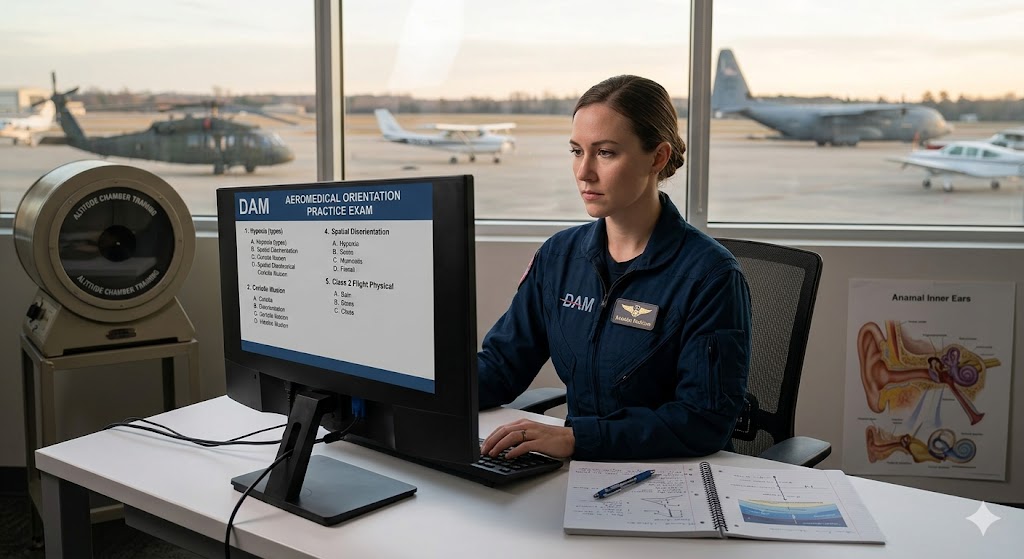
Additional Information
What the Course Entails and Exam Details
This comprehensive course, and by extension, the final and practice exams, cover a critical intersection of medicine, aviation, and atmospheric physics. The curriculum is meticulously structured to include, but is not limited to, the following core topics:
Aviation Physiology: Mastery of the effects of altitude on the human body is paramount. This includes an in-depth study of hypoxia (its four types: hypoxic, hypemic, stagnant, and histotoxic), hyperventilation, decompression sickness (DCS), the "trapped gases" phenomenon, and the physical laws governing gases, such as Dalton’s and Henry’s Laws.
Aviation Psychology and Human Factors: Professionals must understand the factors contributing to pilot performance and error. Key subjects include stress, acute and chronic fatigue, and the decision-making process.
Spatial Disorientation and Sensory Systems: One of the most critical flight safety modules, this covers the eight common sensory illusions (the leans, graveyard spin, Coriolis effect, autokinesis, inversion, etc.), the intricate function of the vestibular (inner ear) and visual systems, and strategies for recognizing and mitigating disorientation. This also encompasses dark adaptation, night vision (scotopic), and daytime vision (photopic).
Toxicology and Environmental Factors: Understanding how the flight environment interacts with hazardous substances is essential. This covers carbon monoxide poisoning, noise, vibration, and the strict classification and administration of medications for aircrew.
Aeromedical Administration and Policy: Understanding medical standards and the regulatory environment is critical for managing aircrew. This includes the various classes of flight physicals (Class 1 through 4), "birth month window" management, and the waiver and medical certification process.
What to Expect in the Final Exam
While the exact structure of the official final exam can vary by the administering organization (e.g., military vs. civil aviation authority), it is typically designed to rigorously test both knowledge recall and the application of clinical concepts to aviation-specific scenarios. The final exam commonly takes a structured multiple-choice format, designed to be highly demanding and comprehensive. Candidates should prepare for a significant number of questions—often ranging from 100 to 200—covering the entire breadth of the course. The official passing score generally ranges from 70% to 80%, depending on the specific program’s requirements. A strict time limit is enforced to simulate the high-pressure environment of aviation.
The "DAM Aeromedical Orientation Practice Test" is specifically designed to replicate these conditions as closely as possible. It is intended not only to assess your current knowledge of the syllabus but also to build your endurance and proficiency in high-stakes testing, enabling you to identify weaker areas for targeted study.
How to Study and Exam Centers
Preparation for this exam requires a strategic, multifaceted approach, utilizing the same techniques needed to pass any licensing board or technical certification.
Practice with Purpose: Do not simply take a practice test to see your score. The most crucial part is reviewing the rationale for every answer—both those you answered correctly and incorrectly. This reinforces the core concepts and corrects misconceptions before the final exam.
Focus on High-Yield Content: Revisit your weakest areas repeatedly. Concepts like the types of hypoxia, the spatial disorientation illusions, and the exact steps of the MEDEVAC process are frequent targets in the final exam. Use active recall techniques like flashcards (both physical and digital) for fast, spaced repetition.
Simulate the Real Exam: When taking practice tests, create a distraction-free environment and strictly time yourself to build familiarity with the final exam's time pressure and format.
Exam Centers and Accessing the Test:
The actual final exam is not available to the public and is restricted to candidates enrolled in an authorized "DAM Aeromedical Orientation" program.
For Military Personnel: The final exam is typically administered upon the conclusion of formal training at designated centers, such as the Department of Aviation Medicine at Fort Novosel (formerly Fort Rucker) or other major military training installations and aviation clinics.
For Civil Practitioners: The orientation and final exam are usually accessed through specialized aviation medicine schools or authorized training portals sanctioned by a national civil aviation authority (e.g., KCAA, FAA, etc.).
Job Opportunities from the Course
Upon completion of the DAM Aeromedical Orientation and obtaining your certification, a wide array of specialized career paths in aviation medicine will unlock. Professionals in this field find rewarding roles in both the military and civilian sectors. Specific job opportunities include:
Military Flight Surgeon: As the primary physician for a military unit, you manage the medical readiness and flight status of aviators and aircrew.
Aviation Medical Examiner (AME): For civil practitioners, this certification is a crucial step toward becoming a designated AME, who performs mandatory FAA or equivalent medical examinations for civilian pilots.
Critical Care Flight Paramedic/Medic: Specialized flight paramedics use this orientation to operate in both military and civilian air ambulance (MEDEVAC/HEMS) services, providing life-saving care during patient transport.
Aeromedical Technician/Physician Assistant: In this role, you provide clinical support in an aviation medicine clinic, managing flight physicals, health records, and wellness programs.
Aviation Health and Safety Consultant: Use your expertise to advise major airlines, helicopter operators, or regulatory bodies on human factors, health policies, and mishap prevention.
Frequently Asked Questions
Reviews
5.0
Based on 0 reviews
Leave a Review
No reviews yet. Be the first to review!