
DAM Aeromedical Practice Exam
$69.00
- Buy to unlock unlimited access to all Quiz questions and Answers in this Quiz.
- After purchase you can print a PDF of the whole quiz at any point. The PDF will contain the questions and the correct answers.
About this Exam
The Department of Aviation Medicine (DAM) Aeromedical Practice Exam is an essential preparatory tool for military personnel—including aviators, aircrew, and medical providers—aiming to obtain certification in aerospace medicine and human factors. This comprehensive practice test is specifically designed to simulate the final qualification exam administered by the U.S. Army's Department of Aviation Medicine, located at Fort Novosel, Alabama (formerly Fort Rucker). It provides a critical review of the complex physiological and psychological challenges faced in the flight environment. By engaging with this resource, candidates can assess their knowledge, identify areas for improvement, and build the confidence necessary to successfully navigate the high standards of the actual DAM aeromedical certification process.
Ready to test your knowledge?
Buy Now to Access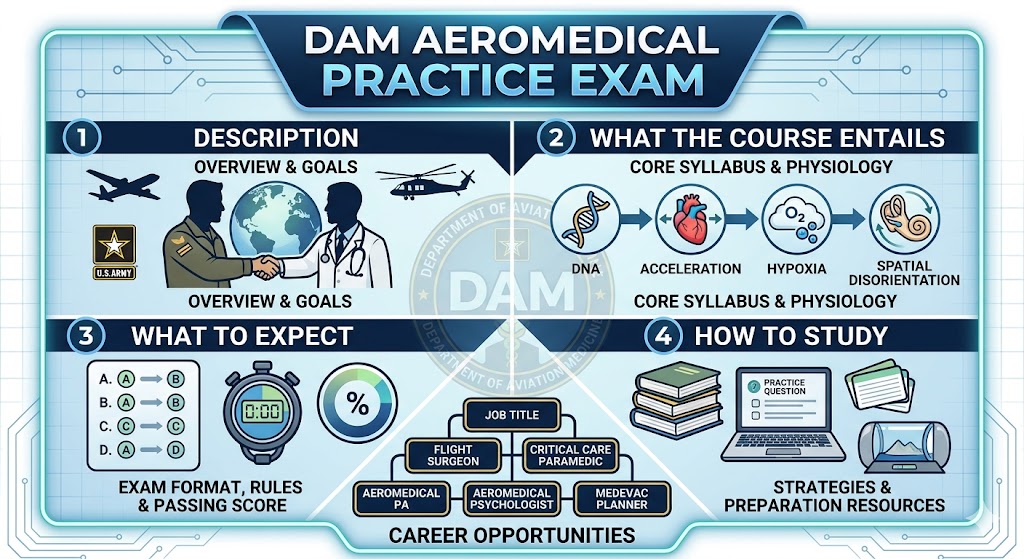
Additional Information
What the Course Entails and Exam Details
This examination covers a broad, specialized curriculum that combines advanced medical knowledge with practical aviation standards. The core syllabus is designed to ensure all personnel can recognize and mitigate the threats of flight. Key topics include, but are not limited to:
Physiology of Flight: Detailed study of the Earth’s atmosphere, including the physiological zones and the effects of pressure changes on the human body.
Hypoxia: Comprehensive understanding of the types of hypoxia (hypoxic, hypemic, stagnant, and histotoxic), their symptoms, prevention, and emergency treatments.
Cardiovascular and Circulatory Systems: How acceleration forces (Gs) and altitude affect blood flow and oxygen transport.
Spatial Disorientation and Sensory Illusions: The vestibular, visual, and proprioceptive systems and how they contribute to dangerous illusions in flight.
Aviation Toxicology: The effects of substances such as carbon monoxide, jet fuel, and medications on performance.
Acceleration Forces: The impact of positive and negative Gx, Gy, and Gz forces on the body and methods for G-tolerance enhancement.
Noise and Vibration: The long-term physiological and psychological effects of the flight environment.
Vision in Aviation: Distinctions between photopic, mesopic, and scotopic vision, and optimal visual scanning techniques for day and night.
The practice exam consists of multiple-choice questions that reflect the complexity and breadth of this curriculum. For the official DAM qualification, the program may also include practical components, such as a low-pressure altitude chamber flight, where candidates apply their knowledge in a controlled environment.
What to Expect in the Final Exam
While the exact format can vary, the final qualification exam at the Department of Aviation Medicine is typically a proctored, comprehensive test. Candidates should expect a standard multiple-choice format with questions that assess both factual recall and the application of physiological principles to real-world aviation scenarios. The practice exam you are using will emulate this, serving as a realistic simulation. For the final assessment, the passing score is high, often requiring a result of 80% or better, which underscores the critical nature of the material. There are strict time limits, which vary by course but are designed to test efficient decision-making. Specific rules, including prohibitions on external materials, are enforced. Success in this final exam, alongside completion of any required practical training, grants official certification and clearance for specific aviation duties.
How to Study and Exam Centers
Preparation for the DAM Aeromedical Practice Exam requires a disciplined approach. We recommend a structured study plan:
Utilize Official DAM Materials: Your primary resources should be the training manuals, lecture notes, and specific Technical Circulars (e.g., TC 3-04.93) provided by the Department of Aviation Medicine.
Take Multiple Practice Tests: Engage with this practice exam and any others available to you. Analyze both correct and incorrect answers to understand the underlying rationale.
Focus on High-Yield Topics: Dedicate extra time to core concepts like hypoxia, spatial disorientation, and acceleration forces, which consistently form the backbone of the assessment.
Active Learning: Create flashcards for key terms, diagrams, and emergency procedures. Study in a group to discuss complex scenarios and test each other's knowledge.
Practical Application: In a course with an altitude chamber component, pay close attention to your individual symptoms and the operation of life-support equipment.
For military personnel, the final qualification exam is taken directly through the U.S. Army Department of Aviation Medicine (DAM), located at Fort Novosel, Alabama. Remote testing options may be available for specific cohorts, managed through official Army channels and training portals. This practice exam, however, can be accessed through approved online educational platforms and internal military network resources.
Job Opportunities from the Course
Successfully completing this certification course opens specific, vital career paths and unlocks high-responsibility roles within military aviation and medicine, particularly in the U.S. Army. Personnel with this qualification are eligible for the following job titles and roles:
Flight Surgeon
Aeromedical Physician Assistant (APA)
Aviation Medicine Nurse Practitioner (AMNP)
Critical Care Flight Paramedic (CCFP)
Aeromedical Psychologist
Medical Planner (with a focus on aeromedical evacuation)
Aeromedical Evacuation Officer
Aviation Life Support Systems (ALSS) Officer (for relevant aircrew roles)
Aeromedical Instructor
Frequently Asked Questions
Reviews
5.0
Based on 0 reviews
Leave a Review
No reviews yet. Be the first to review!