
Damage Control Assistant / Senior Enlisted (DCASE) Unit 3 Practice Test
$69.00
- Buy to unlock unlimited access to all Quiz questions and Answers in this Quiz.
- After purchase you can print a PDF of the whole quiz at any point. The PDF will contain the questions and the correct answers.
About this Exam
The Damage Control Assistant / Senior Enlisted (DCASE) certification is designed for the US Navy's most dedicated engineering leaders. This advanced course equips Senior Enlisted personnel—typically Chief Petty Officers or senior First Class Petty Officers—and junior officers with the refined expertise required to manage a ship's entire damage control organization. As the primary advisor to the Commanding Officer on all matters concerning watertight integrity, firefighting, and Chemical, Biological, and Radiological (CBR) defense, the DCA is a critical role that ensures ship survivability during combat or peacetime emergencies. DCASE Unit 3 focuses specifically on culminating leadership skills, advanced program management, and command-level decision-making required in the most high-pressure scenarios.
Ready to test your knowledge?
Buy Now to Access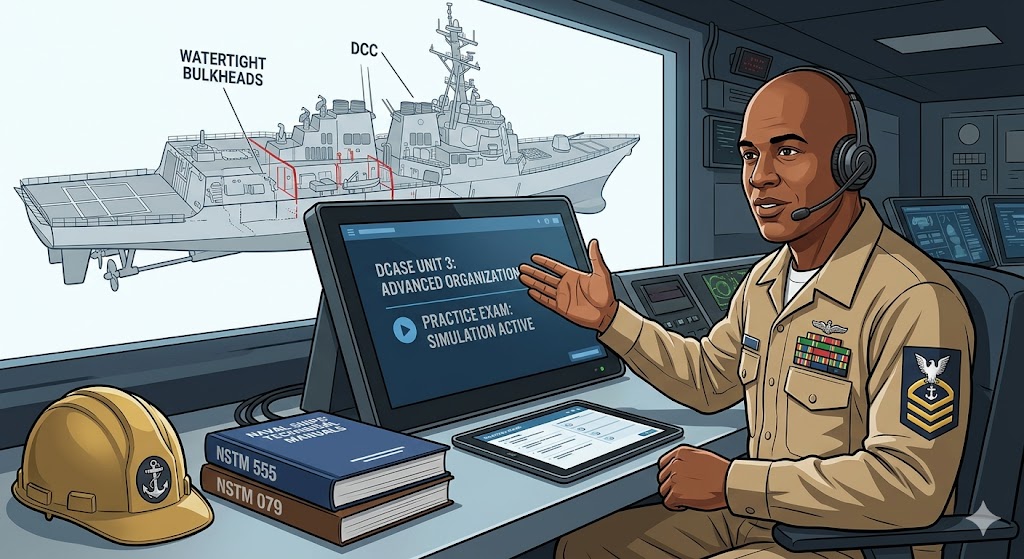
Additional Information
What the Course Entails and Exam Details
This comprehensive course moves beyond basic firefighting and flooding repair, prioritizing supervisory and organizational readiness. DCASE Unit 3 entails mastering the following core competencies:
Advanced Damage Control Organization: Deep diving into the Battle Organization and Administrative Organization. Understanding the precise flow of information between Repair Lockers, Damage Control Central (DCC), and the Bridge.
DCC Management and Communication: Expertise in managing all DC communication circuits (e.g., 2JZ, 4JZ, X40J) and the technology used to track and plot damage.
Material Condition of Readiness Mastery: Authoritatively managing the ship's material conditions (X-RAY, YOKE, ZEBRA) and supervising the meticulous maintenance of the Damage Control Closure Log.
CBR-D Program Administration: High-level management of the ship's CBR-N defense posture, including equipment readiness, training, and operational doctrine integration.
Safety, Training, and Inspections: Designing and supervising effective shipboard damage control drills, certifying repair parties, and preparing the command for major inspections like INSURV.
What to Expect in the Final Exam
This practice test is an essential tool to prepare for the final certification exam. While format can vary by command and training platform, students should generally expect the final DCASE exam to be a comprehensive assessment. It typically consists of a timed, multiple-choice computerized exam taken through an authorized military training portal. The exam is demanding and closed-book, requiring you to recall specific Navy instructions (NSTMs), directives, and organizational protocols instantly. The questions are designed to test your ability to make critical, doctrine-based decisions under time constraints. You must achieve a passing score—usually around 80%—to demonstrate your mastery of the advanced DCASE Unit 3 materials.
How to Study and Exam Centers
Preparation for the DCASE exam must be methodical and focused on active recall.
Leverage Practice Tests: Use this DCASE Unit 3 practice test repeatedly to identify knowledge gaps. Analyze not just the correct answers, but why the wrong answers are incorrect according to doctrine.
Master the Core Instructions: Study the pivotal Naval Ships’ Technical Manuals (NSTMs). Pay special attention to NSTM 555 (Firefighting), NSTM 079 Vol 2 (Practical DC), and NSTM 470 (CBR-D). Do not just skim them; know how to apply them to scenarios.
Utilize Flashcards: Create digital or physical flashcards for acronyms, specific circuit designations, material condition fittings, and logging requirements.
Group Study: Engage with other Senior Enlisted or officers preparing for the same goal. Scenario-based discussion is exceptionally effective for DCASE material.
The final DCASE exam is administered at authorized Military Testing Facilities (MTFs), command-proctored environments, or through authorized online portals such as Navy e-Learning (NEL) while on shore duty or deployed. Ensure you have the necessary prerequisite qualifications and command approval before scheduling your final test.
Job Opportunities from the Course
Earning the DCASE certification and its corresponding NEC (e.g., U46A) unlocks significant leadership opportunities and elevates your career trajectory within the engineering and deck communities. The critical thinking and program management skills verified by this course are highly valued throughout the Navy.
Graduates are qualified for prestigious leadership roles, including:
Damage Control Assistant (DCA): Serving as the Division Officer or Department Head responsible for shipboard survivability.
Senior Damage Control Instructor: Training the next generation of sailors at major training commands.
Repair Party Leader/Scene Leader: Leading high-level repair locker teams during General Quarters.
Shipboard CBR-D Program Manager: Managing complex chemical, biological, and radiological defense readiness.
Engineering Department LCPO: Providing senior enlisted leadership to the entire Engineering Department.
Fleet-Level Damage Control Advisor: Serving on ATG (Afloat Training Group) or ISIC (Immediate Superior in Command) staffs.
Frequently Asked Questions
Reviews
5.0
Based on 0 reviews
Leave a Review
No reviews yet. Be the first to review!