
Damage Control Repair Party Investigator (DC-312) Practice Test
$69.00
- Buy to unlock unlimited access to all Quiz questions and Answers in this Quiz.
- After purchase you can print a PDF of the whole quiz at any point. The PDF will contain the questions and the correct answers.
About this Exam
The Damage Control Repair Party Investigator (DC-312) qualification is a vital credential for maritime and naval personnel responsible for shipboard safety.
This designation, widely recognized within naval organizations like the U.S. Navy, signifies proficiency in rapidly and accurately investigating onboard damage during emergencies.
The DC-312 program is designed for dedicated sailors and mariners seeking specialized knowledge in identifying hazards, reporting critical data, and contributing effectively to a repair party’s response efforts, ultimately enhancing vessel survivability.
Ready to test your knowledge?
Buy Now to Access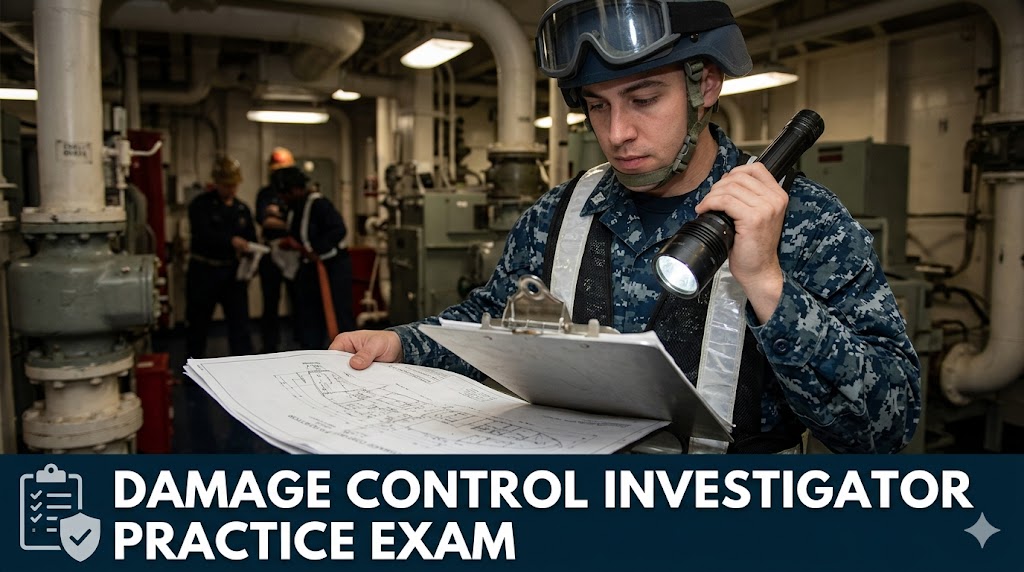
Additional Information
What the Course Entails and Exam Details
The DC-312 course is a combination of comprehensive self-study and rigorous practical application, typically structured around the Damage Control PQS (Personnel Qualification Standard). It covers the essential theory and hands-on skills needed for safe and effective damage investigation. Core areas of study include:
Principles of Investigation: Learning the four phases of investigation: Initial, Continuous, Thorough, and Post-Casualty.
Safety Procedures and PPE: Proper use of required Personnel Protective Equipment, including battle dress, flash hoods, and SCBA (Self-Contained Breathing Apparatus).
Setting Material Conditions: Mastering the techniques for setting and maintaining material conditions of readiness, especially Condition Zebra, to preserve a ship's watertight integrity.
Investigating Casualties: Expert knowledge of how to investigate for all classes of fire (A, B, C, D) and all types of flooding.
Specialized Equipment: Proficiency in using the Investigator Kit, which includes sounding tapes, dogging wrenches, air test fittings, watertight door indicators, and understanding the use of the NFTI (Naval Firefighter's Thermal Imager).
Communication: Learning standard radiotelephone (R/T) procedures and internal communication protocols to provide clear, concise reports under pressure.
What to Expect in the Final Exam
The DC-312 final exam is a two-part assessment designed to test both theoretical understanding and practical performance. It is not an entry-level test; you must be thoroughly prepared to demonstrate your competency.
Written Knowledge Examination: This portion typically consists of 50 to 100 multiple-choice questions. It assesses your knowledge of DC organization, fire physics, material conditions, equipment operation, and reporting procedures. A common passing score is 80% or higher.
Practical Performance Test (PQS Board): This is the most crucial part. Under the observation of an authorized qualifier, such as a member of the Damage Control Training Team (DCTT) or the Damage Control Assistant (DCA), you will be required to perform a series of practical tasks. This can include conducting a simulated investigation of a space, demonstrating the correct use of sounding tape, properly rigging equipment, setting material condition Zebra on a complex watertight door, and delivering a formal report of damage to a watchstation. You must successfully perform all tasks to pass.
How to Study and Exam Centers
Preparation for DC-312 requires a combination of rote learning and tactile experience.
Study Materials: Your primary sources are the NAVEDTRA 14057 (Damage Controlman) rate training manual, the specific DC-312 PQS booklet, and your ship's Standard Operating Procedures (SOPs) and Damage Control Instructions.
Practice Methods: Create physical flashcards for visual identifiers (smoke color, flame type, material condition symbols). Participate actively in all shipboard damage control drills. Seek out mentorship from qualified investigators, scene leaders, or a Damage Control Petty Officer (DCPO). Request to practice physical tasks, like sounding tanks and setting Zebra, repeatedly in a controlled environment. Use online practice tests, such as a DC-312 Practice Exam, to build confidence and identify weak areas in your knowledge base.
Exam Centers: The DC-312 exam is a shipboard qualification, meaning it is not administered at external testing centers like Pearson VUE. It is scheduled and conducted onboard your assigned vessel or military command by an authorized qualification board composed of DCTT members and senior DC specialists. Contact your divisional leading petty officer or the ship's DCA to initiate the qualification process.
Job Opportunities from the Course
A DC-312 qualification is a valuable asset that unlocks key positions within the military's damage control organization and is highly relevant to civilian careers in safety and emergency response.
Military Roles:
Damage Control Repair Party Investigator: Your immediate role, crucial for ship survivability.
Scene Leader (SL): A natural progression, leading the attack team at the scene of the casualty.
Damage Control Petty Officer (DCPO): Responsibility for maintaining DC equipment and training personnel.
Damage Control Assistant (DCA): The senior officer responsible for the ship's overall damage control readiness.
Civilian Careers:
Industrial Firefighter / Emergency Response Team Member
Maritime Safety Officer
Occupational Health and Safety Specialist (Industrial / Maritime)
Damage Control Specialist for Commercial Vessels
Fire Inspector / Investigator
Frequently Asked Questions
Reviews
5.0
Based on 0 reviews
Leave a Review
No reviews yet. Be the first to review!