
Damage Controlman (DC) A-School Test 2 Practice
$69.00
- Buy to unlock unlimited access to all Quiz questions and Answers in this Quiz.
- After purchase you can print a PDF of the whole quiz at any point. The PDF will contain the questions and the correct answers.
About this Exam
The Damage Controlman (DC) A-School Test 2 is a pivotal assessment within the specialized training pipeline of the United States Navy. This exam is meticulously designed for Sailors who have selected or been assigned the rating of Damage Controlman, the Navy’s essential structural and safety specialists. This certification process validates the knowledge and technical skills required to maintain, operate, and repair vital safety systems. These sailors are the ship's last line of defense, serving as specialized firefighters, stability experts, and chemical, biological, and radiological (CBR) defense response personnel. Passing Test 2 is critical, marking the progression from fundamental knowledge to the complex, integrated systems management required to safeguard a naval vessel and its crew.
Ready to test your knowledge?
Buy Now to Access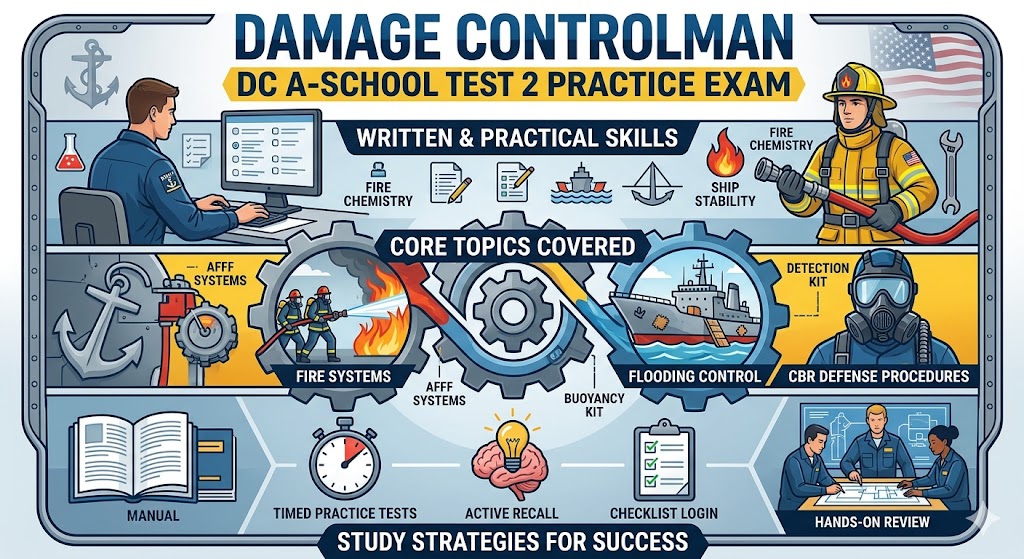
Additional Information
What the Course Entails and Exam Details
The comprehensive Damage Controlman A-School curriculum provides the foundational and intermediate skills necessary to perform DC duties. While specific syllabi vary based on updates to naval doctrine, Test 2 fundamentally assesses the core modules that bridge basic indoctrination with practical application. The topics covered in this stage of training are robust and challenging.
Key curriculum areas assessed in Test 2 include:
Advanced Firefighting Theory and Application: Mastery of fire chemistry, advanced extinguishants, and the operational coordination of firefighting teams (including hose handling, nozzle selection, and search and rescue).
Flooding Control and Ship Stability: In-depth understanding of buoyancy, righting arms, the free communication and free surface effects, and the tactical deployment of shoring, patching, and plugging techniques to maintain vertical integrity.
Chemical, Biological, and Radiological (CBR) Defense: Procedures for detection, containment, decontamination, and the use of protective equipment (such as the MCU-2/P mask) and Collective Protection Systems (CPS).
Damage Control Systems and Organization: Comprehensive knowledge of the shipboard Damage Control organization, including the roles within the Damage Control Central (DCC) and Repair Lockers.
Auxiliary Systems Maintenance: Intermediate knowledge required to operate, inspect, and repair primary systems such as AFFF (Aqueous Film-Forming Foam), Halon 1301/Heptafluoropropane (HFP), and ventilation systems.
What to Expect in the Final Exam
The final A-School Test 2 is designed to simulate the high-pressure environment of actual damage control situations. This ensures that only those who have truly internalized the material advance.
Exam Format:
The assessment typically uses a combination of delivery methods, combining a written knowledge test with a physical, practical application. The written component is generally a comprehensive, timed multiple-choice exam, administered via computer within the school’s testing facilities. The questions are detailed and require both factual recall and critical analysis of complex scenarios. Following the written exam, Sailors are usually required to pass intense, hands-on practical simulations. These practical exams assess speed, accuracy, and safety while performing critical tasks like setting shoring under stress or correctly responding to a simulated CBR alarm.
Scoring Requirements and Regulations:
The passing score for DC A-School tests is stringent, typically requiring a minimum of 75% on the written portion. The practical assessments are graded on a Pass/Fail basis, but criteria are zero-tolerance for safety violations. Time limits are strictly enforced for both components to simulate the operational tempo of an emergency. Students must adhere to all Navy testing protocols, with any form of academic dishonesty or safety violation during practicals resulting in an immediate failure and potential academic review.
How to Study and Exam Centers
Effective preparation for the DC A-School Test 2 requires a blend of academic study and practical immersion.
Actionable Study Strategies:
Practice with Purpose: Utilize comprehensive practice exams designed specifically for A-School material. Focus on the explanation for incorrect answers to bridge knowledge gaps.
Active Recall and Mnemonics: Don't just read the manuals. Use flashcards for vital procedures and mnemonics (like the steps of setting shoring) to lock complex lists into memory.
Collaborative Learning: Study in groups within your repair locker structure. Simulating roles and quizzing each other on "Watch, Quarter, and Station Bill" responsibilities solidifies understanding.
Master the Math: Spend dedicated time on ship stability calculations. Ensure you understand the effects of weight movement on G (center of gravity) and B (center of buoyancy).
Hands-on Repetition: Seize every opportunity to handle the gear. Go to the trainer lockers to practice don/doff procedures, rigging P-100 pumps, and setting pipe patches until the muscle memory is automatic.
Exam Center Location:
The formal Damage Controlman A-School and the testing centers for Test 2 are located exclusively at Surface Warfare Engineering Schools Command (SWESC) Great Lakes, situated within Naval Station Great Lakes, Illinois. This is the sole authorized location for the instruction and administration of these exams within the initial DC pipeline. Sailors are assigned testing windows as part of their structured training schedule.
Job Opportunities from the Course
Successfully completing DC A-School and Test 2 is the gateway to a challenging and vital Navy career. This training is highly technical, unlocking specific, essential ratings and setting a foundation for long-term growth.
Primary Job Titles and Career Paths:
Damage Controlman (DC): The primary rating achieved upon graduation, assigned to every type of surface vessel in the US Navy.
Repair Locker Leader: Taking a leadership role in managing firefighting and repair efforts during General Quarters.
Damage Control Petty Officer (DCPO): A divisional collateral duty, ensuring all divisional spaces maintain the highest level of DC readiness.
On-Scene Leader (OSL): Providing immediate tactical direction to a fire or flooding team at the actual site of damage.
CBR Defense Specialist: A specialized role focused on the operation, maintenance, and training related to CBR countermeasures and monitoring equipment.
Navy Instructor (Surface Warfare): Following successful sea tours, experienced DCs often return to Great Lakes to train the next generation.
Damage Control Assistant (DCA): A critical officer role on ships; prior-enlisted DC experience is often a desired qualification for Sailors who later seek a commission.
Frequently Asked Questions
Reviews
5.0
Based on 0 reviews
Leave a Review
No reviews yet. Be the first to review!