
Dangerous Goods Practice Test
$69.00
- Buy to unlock unlimited access to all Quiz questions and Answers in this Quiz.
- After purchase you can print a PDF of the whole quiz at any point. The PDF will contain the questions and the correct answers.
About this Exam
The Dangerous Goods certification is a vital credential for anyone involved in the handling, packaging, storage, or transport of hazardous materials.
Dangerous goods, often referred to as hazmat, include substances or articles that pose a risk to health, safety, property, or the environment, such as chemicals, gases, flammable liquids, explosives, and lithium batteries.
This comprehensive program is designed to ensure that personnel across the supply chain—including shippers, freight forwarders, warehouse staff, cargo handlers, and even aircraft crew—possess the knowledge to manage these items safely and in strict compliance with complex international and national regulations.
Earning this certification proves you are competent to classify, pack, label, and document dangerous goods, thereby preventing accidents and ensuring regulatory compliance.
Ready to test your knowledge?
Buy Now to Access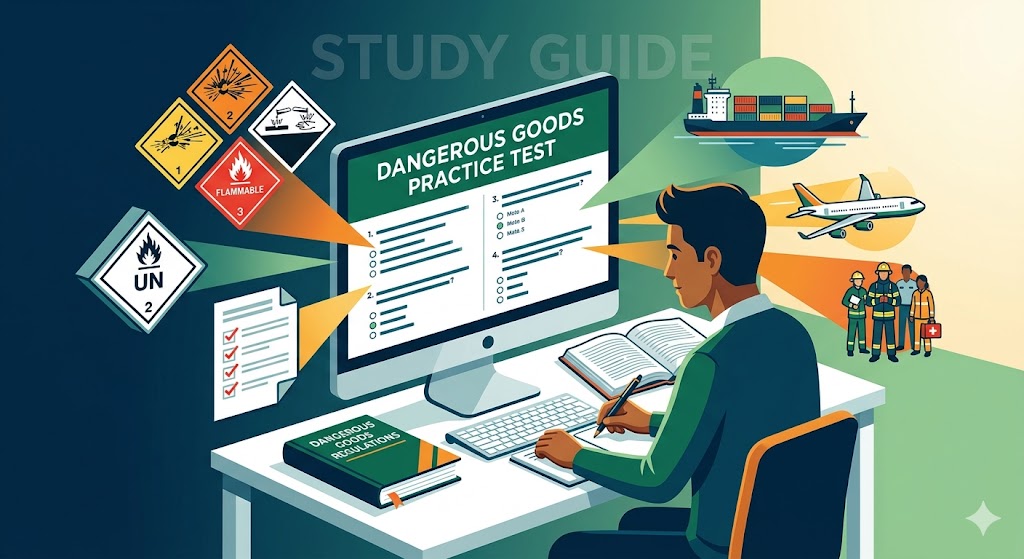
Additional Information
What the Course Entails and Exam Details
A dangerous goods training course provides an in-depth understanding of the regulatory framework appropriate to the mode of transport, such as the IATA Dangerous Goods Regulations (DGR) for air, the IMDG Code for sea, and ADR for road transport.
The syllabus covers several core competencies:
Classification: Learning to identify which of the nine hazard classes a substance belongs to.
Identification: Using the Dangerous Goods List to determine proper shipping names and UN numbers.
Packaging: Selecting and using UN-specification packaging correct for the substance and quantity.
Marking and Labeling: Applying necessary hazard labels, handling labels, and marks to packages.
Documentation: Accurately completing crucial forms, such as the Shipper’s Declaration for Dangerous Goods and the Dangerous Goods Note.
Handling and Storage: Understanding the rules for segregation of incompatible goods and safe storage practices.
Emergency Response: Knowing the immediate actions to take in the event of a leak, spill, or incident.
The exam details, specifically, will test your ability to apply these concepts, particularly through the use of the relevant regulatory manuals. A "practice test" is designed to simulate this assessment experience.
What to Expect in the Final Exam
The final certification exam is a formal assessment of your competency.
It typically includes a significant multiple-choice component, where you must select the correct answer regarding regulatory requirements, classifications, and procedures.
Many exams also feature practical, open-book sections that require you to actively use the relevant regulation manual (like the IATA DGR) to solve scenarios. For instance, you might be asked to find the correct packing instruction for a specific chemical or to identify errors on a sample Shipper’s Declaration.
You can expect a high passing score requirement, often 80% or higher, reflecting the safety-critical nature of the work. The exam will have a strict time limit, typically ranging from two to four hours. The final result is a certification that is valid for a limited period, usually two years, after which a refresher course and re-assessment are mandatory.
How to Study and Exam Centers
Effective preparation is key to passing the Dangerous Goods exam.
Actively engage with your training provider’s course materials, including workbooks, exercise questions, and model questions. The most effective strategy is to utilize comprehensive Dangerous Goods practice tests. These tests help you understand the formatting, question style, and the practical application of the regulations under timed conditions, identifying areas where you need further study. Focus on learning how to navigate the regulatory manuals efficiently.
The final exam is typically administered by accredited training schools, specialized logistics training centers, airlines, or authorized regulatory bodies. Many providers now offer the option to take the exam at authorized physical testing centers or through secure, proctored online portals. When booking your course, confirm the specific exam delivery method and the location of available testing centers.
Job Opportunities from the Course
A Dangerous Goods certification is a powerful asset that unlocks a wide array of career opportunities in the global logistics, transportation, and manufacturing sectors.
A clear list of potential job titles includes:
Dangerous Goods Coordinator
Hazardous Materials Specialist
Logistics Compliance Officer
Freight Forwarder
Air Cargo Handler / Agent
Warehouse Supervisor / Manager
Shipper / Packer of Dangerous Goods
Dangerous Goods Safety Adviser (DGSA)
Supply Chain Manager
Dangerous Goods Training Instructor
Frequently Asked Questions
Reviews
5.0
Based on 0 reviews
Leave a Review
No reviews yet. Be the first to review!