
Day Trading Practice Test
$69.00
- Buy to unlock unlimited access to all Quiz questions and Answers in this Quiz.
- After purchase you can print a PDF of the whole quiz at any point. The PDF will contain the questions and the correct answers.
About this Exam
The Day Trading Practice Exam is an essential diagnostic tool designed for aspiring financial traders aiming to enter the fast-paced world of intraday trading.
This simulation is crafted for individuals who want to validate their understanding of market mechanics before risking actual capital in live markets.
It is ideal for beginners seeking structure in their learning journey, as well as intermediate investors transitioning from long-term holding to short-term scalping or momentum strategies.
By taking this practice test, candidates can accurately assess their readiness, identify critical knowledge gaps, and build the necessary confidence to execute trades under pressure.
Ready to test your knowledge?
Buy Now to Access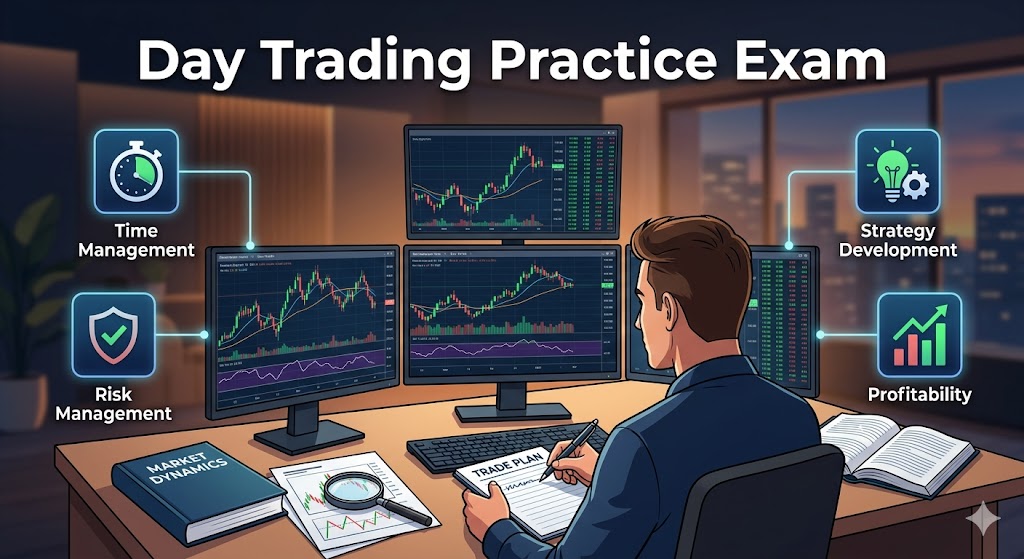
Additional Information
What the Course Entails and Exam Details
To succeed on this practice exam, candidates must possess a comprehensive understanding of several core trading pillars.
The curriculum covered by this assessment includes, but is not limited to, the following domains:
Technical Analysis: Mastery of chart patterns, candlestick analysis, and the application of technical indicators such as Moving Averages, RSI, and MACD to predict short-term price movements.
Risk Management: Critical skills in calculating position sizing, setting effective stop-loss and take-profit levels, and understanding the risk-to-reward ratio necessary for long-term profitability.
Market Mechanics and Order Types: Deep knowledge of how exchanges operate, reading the Level 2 market depth (Order Book), and the strategic use of market, limit, and stop orders.
Trading Psychology: Understanding the emotional challenges of trading, such as fear and greed, and developing the discipline required to adhere strictly to a trading plan.
Regulatory Framework: Basic awareness of the rules governing day trading, such as pattern day trader (PDT) rules in applicable markets.
What to Expect in the Final Exam
As this is a practice examination designed to simulate various real-world scenarios, the format may vary slightly depending on the specific educational platform providing the test.
However, a comprehensive Day Trading Practice Exam typically consists of 50 to 100 multiple-choice questions.
Candidates are usually given a time limit ranging from 60 to 120 minutes, simulating the time-sensitive decision-making required during market hours.
A passing score is often set at 70% or higher, indicating a foundational readiness for live market simulation (paper trading).
Some advanced practice tests may also include interactive chart modules where candidates must identify entry and exit points based on live data scenarios.
How to Study and Exam Centers
Effective preparation requires a blend of theoretical study and practical application.
Begin by thoroughly reviewing a reputable day trading curriculum or textbook focusing on the domains mentioned above.
Supplement your reading by utilizing "paper trading" accounts provided by brokerage platforms to practice executing strategies in real-time without financial risk.
Create flashcards for technical indicators, chart patterns, and key financial terms.
When you feel ready, take this practice exam in a quiet environment, free from distractions, to simulate true testing conditions.
Exam Centers:
Because this is a practice and self-assessment tool, it does not require attendance at a physical testing center like Pearson VUE.
The Day Trading Practice Exam is administered exclusively online through various financial education portals, proprietary trading school websites, and learning management systems.
Upon registration with your chosen provider, you will receive login credentials to access the secure testing portal from any location with a stable internet connection.
Job Opportunities from the Course
While a practice test is a self-diagnostic tool rather than a state-sponsored license, the knowledge and proficiency it validates are critical for numerous career paths in finance.
Successfully mastering the concepts in this exam prepares you for the following opportunities:
Independent Retail Trader: Managing your own capital to generate income through short-term market speculation.
Proprietary Trader: Trading a firm’s capital (rather than your own) and keeping a percentage of the profits, often after passing the firm's specific evaluation challenges.
Trading Floor Support/Assistant: Providing operational or analytical support to senior traders within an institutional setting.
Financial Content Creator/Educator: Utilizing your verified knowledge to teach others through blogs, courses, or financial news outlets.
Junior Analyst: Analyzing short-term market trends and providing actionable data to investment teams.
Frequently Asked Questions
Reviews
5.0
Based on 0 reviews
Leave a Review
No reviews yet. Be the first to review!