
De‑icing Practice Test
$69.00
- Buy to unlock unlimited access to all Quiz questions and Answers in this Quiz.
- After purchase you can print a PDF of the whole quiz at any point. The PDF will contain the questions and the correct answers.
About this Exam
The aviation industry demands impeccable safety standards, especially in challenging weather.
Proper aircraft de-icing is a crucial element of flight safety, preventing the dangerous buildup of ice and snow on aircraft surfaces.
A de-icing certification demonstrates that an individual possesses the vital knowledge and operational skills required for this critical role.
This comprehensive guide is designed to help ground crew, airport operations personnel, mechanics, and other aviation safety stakeholders prepare for the De-icing Practice Test and their final certification exam.
Whether you are just starting your career or looking to validate your skills, this resource provides the necessary framework for success.
Ready to test your knowledge?
Buy Now to Access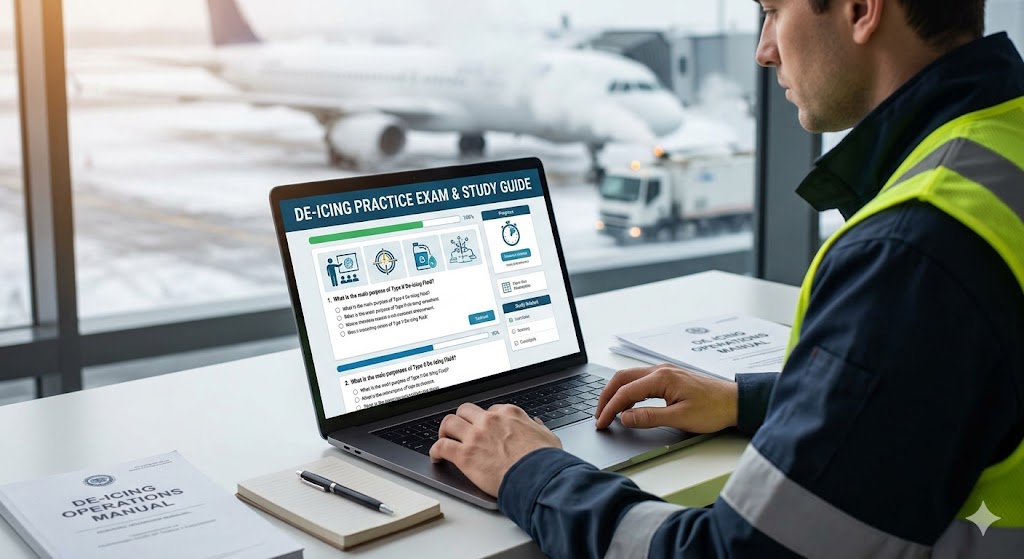
Additional Information
What the Course Entails and Exam Details
This guide covers the key domains tested in most recognized aviation de-icing certifications and associated courses.
Topics include the fundamentals of ground icing conditions, weather interpretation, and the various types of de-icing and anti-icing fluids (Type I, II, III, IV).
You will learn about the chemistry and characteristics of these fluids, including holdover times (HOT) and viscosity.
The core syllabus encompasses:
De-icing methods and equipment operation, including different types of spraying systems and forced-air techniques.
Safety protocols for handling chemical fluids and working on and around active aircraft and ground equipment.
Critical inspection techniques for verifying that an aircraft is clear of all frozen deposits before departure.
Relevant regulatory standards and guidelines, such as those from the SAE and your local aviation authority.
Effective communication procedures between de-icing crews, pilots, and air traffic control.
The specific "De-icing Practice Test" covered here typically focuses on these core knowledge areas, providing a crucial check of your understanding in preparation for the higher stakes final exam.
Details regarding the format of any specific practice or official exam can vary, but generally involve multiple-choice and potentially practical, hands-on components for full certification.
What to Expect in the Final Exam
While a De-icing Practice Test helps you gauge your readiness, the official Final Exam is a more formal, proctored event required for certification.
Expect the final written exam to be robust, often comprising 50 to 100 multiple-choice questions.
The content will thoroughly test your knowledge of fluids, holdover times, equipment, safety, and regulations.
A typical passing score for these types of high-stakes aviation certifications is in the range of 75% to 80% or higher.
You will likely face time limits, which could range from 1 to 2 hours for the written portion.
Certain certifications also require a practical assessment, where you must demonstrate your skills in a real or simulated operational environment, including proper fluid application and inspection.
Be prepared to strictly follow all instructions, including ID verification and rules against using unauthorized resources during the exam.
How to Study and Exam Centers
Preparation is the absolute key to success on both the practice test and the final certification.
Utilize Practice Resources: Engage actively with a De-icing Practice Test to familiarize yourself with the type of questions asked and to identify weak areas. Repeated practice will improve both your knowledge and confidence.
Study Official Manuals and Standards: Thoroughly review all course materials provided by your training organization. Pay close attention to current industry standards, especially the latest revisions of SAE Aerospace Recommended Practices (ARPs) and relevant regulatory documents.
Take Comprehensive Notes and Use Flashcards: Create concise summaries of key topics, fluid characteristics, holdover tables, and safety procedures. Flashcards are excellent for memorizing crucial facts and acronyms.
Seek Hands-On Training: If possible, participate in practical de-icing training or seek mentorship from experienced ground crew members. Understanding the physical operations can make the technical knowledge much easier to grasp.
Focus on Weak Points: Do not just review what you know. Dedicate extra study time to the areas you find most challenging during your practice tests.
Finding Exam Centers
Official certification exams are typically administered through:
Authorized Training Organizations: Many specialized aviation schools and training providers offer both de-icing courses and the final certification exams.
Airline and Airport Training Programs: For those already employed, many airlines and major airports have their own in-house training and certification processes for de-icing.
Specialized Testing Portals: Some theoretical written exams might be available through online proctored systems or at designated computer-based testing centers, similar to services like Pearson VUE. Always confirm the accepted testing methods for your specific certification.
Job Opportunities from the Course
A recognized de-icing certification is often a vital requirement for key ground handling roles and can open numerous career paths within the dynamic aviation industry. Potential job opportunities include:
De-icing Technician: Responsible for preparing and operating specialized de-icing and anti-icing equipment.
De-icing Operator/Specialist: Directly applies fluids to aircraft, following precise procedures to ensure safety.
Ground Crew Member: Includes various on-apron support roles, of which de-icing is a crucial winter function.
Airport Operations Coordinator: Oversees ground handling, including coordinating efficient de-icing during inclement weather.
Aviation Mechanic/Maintainer: May require de-icing knowledge for maintaining ground equipment or for specific airframe procedures.
Safety Inspector/Auditor: Evaluates ground operations for compliance with safety standards and regulations.
Frequently Asked Questions
Reviews
5.0
Based on 0 reviews
Leave a Review
No reviews yet. Be the first to review!