
DEA Pharmacist's Manual Practice Test
$69.00
- Buy to unlock unlimited access to all Quiz questions and Answers in this Quiz.
- After purchase you can print a PDF of the whole quiz at any point. The PDF will contain the questions and the correct answers.
About this Exam
The DEA Pharmacist's Manual Practice Exam is a crucial preparatory tool designed for pharmacy students, newly licensed pharmacists, and seasoned professionals seeking to validate their knowledge of federal controlled substance regulations. This practice exam is specifically engineered to simulate the legal and regulatory components often found in the Multistate Pharmacy Jurisprudence Examination (MPJE) and internal pharmacy compliance assessments.
It serves as a comprehensive assessment of a pharmacist's ability to interpret and apply the regulations outlined in the official Drug Enforcement Administration (DEA) Pharmacist's Manual.
Navigating the complexities of the Controlled Substances Act (CSA) is a "corresponding responsibility" for all pharmacists. Passing this practice exam demonstrates a strong commitment to preventing drug diversion and ensuring public safety, making it an essential milestone for anyone authorized to dispense controlled substances in the United States.
Ready to test your knowledge?
Buy Now to Access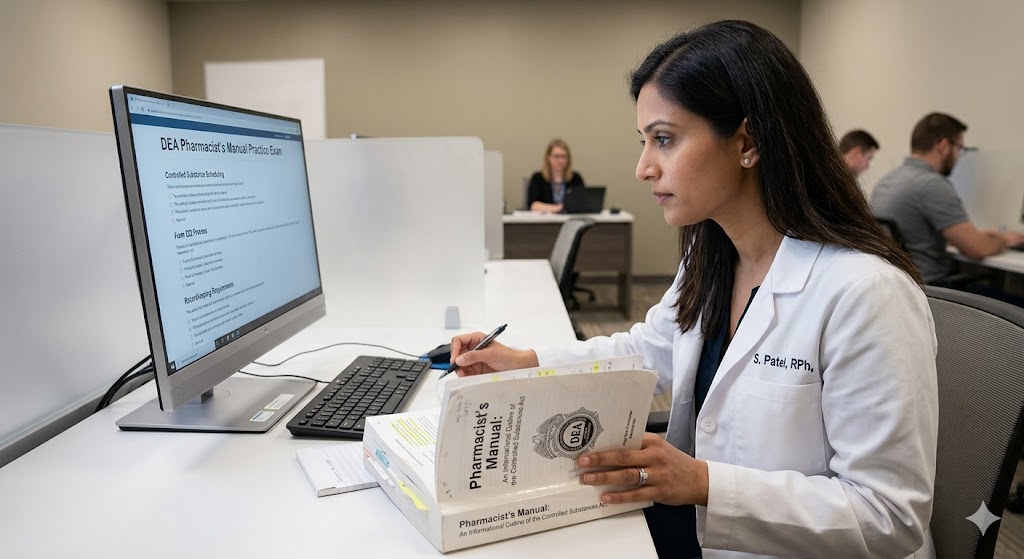
Additional Information
What the Course Entails and Exam Details
A comprehensive DEA Pharmacist's Manual practice program aims to provide a thorough understanding of federal controlled substance regulations. While a single "course" structure may vary by provider, a comprehensive practice test covers the full syllabus of the official DEA manual. Key topics include:
Introduction to the Controlled Substances Act (CSA): Understanding the legal framework, the 'closed system' of distribution, and definitions of key terms.
Schedules of Controlled Substances: Deep knowledge of the criteria and examples for Schedule I through V drugs, including rules for reclassification.
Registration Requirements: Who must register with the DEA, different types of registration, and the exemption categories.
DEA Forms and Their Uses: Mastering the application, record-keeping, and process for critical forms, including DEA Form 222 (ordering C-I and C-II), DEA Form 106 (theft or significant loss), DEA Form 41 (destruction), and DEA Form 224 (new pharmacy registration).
Inventory and Record-Keeping: Exact rules for initial, biennial, and newly-scheduled drug inventories, and specific methods for maintaining records for two years.
Prescription Requirements: The validity of prescriptions, necessary elements, partial filling rules, and specific exceptions for emergency oral prescriptions and central fill pharmacies.
Validating Prescriptions and Corresponding Responsibility: The dual responsibility of the prescriber and pharmacist to ensure a legitimate medical purpose.
Security Requirements: Physical security standards for pharmacies, including disposal and employment waivers for individuals with felony convictions related to controlled substances.
What to Expect in the Final Exam
While the "DEA Pharmacist's Manual" is a text, the final exam that assesses this knowledge is the Multistate Pharmacy Jurisprudence Examination (MPJE), administered by the National Association of Boards of Pharmacy (NABP).
Candidates must register through the NABP and schedule their appointment at a Pearson VUE testing center.
Format: The MPJE is a computer-adaptive test (CAT), meaning the difficulty of subsequent questions is based on your answers to previous ones. It is composed of 120 multiple-choice questions.
Time Limit: You have 2.5 hours (150 minutes) to complete the 120 questions. There are no scheduled breaks.
Scoring: 100 of the 120 questions are used to calculate your score, which is reported on a scale from 1 to 100. A scaled score of 75 or higher is required to pass. The remaining 20 questions are pre-test questions used for future exams and do not count toward your score.
Rules: Because it is a CAT, you cannot skip questions, and you cannot go back to change an answer once it has been submitted.
How to Study and Exam Centers
Preparation for an exam with a 75% passing score requires a diligent, multi-modal study strategy.
Actionable Study Strategies:
Primary Source Mastery: Read the official, latest version of the DEA Pharmacist's Manual multiple times. It is accessible for free on the DEA Diversion Control Division website. Do not skip the small print.
Simulate the Exam: Utilize high-quality, third-party practice tests that specific mimic the MPJE CAT format and feature content solely from the DEA manual. NABP also offers the Pre-MPJE, a 100-question practice exam that uses retired MPJE questions.
Create Flashcards for Forms: Memorize the number, name, and exact use case for every DEA form (e.g., 222, 106, 41, 224).
Compare and Contrast: Pay close attention to the specific procedural differences between Schedule II and Schedule III-V drugs (ordering, partial fills, transfers, oral orders).
Study Guides: Use established pharmacy law review books, but always cross-reference them with the primary DEA text for the most up-to-date regulations.
Exam Center Information:
The official final exam, the MPJE, is not taken in a pharmacy school or through a practice portal, but in a highly secure Pearson VUE testing center. Pearson VUE operates a global network of testing locations, and you must schedule your appointment in advance after receiving Authorization to Test (ATT) from the NABP and your state board of pharmacy. Practice tests are typically administered through the specific vendor's online platform.
Job Opportunities from the Course
While "DEA Pharmacist's Manual expert" is not a formal job title, the deep understanding of federal regulations you gain is mandatory for the initial and continued practice of pharmacy. Licensed pharmacists must possess this knowledge to work. Mastering this content is a direct pathway to, and requirement for, the following career roles:
Licensed Pharmacist (RPh) / Doctor of Pharmacy (PharmD)
Pharmacy Manager / Pharmacist-in-Charge (PIC)
Controlled Substance Compliance Officer (within health systems or large chains)
Pharmacy Auditor (evaluating pharmacy compliance for PBMs or consulting firms)
Regulatory Affairs Specialist (for pharmaceutical manufacturers or distributors)
Wholesale Distribution Compliance Manager
DEA Diversion Investigator (requires further specialized federal hiring process)
Frequently Asked Questions
Reviews
5.0
Based on 0 reviews
Leave a Review
No reviews yet. Be the first to review!