
DECA Business Law and Ethics Team Decision Making (BLTDM) Practice Test
$69.00
- Buy to unlock unlimited access to all Quiz questions and Answers in this Quiz.
- After purchase you can print a PDF of the whole quiz at any point. The PDF will contain the questions and the correct answers.
About this Exam
The DECA Business Law and Ethics Team Decision Making (BLTDM) practice test is designed to prepare student leaders and entrepreneurs for real-world scenarios at the intersection of business strategy and moral accountability.
This event is specifically tailored for high school members of DECA who are aspiring professionals interested in careers such as corporate law, human resources, compliance management, or ethical leadership.
It tests a team of two on their ability to analyze complex situations, synthesize legal knowledge with ethical frameworks, and present coherent, strategically sound decisions that balance corporate responsibility with legal mandates.
Ready to test your knowledge?
Buy Now to Access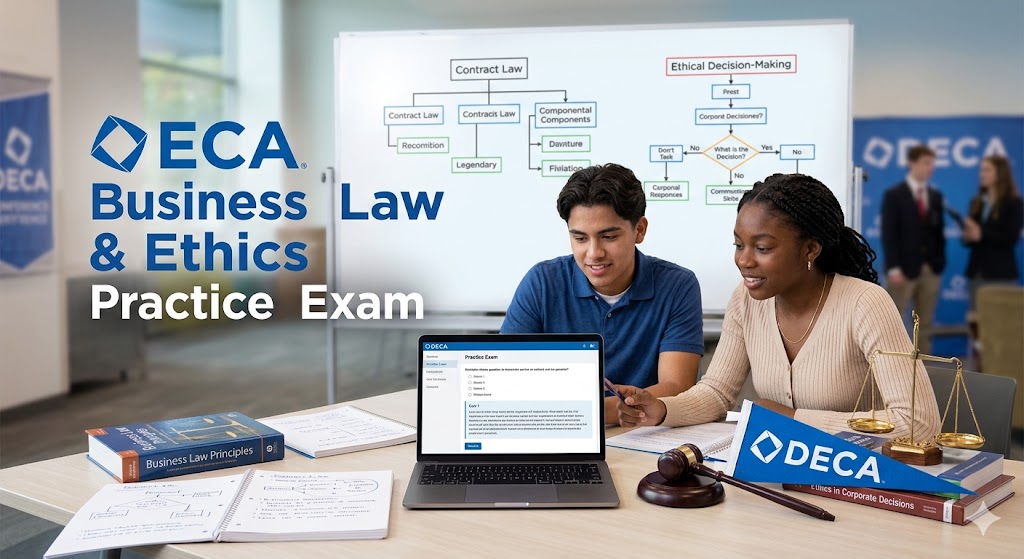
Additional Information
What the Course Entails and Exam Details
Preparing for the Business Law and Ethics competitive event requires mastering a broad set of skills within the Business Management and Administration career cluster.
The core of the curriculum involves an in-depth understanding of foundational legal systems, consumer protection, and the nuances of human resources law, including labor relations, employment discrimination, and health and safety standards.
Students must gain proficiency in interpreting contract law and sales regulation, which form the backbone of many business transactions.
Crucially, the "course" involves learning various ethical decision-making models, understanding corporate social responsibility (CSR) principles, and appreciating the complexities of international legal considerations in modern commerce.
The main objective is developing the analytical capacity to synthesize this legal knowledge quickly, apply it to unique business challenges, and communicate solutions effectively under pressure.
What to Expect in the Final Exam
The full DECA Business Law and Ethics Team Decision Making competition structure involves two major components that are combined to determine advancement.
First, each team member must individually complete a comprehensive written cluster examination, which usually consists of 100 rigorous multiple-choice questions focusing on key concepts in legal systems and business ethics.
Second, the team (the two members collaborating) receives a real-world case study scenario involving a complex business legal or ethical dilemma.
Teams are given a specific preparation time (often 30 minutes at regional levels and 15-20 minutes at higher levels) to read the scenario, identify the core problems, analyze the implications, and develop a strategic action plan.
Following this preparation, the team delivers a collaborative presentation to a volunteer industry judge, often acting as executives, board members, or legal counsel, explaining their decision-making process and final recommendation.
Advancement to higher levels, such as the International Career Development Conference (ICDC), is based on the composite score of both the written exam and the dynamic judge’s critique.
How to Study and Exam Centers
Effective preparation for this competitive event requires a balanced study plan targeting both the individual exam and the team dynamics.
Utilize official DECA practice tests to familiarize yourselves with the types and structure of the 100 cluster-specific multiple-choice questions.
Reviewing past case study examples with your teammate is critical; practice analyzing dilemmas quickly and synthesizing arguments effectively within the tight preparation timeframe.
Develop a consistent method for analyzing case studies that prioritizes understanding the foundational ethical issue, identifying the relevant legal precedents, and balancing stakeholder interests.
The actual competition and assessment events do not take place in standard testing centers like Pearson VUE.
Instead, they occur during sequential official DECA conferences, usually starting at the regional or district level, advancing to the state or provincial level, and culminating in the annual International Career Development Conference (ICDC).
To participate, students must be registered DECA members in high school or college, and qualifying scores at each level are necessary to advance.
Job Opportunities from the Course
While succeeding in the DECA Business Law and Ethics event does not confer a formal professional license, the rigorous analytical and communication skills developed are highly valued across multiple career paths in the business world.
This competitive event provides exceptional foundation building for several rewarding career fields, including:
Corporate Compliance Officer
Human Resources Manager
Paralegal
Business Management Consultant
Ethical Officer (or Chief Ethics Officer)
Contract Administrator
Labor Relations Specialist
Risk Management Analyst
Legal Administrative Assistant
Public Relations Manager specializing in Corporate Social Responsibility
Entrepreneur (with a strong legal/ethical foundation)
Business Lawyer (following further education)
Frequently Asked Questions
Reviews
5.0
Based on 0 reviews
Leave a Review
No reviews yet. Be the first to review!