
DECA Economics Practice Exam
$69.00
- Buy to unlock unlimited access to all Quiz questions and Answers in this Quiz.
- After purchase you can print a PDF of the whole quiz at any point. The PDF will contain the questions and the correct answers.
About this Exam
The DECA Economics Practice Exam is an essential preparatory tool designed for high school students aiming to excel in DECA’s competitive events program. This exam specifically targets students competing in marketing, finance, hospitality, and management events where a strong foundation in economic principles is required. It is ideal for ambitious students looking to sharpen their academic knowledge, improve their test-taking speed, and gain a competitive edge in regional, state, or international competitions.
Ready to test your knowledge?
Buy Now to Access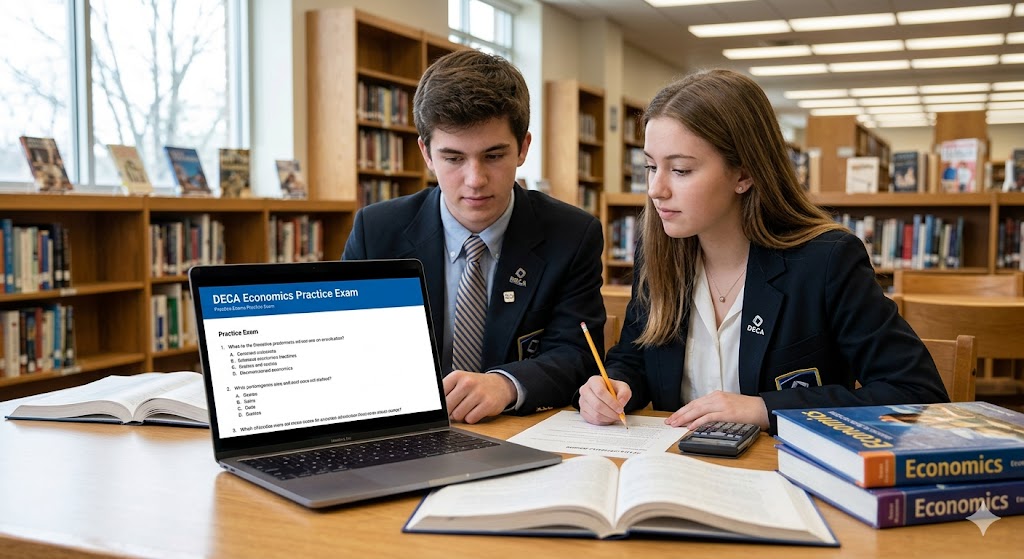
Additional Information
What the Course Entails and Exam Details
While not a formal "course" with a fixed syllabus, the DECA Economics Practice Exam evaluates a student's understanding of key economic concepts identified by National Curriculum Standards. The content areas typically covered include fundamental economic concepts (scarcity, opportunity cost, supply and demand), microeconomic principles (market structures, price elasticity, business cycles), and macroeconomic indicators (inflation, unemployment, GDP, monetary and fiscal policy). The exam is designed to test a student's ability to apply these concepts to real-world business scenarios and decision-making processes.
What to Expect in the Final Exam
When you sit for a DECA competitive event exam, you can expect a rigorous evaluation focused on applying knowledge rather than simple memorization. The final exam typically takes the form of a 100-question multiple-choice test. These exams are usually timed, often providing a 90-minute window for completion, which demands both accuracy and efficiency from competitors. The questions frequently use business-oriented scenarios to frame economic problems. While there is no universal "passing score," your objective is to achieve the highest possible score, as this score is combined with your performance in role-play scenarios to determine your overall standing and eligibility for awards.
How to Study and Exam Centers
Effective preparation for the DECA Economics exam involves a mix of conceptual review and practical application.
Review Core Concepts: Utilize standard high school economics textbooks and the official AP Microeconomics and Macroeconomics course descriptions as reliable content guides.
Take Practice Tests: The most critical strategy is taking timed practice exams from previous DECA years. This familiarizes you with the question style and helps you manage your time effectively. Analyze every incorrect answer to understand the underlying principle.
DECA Resources: Utilize study materials provided by your chapter advisor and resources available on the official DECA website, including sample questions and performance indicators.
Regarding exam centers, students typically do not visit a third-party testing center like Pearson VUE. Instead, DECA exams are usually administered in an online format within the student's own high school, proctored by their DECA advisor or a school official. For state or international competitions, the testing often occurs on-site at the convention center hosting the event, using designated computer labs or large-scale testing halls.
Job Opportunities from the Course
While the DECA Economics Practice Exam itself is not a certification for employment, achieving a high score demonstrates critical thinking and business acumen. This knowledge base is a prerequisite for success in DECA’s business administration competitive events and provides a strong foundation for future career paths in the corporate sector. Careers that utilize these economic and analytical skills include:
Financial Analyst
Market Research Analyst
Management Consultant
Economic Consultant
Corporate Strategist
Business Analyst
Supply Chain Manager
Investment Banker
Policy Analyst
Data Analyst
Entrepreneur
Frequently Asked Questions
Reviews
5.0
Based on 0 reviews
Leave a Review
No reviews yet. Be the first to review!