
DECA Hospitality Services Team Decision Making Practice Exam
$69.00
- Buy to unlock unlimited access to all Quiz questions and Answers in this Quiz.
- After purchase you can print a PDF of the whole quiz at any point. The PDF will contain the questions and the correct answers.
About this Exam
Welcome to the ultimate preparation zone for your DECA Hospitality Services Team Decision Making (TDM) competition! This specialized competitive event is designed for high school and collegiate DECA members who possess a passion for the dynamic world of hospitality, tourism, and travel. Teams of two participants are presented with a real-world business case study, challenging them to think like management and provide innovative, effective solutions. If you dream of leading a grand hotel, optimizing a bustling restaurant, or curating unforgettable guest experiences, this event and the invaluable practice exam that supports it are your first steps towards that rewarding career. This guide will walk you through everything you need to know to excel in this exciting challenge.
Ready to test your knowledge?
Buy Now to Access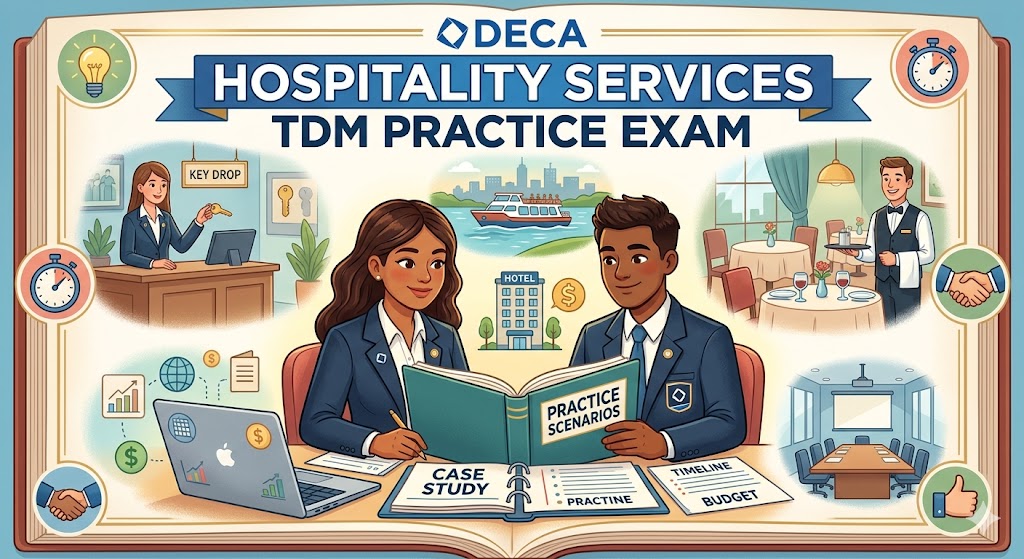
Additional Information
What the Course Entails and Exam Details
As a competitive event rather than a traditional "course," the material covered by HTDM is comprehensive, spanning the entire Hospitality and Tourism Cluster. This cluster includes a wide range of business functions tailored to the service economy. Your team will need to be proficient in topics such as:
Customer Relations: Strategies for exceeding guest expectations, handling complaints, and building long-term loyalty.
Hospitality Operations: The day-to-day management of facilities, human resources, and back-of-house functions.
Marketing and Sales: Techniques for promoting services, managing reservations, and creating effective advertising campaigns.
Financial Analysis: Understanding budgets, pricing strategies, and key performance indicators like occupancy rates and revenue per available room (RevPAR).
Safety, Security, and Compliance: Navigating the regulatory and risk management aspects of the industry.
The "exam" process for this event actually consists of two distinct, equally important components that are combined for a total score:
A Written Cluster Exam: This is an individual 100-question, multiple-choice test focusing on the broad Hospitality and Tourism Cluster content. Each teammate takes the same test, and their individual scores are averaged to create a single "exam score" for the team.
A Team Decision Making Role-Play: This is a collaborative performance in front of a judge, who acts as a manager or executive. The team receives a case study, which presents a specific hospitality business problem.
What to Expect in the Final Exam
While the exact nature of the case study changes for every competition, the structure of the DECA Hospitality Services Team Decision Making final evaluation is predictable.
The Written Cluster Exam
The individual written exam is a rigorous assessment of your knowledge. It includes 100 multiple-choice questions with a time limit of 90 minutes. It covers four major areas within the cluster: Marketing, Finance, Management, and Operations, with a strong emphasis on service management and industry-specific applications.
The Team Role-Play
This is where your team must shine. Here is the exact breakdown:
Preparation Time: You and your partner will have 30 minutes to review the case study, analyze the problem, and develop a comprehensive solution. You may only make notes on the paper provided.
Presentation Time: You will have 15 minutes to present your solution to the judge(s). The judge will then have 5 minutes to ask you questions. Crucially, all team members must participate in the presentation.
Scoring: Your presentation is evaluated based on a specific rubric, called an "evaluation form," that includes a set of "Performance Indicators" (PIs). These PIs are specific business concepts you must address. Example PIs might be "Demonstrate a customer-service mindset" or "Analyze hotel revenue data to make strategic decisions."
The total score for the event is a weighted combination: the average of the two team members' written exam scores (typically valued at 1/3) and the team’s role-play presentation score (typically valued at 2/3). In the final round, the role-play is often weighted double the exam.
How to Study and Exam Centers
Preparation for DECA HTDM requires a balanced approach that tackles both the knowledge based on the cluster exam and the performance skills needed for the role-play.
How to Study and Practice
Master the Performance Indicators: This is the single most important part of role-play preparation. Review the list of PIs for the Hospitality and Tourism Cluster. For every PI, you and your partner should be able to define it and, more importantly, explain how you would apply it to a business problem.
Practice Past Case Studies: You can access previous years' case studies and evaluation forms on the official DECA website (deca.org) or other DECA-focused educational platforms. This will teach you how to read a scenario, allocate prep time, and align your presentation with the judges' scoring rubric.
Take Mock Exams: Utilize sample cluster exams to identify your knowledge gaps. Practice under timed conditions.
Learn Industry Terminology: Use a glossary of hospitality and tourism terms to familiarize yourself with concepts like "front of house," "back of house," "yield management," and "ancillary revenue."
Develop a Team Dynamic: Practice presenting with your partner. Learn when to lead, when to support, and how to transition smoothly between speakers to maximize your time.
Exam Centers and Access
Unlike a professional certification exam, the DECA HTDM competition is administered through authorized schools and the DECA organization itself. You cannot schedule a time at a commercial testing center like Pearson VUE.
Registration: All competitive event registration is handled through your school's official DECA chapter advisor. Students must be active DECA members to compete.
Competition Locations: The competition occurs in stages, beginning at the District/Regional level. Top performers advance to the State/Provincial level (often called Career Development Conferences or CDCs). The winners from these conferences then compete at the international level: DECA's International Career Development Conference (ICDC), a premier event that brings together over 20,000 students.
Job Opportunities from the Course
Competing in DECA Hospitality Services Team Decision Making develops the high-demand "soft skills" and foundational knowledge that are immediately applicable to any career, but it especially primes you for leadership roles within the massive global hospitality industry. Participation demonstrates to universities and future employers that you possess problem-solving acumen, collaboration skills, and a professional mindset.
Here are specific job titles and career paths this experience unlocks:
Hotel General Manager: Responsible for the entire operation, profitability, and guest experience of a lodging property.
Event and Conference Planner: Orchestrates large-scale events, meetings, weddings, and conventions for corporations and private clients.
Guest Services Manager: Leads the front office, concierge, and valet teams to ensure top-tier guest satisfaction.
Restaurant and Food Service Manager: Oversees operations, staffing, and marketing for dining establishments.
Revenue and Yield Manager: Uses financial data to optimize room pricing and inventory to maximize profitability.
Tourism and Destination Director: Works for local or state agencies to promote a specific region to tourists and business travelers.
Human Resources Manager (Hospitality Focus): Recruits, trains, and manages staff in a high-turnover service environment.
Frequently Asked Questions
Reviews
5.0
Based on 0 reviews
Leave a Review
No reviews yet. Be the first to review!