
DECA Marketing Communications Practice Test
$69.00
- Buy to unlock unlimited access to all Quiz questions and Answers in this Quiz.
- After purchase you can print a PDF of the whole quiz at any point. The PDF will contain the questions and the correct answers.
About this Exam
The DECA Marketing Communications Series event is a flagship competition designed for high school students aspiring to careers in marketing, advertising, public relations, and digital communications. This event challenges participants to assume the role of a marketing communications specialist, where they must demonstrate their ability to form strategies that inform, persuade, or remind a target market about ideas, goods, or services. It is an ideal platform for students to blend creative thinking with analytical skills in real-world business scenarios, proving their readiness for the dynamic world of modern integrated marketing campaigns.
Ready to test your knowledge?
Buy Now to Access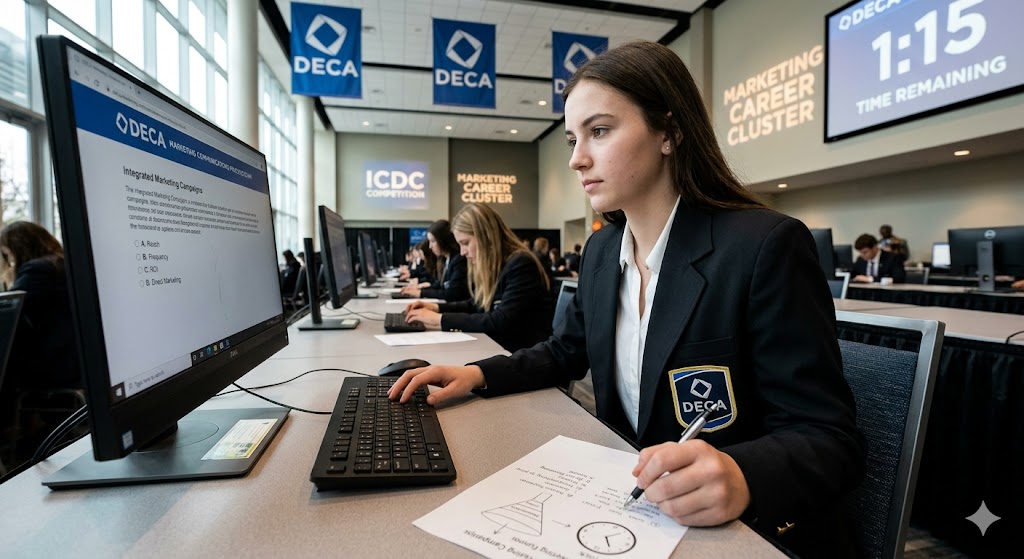
Additional Information
What the Course Entails and Exam Details
This competitive event is part of DECA's Marketing Career Cluster and is comprehensive, covering a broad spectrum of industry-standard knowledge. While there isn't a traditional "course" for the practice test, it assesses mastery of specific instructional areas and performance indicators.
The core syllabus and skills covered are derived from the National Business Administration Standards. Key instructional areas include:
Communications: Focus on internal and external business communication, including written reports and oral presentations.
Promotion: This is a major focus, covering advertising, public relations, sales promotion, and direct marketing.
Marketing: Understanding the fundamentals of the marketing mix, target markets, and market segmentation.
Emotional Intelligence: Skills related to empathy, communication, and relationship management, vital for client and team interactions.
Business Law: Basic understanding of legal issues affecting marketing and business operations.
Financial Analysis: Interpreting financial data relevant to marketing budgets and campaign ROI.
Information Management: Utilizing data to make informed marketing decisions.
What to Expect in the Final Exam
For those aiming for top honors at DECA's International Career Development Conference (ICDC), the final evaluation is a multi-stage process. Understanding the format of the competition is crucial.
The standard final exam format includes two main components:
A Comprehensive Multiple-Choice Test: This is a 100-question exam, with questions pulled from the designated instructional areas. The questions are designed to discriminate, meaning they range in difficulty to effectively rank the top competitors. A practice test like the one this guide supports focuses primarily on this element.
A Role-Play/Case Study Presentation: For the Marketing Communications Series, students receive a real-world scenario (such as developing a social media strategy or a promotional plan for a new product). They are given time to prepare their solution and then present it live to a judge, who acts as a corporate executive. The presentation is evaluated using a specific rubric.
How to Study and Exam Centers
Effective preparation for the DECA Marketing Communications exam requires a two-pronged approach, focusing on both content knowledge and case study application.
Actionable Study Strategies: Start by reviewing the official DECA Performance Indicators for the Marketing Communications Series. Utilize standard high school marketing textbooks as your foundational resource. The most effective method is repeated practice. Take as many practice exams as possible to familiarize yourself with the question style and manage your time. For the role-play, practice analyzing case studies within the allotted preparation time and presenting your solutions clearly to a teacher, advisor, or peer.
Exam Centers: Unlike traditional certification exams taken at independent testing centers like Pearson VUE, DECA exams are unique to the organization's competitive events structure. You take these tests through your high school's DECA chapter. Your advisor will guide you through the initial testing (often online or in-school) to qualify for state-level and eventually the international competition. The major, final exams are held live during the annual DECA conferences.
Job Opportunities from the Course
A strong performance in the DECA Marketing Communications event is a significant differentiator on a resume or college application. It signals to employers that you possess practical, tested skills that translate directly into professional roles within the marketing and communications industry.
Possible career paths and job titles this experience unlocks include:
Social Media Manager
Marketing Communications Specialist
Advertising Coordinator
Public Relations Assistant
Digital Marketing Analyst
Content Producer/Copywriter
Brand Manager
Communications Director
Account Executive at a Marketing Agency
Event Planner
Frequently Asked Questions
Reviews
5.0
Based on 0 reviews
Leave a Review
No reviews yet. Be the first to review!