
DECA Restaurant and Food Service Management Practce Test
$69.00
- Buy to unlock unlimited access to all Quiz questions and Answers in this Quiz.
- After purchase you can print a PDF of the whole quiz at any point. The PDF will contain the questions and the correct answers.
About this Exam
The DECA Restaurant and Food Service Management Series is a competitive event designed for students with a keen interest in marketing, management, and entrepreneurial functions within a full-service restaurant or food service business. This competition challenges participants to think like industry leaders, analyze complex scenarios, and present innovative solutions. It is ideally suited for ambitious high school students who are active in their local DECA chapter and aim to pursue career paths in the dynamic, fast-paced world of hospitality, restaurant operations, and corporate food service. While this is a competition, a practice test serves as a critical simulation of the written exam portion, helping you build the foundational knowledge necessary to compete at the highest level, from regional to international conferences.
Ready to test your knowledge?
Buy Now to Access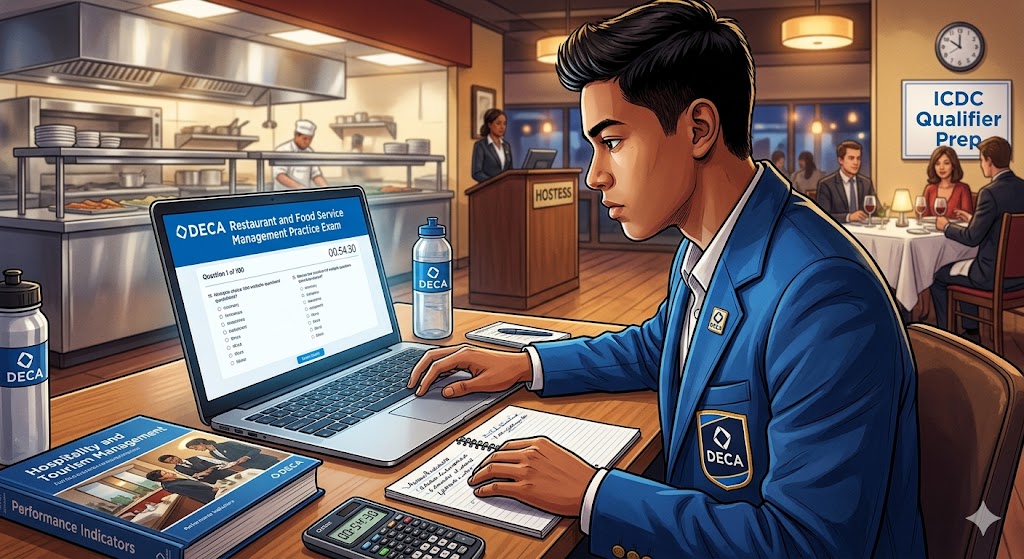
Additional Information
What the Course Entails and Exam Details
This competitive event assesses a student's proficiency in core concepts relevant to Hospitality and Tourism Career Cluster, with a focus on restaurant and food service operations. The overarching themes include:
Instructional Areas: The written exam is built upon foundational instructional areas, which might include Business Law, Communications, Customer Relations, Economics, Emotional Intelligence, Entrepreneurship, Financial Analysis, Human Resources Management, Information Management, Marketing, Operations, Professional Development, and Strategic Management.
Restaurant Operations: Key tasks like managing daily restaurant activities, understanding food safety and sanitation regulations, and handling inventory and supply chain logistics.
Financial Management: Grasping essential principles like budgeting, cost control, pricing strategies, and profit and loss management in a food service setting.
Human Resources: Developing an understanding of staff training, motivation, and leadership within a hospitality environment.
Marketing and Customer Relations: Learning how to develop promotional strategies, enhance brand image, handle customer feedback, and maintain exceptional service standards.
The DECA practice test is designed to strictly replicate the content and difficulty of the official DECA written competition exam, specifically targeting the Hospitality and Tourism Exam common to individual series events in this sector.
What to Expect in the Final Exam
While the overall DECA competition includes both a written exam and interactive role-play scenarios, a practice test focuses exclusively on simulating the written component. The official DECA Restaurant and Food Service Management written exam features the following structure:
Format: A comprehensive, 100-question multiple-choice exam.
Content: Questions are derived from a bank based on Performance Indicators within the Hospitality and Tourism Career Cluster.
Time Limit: Participants are given 90 minutes to complete the entire 100-question exam, requiring speed, accuracy, and strong time management skills.
Scoring: To achieve a competitive edge and advance from your district or state/chartered association competition to the International Career Development Conference (ICDC), you must aim for a high composite score. Your final competition ranking is a combination of your written exam score and your performance in one or two role-play events. A standard practice test provides you with a score, which you can use to benchmark your knowledge against previous ICDC cut-off scores.
How to Study and Exam Centers
Preparation is key to succeeding in DECA’s highly competitive landscape. Here are actionable study strategies and information about how the final exams are conducted:
Actionable Study Strategies:
Master the Performance Indicators: The most crucial step is to download and study the official list of DECA Performance Indicators for the Hospitality and Tourism Career Cluster. These are the specific concepts you are required to understand. Use them to guide your studying, create flashcards, and review textbook material.
Take Practice Tests: Consistent practice is essential. Utilize a high-quality DECA Restaurant and Food Service Management Practice Exam to build familiarity with the question style, difficulty, and variety. Track your progress, review every incorrect answer, and understand the core concept behind it.
Simulate Exam Conditions: For your practice sessions, set aside a quiet, uninterrupted block of 90 minutes. Do not use external resources to simulate the real competition experience. This will help you learn to manage your time and reduce anxiety.
Review Sample Role-Plays: While this guide focuses on the exam, you cannot neglect the role-play component. Practice presenting solutions for previous case studies from the Restaurant and Food Service Management category. Work with a partner or your DECA advisor to refine your oral presentation skills and logical thinking.
Utilize DECA Resources: Take advantage of official DECA study guides, sample events, and webinars available through the Shop DECA website and the main DECA Inc. portal. Work closely with your chapter advisor to access these materials.
Exam Centers:
It is important to understand that the final exams for the DECA competition are not administered at open testing centers like Pearson VUE or Prometric. The official competition exams are only held at official DECA conference venues during the competition season. You must be an active DECA member and register to compete in this event to take the exam. The path is as follows:
District/Regional Competitions: The first stage often involves an online or in-person exam administered by your district DECA leadership.
State/Chartered Association Career Development Conferences (SCDC): High scorers from districts advance to compete and take the exam at the chartered association level.
International Career Development Conference (ICDC): The final and most prestigious stage, where top performers from around the world compete. The ICDC written exam is a final hurdle.
Therefore, you cannot sign up to take the "final exam" independently; you must do so as a part of a competing DECA team.
Job Opportunities from the Course
A strong performance in the DECA Restaurant and Food Service Management event demonstrates exceptional skill and leadership potential, opening doors to advanced studies and prestigious career paths in the bustling hospitality sector. The concepts you master are directly applicable to numerous professional roles. Key job opportunities and career paths this experience prepares you for include:
Restaurant General Manager
Food and Beverage Director
Kitchen Manager
Catering Manager
Operations Manager for a Food Service Chain
Hospitality Entrepreneur or Owner
Hotel Manager (Food and Beverage focus)
Corporate Food Service Manager (e.g., within large companies, universities, or hospitals)
Event and Conference Coordinator (focused on food service)
Restaurant Consultant
Menu Developer or Culinary Operations Director
Frequently Asked Questions
Reviews
5.0
Based on 0 reviews
Leave a Review
No reviews yet. Be the first to review!