
Deck General and Deck Safety Practice Test
$69.00
- Buy to unlock unlimited access to all Quiz questions and Answers in this Quiz.
- After purchase you can print a PDF of the whole quiz at any point. The PDF will contain the questions and the correct answers.
About this Exam
The United States Coast Guard (USCG) Deck General and Deck Safety examination is a critical hurdle for aspiring mariners looking to advance their careers at sea. This comprehensive test evaluates a candidate's knowledge of fundamental maritime operations and essential safety protocols required of deck officers and crew members on commercial vessels. It is specifically designed for individuals pursuing a Merchant Mariner Credential (MMC) for various ratings, including Able Seaman, Mate, or Master, depending on the specific tonnage and route required. Earning passing scores on these modules demonstrates a necessary level of competence to ensure the safety of the vessel, the crew, the cargo, and the marine environment.
Ready to test your knowledge?
Buy Now to Access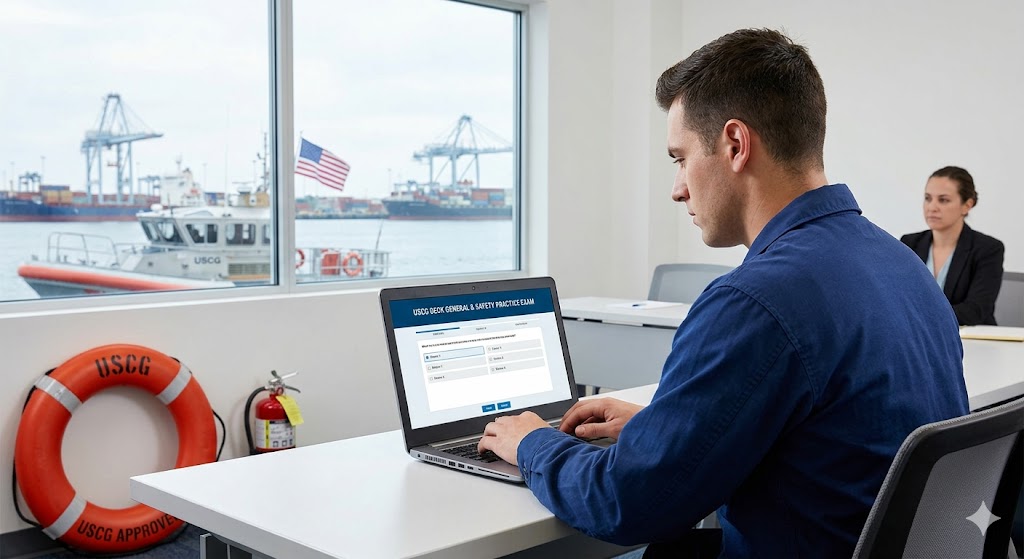
Additional Information
What the Course Entails and Exam Details
This examination is not usually a single "course" but a standardized USCG assessment covering two distinct yet overlapping knowledge areas. Studying for this test requires comprehensive knowledge across a broad maritime syllabus.
Deck General Topics Include:
Seamanship: Proper use and maintenance of lines, knots, splices, and rigging. Ground tackle (anchors) handling and operations.
Vessel Handling: Principles of maneuvering under various conditions (wind, current, shallow water). Understanding boat handling, especially during docking, undocking, and anchoring.
Cargo Handling: Safety regulations and best practices for loading, stowing, and discharging various types of cargo (break bulk, containerized, dry bulk, and liquid bulk). Understanding the principles of stowage and the dangers of hazardous materials.
Rules of the Road (Navigation): While often a separate module, fundamental knowledge of the International Regulations for Preventing Collisions at Sea (COLREGs) and Inland Navigation Rules is crucial and often integrated.
Deck Safety Topics Include:
Firefighting: Understanding the chemistry of fire, classifications of fire, and operating portable and fixed fire suppression systems. Knowledge of fire prevention strategies and emergency response.
Lifesaving and Survival: Proficiency in using lifesaving equipment (lifeboats, liferafts, immersion suits, life jackets). Knowledge of survival techniques at sea and search and rescue procedures.
First Aid and Medical Care: Basic emergency medical response, CPR, and treating common maritime injuries.
Watchkeeping and Pollution Prevention: Regulatory knowledge regarding proper watchstanding practices (STCW guidelines). Understanding MARPOL regulations regarding the prevention of pollution from oil, sewage, garbage, and hazardous substances.
Emergency Procedures: Knowledge of standardized responses to various emergencies (man overboard, flooding, grounding, and abandon ship scenarios).
What to Expect in the Final Exam
The actual USCG examination format is strictly regulated. It consists of multiple-choice questions administered through the USCG’s specialized testing system.
Format: Multiple-choice questions, ranging from 50 to 70 questions per module (Deck General and Deck Safety often being distinct modules, each requiring a separate sitting).
Duration: Candidates are typically allotted a strict time limit per module, usually between 2 and 3 hours each.
Passing Score: The USCG usually requires a minimum passing score of 70% or 75%, depending on the specific qualification sought. For certain high-risk safety components (like navigation rules), a higher score (90%) is required.
Rules: The exams are proctored. No unauthorized materials (including cell phones or reference books not specifically permitted by the Coast Guard) are allowed during the test. For calculations, standard tools like non-programmable calculators may be permitted.
How to Study and Exam Centers
Studying for the USCG Deck General and Deck Safety examination requires a combination of rote memorization, conceptual understanding, and practice.
Effective Study Strategies:
Use Practice Exams: Utilizing dedicated "Deck General and Deck Safety Practice Test" software, apps, and study guides is paramount. Simulating exam conditions with timed practice questions helps build stamina and familiarity with the question phrasing.
Review USCG Sample Questions: The USCG National Maritime Center (NMC) provides sample examination questions for various ratings. Familiarizing yourself with this format is vital.
Study Official Textbooks: Consult key maritime textbooks, including The American Practical Navigator (Bowditch), Merchant Marine Officers' Handbook, and relevant CFRs (Code of Federal Regulations).
Flashcards: Create flashcards for critical definitions, regulations, safety signals, and knots.
Exam Centers:
The USCG examinations are not taken online at home. They are administered at official, authorized locations.
USCG Regional Examination Centers (RECs): This is the most common location. Candidates must schedule an appointment at an REC located across the United States, usually at major ports.
USCG-Approved Schools: Many maritime academies and private maritime training institutions offer approved courses. Completion of an "approved course" from an authorized school may allow the school to administer the examination directly (in lieu of testing at an REC) or provide a course completion certificate that the USCG accepts as passing the examination requirement.
Job Opportunities from the Course
Successfully passing the Deck General and Deck Safety examinations is essential for achieving various Merchant Mariner Credential ratings and endorsements, which directly translate into a wide array of career opportunities in the maritime industry.
Able Seaman (AB): (Unlimited, Limited, Special, Fishing Industry)
Boatswain (Bosun): Head of the deck department crew.
Third Mate / Second Mate: (Licensed Officer positions on unlimited tonnage vessels).
Master or Mate (Limited Tonnage): (e.g., 100 Ton, 200 Ton Master for smaller vessels, ferries, tugs).
Tankerman: With additional endorsements.
Harbor Tug Captain/Mate:
Offshore Supply Vessel (OSV) Officer:
Cruise Ship Deck Officer:
Merchant Mariner Academy Cadet (for subsequent licensing).
Frequently Asked Questions
Reviews
5.0
Based on 0 reviews
Leave a Review
No reviews yet. Be the first to review!