
Delaware Civics Practice Test
$69.00
- Buy to unlock unlimited access to all Quiz questions and Answers in this Quiz.
- After purchase you can print a PDF of the whole quiz at any point. The PDF will contain the questions and the correct answers.
About this Exam
The Delaware Civics Practice Exam is a valuable, user-friendly study resource designed to help individuals, particularly students in Delaware's education system, prepare for assessments of their knowledge and understanding of American government and Delaware state civics. This practice exam is not the official certification test itself, but rather an essential tool to gauge readiness and identify areas that need focused study. It is crafted for anyone needing to demonstrate a fundamental understanding of civic principles, from high school students fulfilling graduation requirements to adults preparing for various civics-related roles. By using this practice exam, users can gain confidence, learn the types of questions they might encounter, and ultimately improve their scores on actual civics assessments in Delaware and beyond. This is an indispensable guide for anyone aspiring to be an informed and active citizen.
Ready to test your knowledge?
Buy Now to Access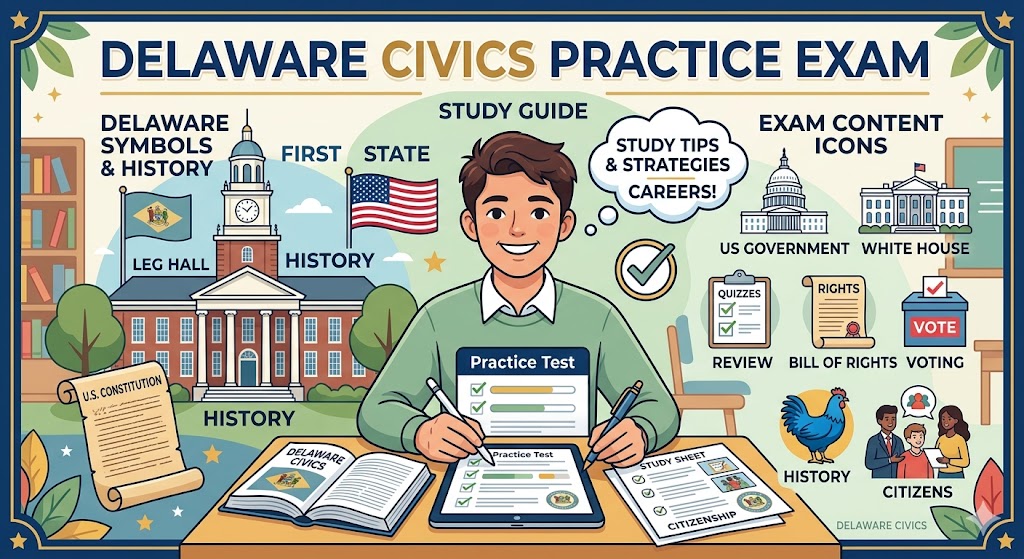
Additional Information
What the Course Entails and Exam Details
This comprehensive study guide and the associated practice exam are built around key foundational pillars of civic education. The covered topics are aligned with standard civics curricula and state education requirements, ensuring users are prepared for the depth and breadth of assessments in this field.
Users can expect to explore:
The U.S. Constitution and Government: This core section delves into the principles of American democracy, the supreme law of the land, the system of government (legislative, executive, judicial), checks and balances, the separation of powers, and key figures throughout American history.
Fundamental Rights and Responsibilities: Understand the Bill of Rights and subsequent amendments, rights such as freedom of speech and religion, and the fundamental responsibilities and roles of citizens, including voting and political participation.
Delaware-Specific Civics: This unique section focuses on Delaware's own history, governance, and important state symbols. Topics include the Delaware State Capitol (Leg Hall), significant historical events like the state's ratification of the U.S. Constitution as the "First State," and the structure of Delaware’s local government.
Citizenship and Legal Process: Learn about the concepts of citizenship, the naturalization process for the U.S. citizenship test (where relevant contextually), and the American legal system.
The "exam details" related to the practice material itself include multiple-choice questions, interactive activities, and perhaps short-answer components within a structured study environment.
What to Expect in the Final Exam
While a standalone, single-date "Delaware Civics Exam" with universally fixed format, passing score, time limits, and specific exam centers does not exist at a state-wide level for all students, your understanding will be formally evaluated. The structure and details of these final evaluations can vary depending on your specific school or educational program, often taking the form of school-based exams within your civics or social studies courses. However, statewide social studies assessments like DeSSA (Delaware System of Student Assessment), which include a significant civics component, are also part of the process for students in key grades.
Generally, here is what you can anticipate in your final assessments or state tests:
Diverse Question Formats: Assessments often go beyond simple multiple-choice to include more complex question types, such as matching, true/false with explanation, short-answer questions requiring analysis, and potentially extended response or essay portions. This allows you to demonstrate your deeper understanding and critical thinking skills.
Focus on State Standards: The content will be based on Delaware’s specific social studies and civics standards, covering all the critical topics outlined in your coursework and the Delaware Center for Civics Education resources.
School-Based Testing: Most final assessments and statewide tests are administered within your school’s standard testing environment, with teachers or specific proctors managing the process.
Varying Scores and Time Limits: Because there is no single test, passing scores, time limits, and specific rules are determined by your individual school and state guidelines for statewide testing. Consult your teachers, school administrators, or the Delaware Department of Education website for the most accurate and up-to-date details relevant to your specific evaluations.
How to Study and Exam Centers
Actionable Study Strategies:
Utilize This Practice Exam: This is your primary tool. Complete multiple practice test attempts to become comfortable with different question formats, gauge your timing, and find your weak spots.
Review Official Study Guides: Consult curriculum materials from your school and official resources, such as those from the Delaware Center for Civics Education and the U.S. Citizenship and Immigration Services (USCIS) for broader context.
Use Interactive Learning: Engage with educational games, flashcards, online videos, and interactive maps to make studying more dynamic and memorable. Focus specifically on Delaware-related content.
Stay Informed: Read current news, explore websites of government bodies (Delaware state government, federal government), and understand the context of civics concepts in current events.
Engage in Discussion: Talk with classmates, family, and teachers about civic topics. Debating different viewpoints can deepen your understanding and analytical skills.
Exam Centers: Final evaluations will typically occur in:
Classrooms and School Labs: Most end-of-course exams and statewide standardized tests are taken within your school building, often on computers for automated testing but potentially also with paper and pencil depending on accommodations. Check with your school for specific testing windows and logistics.
Online Portals (for Practice and Specific Programs): Our Delaware Civics Practice Exam and various other study materials are often available through online platforms, allowing for convenient access from home, school, or library. Some specific adult education or alternative testing programs might utilize designated testing websites.
Designated Public Sites (for Broader Context): For assessments such as the national naturalization test, the location would be a specific USCIS office.
Job Opportunities from the Course
Strong civics knowledge is not only important for active citizenship but can also open doors to various rewarding careers where understanding governmental structures, history, and community engagement is essential. While completing a civics course isn't a direct "certification" for many, the knowledge gained is invaluable across a wide spectrum of fields.
The specific job titles and career paths this strong foundation unlocks or enhances include:
Civics Education Teacher / Instructor
Government Program Manager / Administrator
Policy Analyst
Legislative Assistant / Aide
Community Outreach Coordinator
Legal Assistant / Paralegal
Non-Profit / Advocacy Worker
Public Relations Specialist (Government/Public Sector)
Law Enforcement Officer (State/Local)
Municipal / Regional Planner
Frequently Asked Questions
Reviews
5.0
Based on 0 reviews
Leave a Review
No reviews yet. Be the first to review!