
Delivering Cable Services Practice Test
$69.00
- Buy to unlock unlimited access to all Quiz questions and Answers in this Quiz.
- After purchase you can print a PDF of the whole quiz at any point. The PDF will contain the questions and the correct answers.
About this Exam
The Delivering Cable Services exam validates the knowledge and foundational skills required to successfully install, maintain, and troubleshoot advanced communication services. It is tailored for entry-level broadband and field technicians who are the face of their company on customer premises. This program assesses competence in connecting customers to critical high-speed data, video, and voice services, ensuring a reliable and positive user experience. Earning your certification in this area marks you as a qualified professional in the deployment of contemporary hybrid fiber-coaxial (HFC) networks.
Ready to test your knowledge?
Buy Now to Access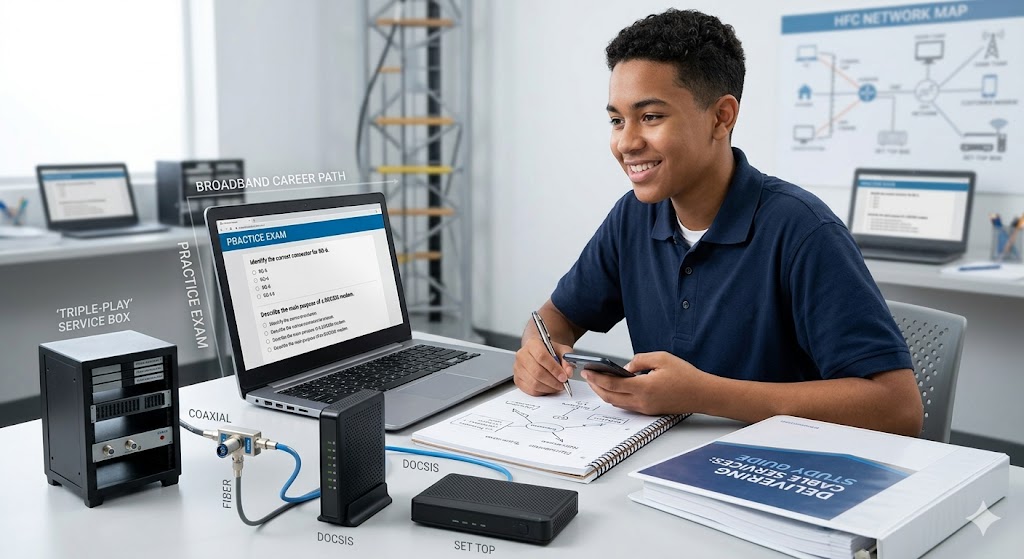
Additional Information
What the Course Entails and Exam Details
The course of study for Delivering Cable Services is designed to provide a well-rounded foundation in both technical theory and practical application. Candidates will gain deep insights into the architecture of modern telecommunications networks, with a focus on delivering "triple-play" services. The exam covers a wide range of essential topics, ensuring you are prepared for the diverse challenges you will face in the field.
Key areas include:
Network Architecture: Understanding the Hybrid Fiber-Coaxial (HFC) and Fiber-to-the-Home (FTTH) network topologies.
Installation Standards: Mastering proper procedures for running coaxial and fiber drop cables from the tap to the customer premises.
DOCSIS Technology: Comprehending the Data Over Cable Service Interface Specification (DOCSIS) standards that power high-speed internet.
Signal Theory: Grasping basics of Radio Frequency (RF) and optical signal propagation, including levels, attenuation, and tilt.
Troubleshooting: Developing a systematic method to identify, analyze, and resolve service issues related to video, data, and voice.
Safety Protocols: Implementing critical safety standards for working on ladders, in confined spaces, with electricity, and in traffic.
Customer Service: Demonstrating effective communication and interpersonal skills to educate users and manage interactions.
What to Expect in the Final Exam
While a practice test helps you refine your knowledge, it is essential to prepare for the final certification exam’s format and rules. The final exam is designed to objectively measure your proficiency against industry-recognized benchmarks. Being well-prepared for the structure and timing of the test will significantly enhance your confidence and performance on exam day.
Here is what you can expect in the final assessment:
Format: The final certification exam is a standard multiple-choice test delivered in a computer-based format. Some exams may also incorporate simple simulation or scenario-based questions.
Number of Questions: You can anticipate between 50 and 80 questions covering all domains in the exam objectives.
Time Limit: Candidates are generally allotted 90 to 120 minutes to complete the exam.
Passing Score: The required passing score is typically set between 70% and 80%, depending on the specific certifying body (e.g., SCTE or another provider).
Language: The primary language for the exam is English, though it may be available in other languages.
How to Study and Exam Centers
Effective preparation is the foundation of exam success. A combination of structured study, practice, and hands-on experience is recommended to gain mastery of the content. Creating a consistent study plan that leverages multiple resources is key to reinforcing your knowledge and identifying weak areas before the final assessment.
Actionable Study Strategies:
Master the Objectives: Begin by reviewing the official exam objectives and curriculum. This is your roadmap to success.
Leverage Practice Exams: This is your best tool. Take practice tests under timed conditions to get a realistic feel for the exam. Analyze all incorrect answers to understand your gaps.
Utilize Study Guides and Material: Go through the recommended textbooks, online courses, or company training materials carefully.
Gain Hands-On Experience: Whenever possible, practice the techniques you are learning. Working with physical tools, cables, and diagnostic equipment will make the theory real.
Prioritize Safety: Never skim over safety modules. Safety is the top priority and is always a significant part of the exam.
Where to Take the Practice Test:
Online Portals: Practice tests are almost exclusively taken online. They are typically accessed through learning management systems, company intranet portals, or official training providers like SCTE, NCTI, or authorized vocational schools.
Where to Take the Final Certification Exam:
Authorized Testing Centers: Standardized final exams for certifications are taken at official testing centers. Large networks like Pearson VUE host these exams in physical locations globally.
Online Proctored Exams: Many organizations now offer online proctored exams. This allows you to take the final test from a secure, private location (like home), with a remote proctor monitoring via webcam.
In-House Training Facilities: Large telecommunications companies may host final exams within their own internal training departments.
Job Opportunities from the Course
A certification in Delivering Cable Services significantly enhances your employability and opens specific, desirable career paths. Employers in the telecommunications and broadband industries actively seek certified professionals to ensure quality service, reduce customer support costs, and enhance safety in the field. This qualification demonstrates your dedication to professional standards and signals that you are ready to be a productive member of a technical team from day one.
Completing this course and earning certification can lead to a diverse array of rewarding job opportunities.
Specific Job Titles and Career Paths:
Cable Installation and Repair Technician: Performing new customer service installations and responding to service calls to troubleshoot and repair existing connections.
Broadband Premises Technician: Installing, servicing, and maintaining integrated "triple-play" voice, video, and data services at residential or small business locations.
Field Services Technician: General field-based role involving network maintenance, service connection, and customer interaction.
Broadband Network Technician: Focuses on maintaining the health and performance of the Access and Distribution portions of the network, outside of the customer's home.
Installation Support Specialist: Provides remote technical support or quality control oversight for field technicians.
Customer Service Technician: A hybrid role combining field technical work with a high emphasis on advanced customer education and service.
Entry-Level Technical Lead or Mentor: With experience, this path leads to supervising and coaching junior technicians.
Frequently Asked Questions
Reviews
5.0
Based on 0 reviews
Leave a Review
No reviews yet. Be the first to review!