
Dental Assistant Terminology Practice Test
$69.00
- Buy to unlock unlimited access to all Quiz questions and Answers in this Quiz.
- After purchase you can print a PDF of the whole quiz at any point. The PDF will contain the questions and the correct answers.
About this Exam
Welcome to your essential first step toward mastering the specialized language of dental assisting. The Dental Assistant Terminology Practice Exam is designed as a comprehensive preparatory tool for aspiring and current dental assistants aiming for certification and professional fluency. This exam ensures you can accurately and confidently communicate using the precise vocabulary required in a modern dental office. Whether you are preparing for a specific certification or looking to solidify your foundational knowledge, this practice test will challenge and refine your understanding of core dental terms. This resource is tailored for students in dental assisting programs, recent graduates, or anyone seeking to validate their knowledge in the dental field.
Ready to test your knowledge?
Buy Now to Access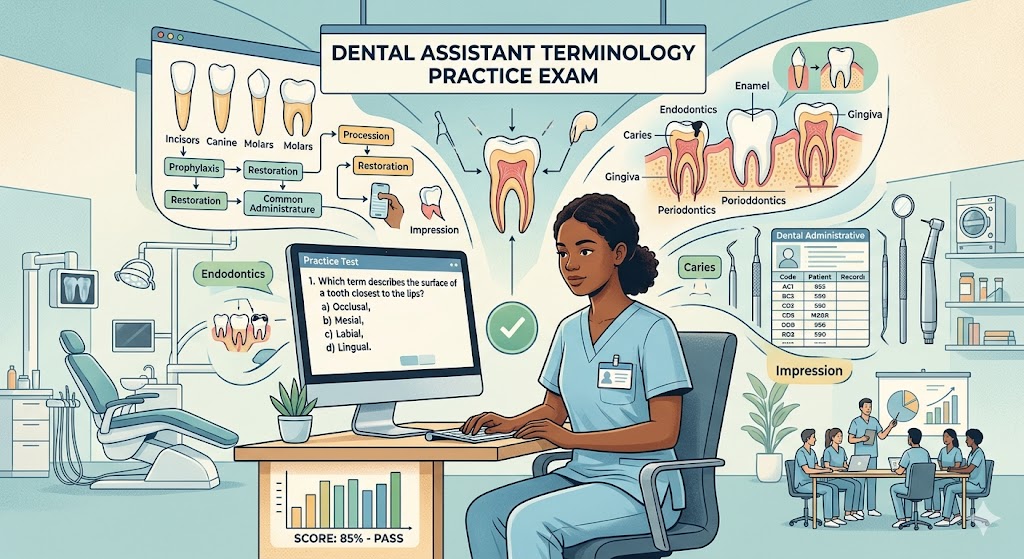
Additional Information
What the Course Entails and Exam Details
This comprehensive practice resource covers the entire spectrum of specialized vocabulary used daily within a modern dental practice. A student utilizing this practice exam will be tested on their knowledge of crucial areas foundational to the dental assistant’s role. The core content focuses on several key domains: comprehensive dental anatomy and physiology, including the structure of the tooth, surrounding tissues, and the numbering systems; common dental pathologies and conditions; standard preventive and restorative procedures; and the complex vocabulary associated with dental instruments, materials, and equipment. The practice test also validates understanding of pharmacology terminology related to local anesthetics and patient management, as well as critical HIPAA and OSHA vocabulary necessary for regulatory compliance. By engaging with this material, you are reviewing the theoretical syllabus required for clinical competence.
What to Expect in the Final Exam
While actual state or national certification formats can vary slightly by organization (such as the DANB or state dental boards), this practice test replicates the most common and challenging format: multiple-choice questions. In the professional environment, the "final exam" is usually a computer-based test administered at an authorized testing center. Passing scores vary—for example, the DANB uses a scaled scoring system with 400 being a minimum passing score on a scale of 200 to 800—but the practice test is typically designed to demand a high level of proficiency (e.g., scoring at least 80% to 85% is recommended to ensure readiness for the real certification). Time limits are crucial to manage; a typical terminology module on a certification exam might allow roughly 60 to 90 minutes. Rules are strict in the actual testing environment: no outside materials, phones, or notes are permitted. This practice exam helps you learn to manage that time effectively and get accustomed to analyzing complex question stems under pressure.
How to Study and Exam Centers
Effective study for dental terminology relies on a strategic combination of memorization and conceptual application. The most actionable strategy is to break the extensive vocabulary into manageable categories. Create a robust system of digital or physical flashcards for definitions, but do not stop at simple recall. Actively practice identifying dental anatomy on diagrams and explaining procedures out loud as if to a patient, using the correct professional terms. Use this Dental Assistant Terminology Practice Exam repeatedly; review your incorrect answers thoroughly, rather than just moving on. Study guides from established organizations like the DANB are excellent primary resources. It is vital to note that this practice test is a study aid and is typically accessed via an online student portal or a practice-specific platform. When you are ready for the official certification exam (the "Final Exam"), you will not take it online at home. You must register through the appropriate licensing body (e.g., DANB) and schedule an appointment at an authorized, proctored physical testing center, most commonly a Pearson VUE professional center, or occasionally an authorized dental school or vocational testing facility.
Job Opportunities from the Course
Achieving proficiency in dental assistant terminology, validated by a practice test score that leads to final certification, is a critical step toward unlocking multiple career paths within the dental field. This foundational knowledge is not just a regulatory requirement; it is a clinical necessity for effective communication with dentists, hygienists, and patients. The skills learned and validated here are essential for, and directly lead to, the following specific job opportunities and career paths:
Certified Dental Assistant (CDA): The foundational clinical role, requiring national certification in specialized areas like Infection Control and Chairside assisting.
Registered Dental Assistant (RDA): A state-specific licensure level often involving expanded functions and responsibilities.
Dental Office Administrator / Office Manager: Proficiency in terminology is crucial for managing dental billing, insurance coding, and scheduling.
Dental Patient Coordinator: Acting as the primary liaison between the clinical team and the patient requires clear understanding of procedures.
Dental Lab Assistant: Utilizing terminology to correctly interpret laboratory prescriptions for prosthetics and appliances.
Expanded Functions Dental Assistant (EFDA): Terminology mastery is a prerequisite for advanced training in restorative procedures allowed in some states.
Orthodontic Assistant: Applying generalized dental knowledge to the specialized vocabulary of orthodontics.
Frequently Asked Questions
Reviews
5.0
Based on 0 reviews
Leave a Review
No reviews yet. Be the first to review!