
Dental Assisting Jurisprudence Practice Exam
$69.00
- Buy to unlock unlimited access to all Quiz questions and Answers in this Quiz.
- After purchase you can print a PDF of the whole quiz at any point. The PDF will contain the questions and the correct answers.
About this Exam
The Dental Assisting Jurisprudence Practice Exam is a crucial preparatory tool for aspiring dental assistants ready to finalize their certification or licensure. This specialized exam does not test your clinical knowledge or hand skills; rather, it assesses your comprehensive understanding of the legal and ethical framework governing dental practice within a specific jurisdiction or state. It is designed precisely for dental assisting students or working professionals who are seeking to obtain their Registered Dental Assistant (RDA) or Certified Dental Assistant (CDA) credentials, ensuring they are fully compliant with state-mandated Dental Practice Acts before they begin operating in a professional setting.
Ready to test your knowledge?
Buy Now to Access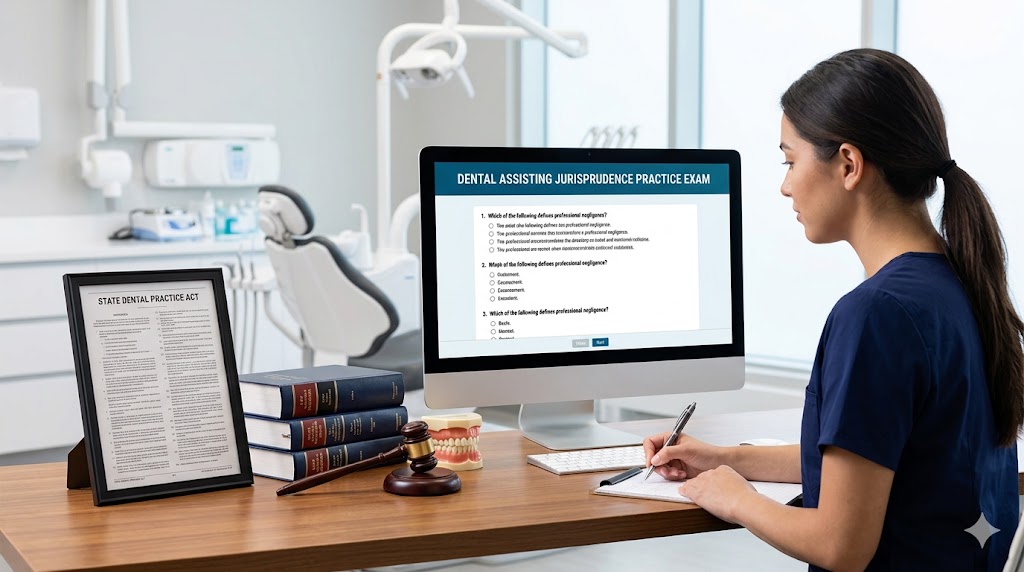
Additional Information
What the Course Entails and Exam Details
This examination focuses entirely on the "rulebook" that dictates how dentistry must be practiced within your specific state. Unlike clinical courses, the jurisprudence curriculum is rooted in law, administrative code, and ethics.
The syllabus typically entails a deep dive into the official State Dental Practice Act. You will study legal definitions, specifically distinguishing between terms like negligence, malpractice, abandonment, and incompetence.
A significant portion of the details covered concerns definitions of the scope of practice for various members of the dental team, clarifying exactly which functions a dental assistant is legally permitted to perform under various levels of supervision.
Furthermore, you will cover essential legal requirements surrounding patient confidentiality (including HIPAA compliance), the required protocol for obtaining informed consent, and mandatory guidelines for maintaining accurate and secure dental records. Finally, the exam details encompass crucial state laws regarding infection control protocols and dental waste management.
What to Expect in the Final Exam
You should prepare for a theoretical, knowledge-based assessment rather than a demonstration of practical skills. The final exam format is almost universally structured with multiple-choice questions.
The entire exam is designed to challenge your understanding of specific state statutes and administrative rules rather than general dental knowledge. Format variability is the most important factor to expect. Depending on the state, the exam might be offered as an "open book" test where you may reference the official documents during the exam, while other states enforce a strictly closed-book environment.
Passing score requirements also vary by state, often ranging from 70% to 100%, as many state boards view mastery of jurisprudence as essential for safe practice. Time limits are usually enforced, often ranging from 30 minutes to one hour, although some online-only formats may be untimed.
How to Study and Exam Centers
The key to succeeding on this exam is direct familiarity with the primary legal source materials. You should begin your study by downloading the exact, current text of your state’s Dental Practice Act from the official state dental board website. This is your study Bible.
You can create digital flashcards to memorize definitions of specific legal terms and mandatory reporting requirements. We highly recommend taking a comprehensive practice exam—like the one referenced in this article—to familiarize yourself with the phrasing of jurisprudence questions and identify weak spots in your understanding of the law.
Regarding exam centers, you must check your specific state board's requirements. Many states have modernized and allow applicants to complete the jurisprudence requirement entirely online through their official government portals or an approved third-party online testing provider. However, some states still require a scheduled, in-person appointment at a physical proctored testing center, authorized school, or a national center like Pearson VUE to complete the requirement under supervision.
Job Opportunities from the Course
Successfully passing your jurisprudence requirement is often the final essential hurdle to gaining licensure or registration, which is required to unlock significant career growth within the dental field. Fulfilling this requirement allows you to advance into key roles:
Registered Dental Assistant (RDA) – A licensed role allowing the performance of expanded functions (varies by state).
Certified Dental Assistant (CDA) – National certification (often requiring jurisprudence alongside other exams) that improves employability and salary.
Orthodontic Assistant (OA) – A specialized role, often requiring separate certification and knowledge of specialty law.
Preventive Functions Dental Assistant – Permitted to perform expanded duties like sealants and coronal polishing.
Dental Office Manager – Advanced role benefiting significantly from a strong understanding of dental law and compliance.
EFDA (Expanded Functions Dental Assistant) – The highest level of assisting, authorizing advanced clinical duties in many states.
Frequently Asked Questions
Reviews
5.0
Based on 0 reviews
Leave a Review
No reviews yet. Be the first to review!