
Denver Fire Engineer Practice Exam
$69.00
- Buy to unlock unlimited access to all Quiz questions and Answers in this Quiz.
- After purchase you can print a PDF of the whole quiz at any point. The PDF will contain the questions and the correct answers.
About this Exam
The Denver Fire Engineer position is a pivotal role within the Denver Fire Department, marking the crucial transition from primary firefighting suppression duties to the technical responsibilities of apparatus operation and scene management.
The Denver Fire Engineer promotional process is exclusively designed for dedicated DFD Firefighters First Grade or Technicians who have the required field experience and ambition to take command of the department's heavy machinery.
Mastering this rigorous multi-stage examination demonstrates the specialized knowledge, mechanical aptitude, and theoretical understanding of hydraulics required to safely transport crews and operate complex pumping and aerial systems under high-pressure emergency conditions.
Achieving this promotion is not merely a career advancement; it is a commitment to the ultimate safety of fellow firefighters operating on the fireground and the protection of the Denver community they serve.
Ready to test your knowledge?
Buy Now to Access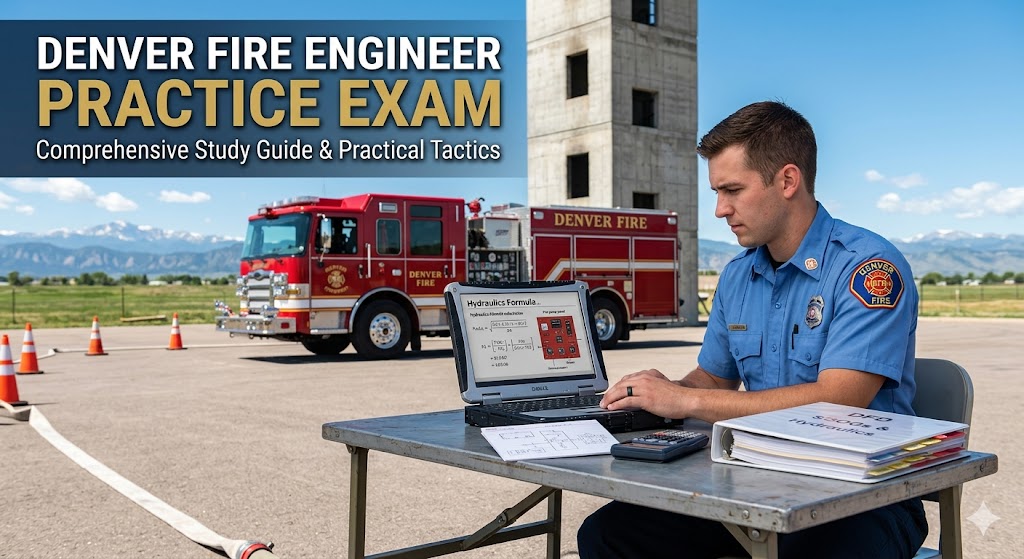
Additional Information
What the Course Entails and Exam Details
While there is no single standardized "course," preparation for this highly competitive promotional process requires a comprehensive dive into several core competencies and regulatory documents essential for the Engineer rank.
Candidates are expected to possess a theoretical and mathematical mastery of fire service hydraulics, which includes performing calculations for friction loss, nozzle pressure, required flow rates (GPM), and engine pressure for complex hose lays, multiple lines, and master stream devices.
A major portion of the examination is dedicated to the study of specific, local Denver Fire Department Standard Operating Guidelines (SOGs) and directives.
These internal documents detail every protocol candidates must know, including emergency driving regulations, strict apparatus positioning tactics for both offensive and defensive operations, water supply strategies, foam application methods, and the mandatory preventative maintenance schedules for all DFD rigs.
Key technical areas covered in study include the principles of centrifugal pumps, the mechanics of aerial ladder and platform systems, foam proportioning systems, and basic automotive maintenance.
A crucial component of this promotional process is local knowledge; candidates must demonstrate detailed familiarity with Denver’s geography, major thoroughfares, hydrant locations, target hazards, and the specific rules of the Denver Civil Service Commission.
Finally, the study curriculum encompasses general administrative policies, department safety regulations, and the specific provisions of the collective bargaining agreement that govern the rank and file.
What to Expect in the Final Exam
The actual promotional process for Denver Fire Engineer is typically a multi-stage evaluation administered by the Denver Civil Service Commission, designed to rigorously test both theoretical knowledge and practical proficiency.
The Multiple-Choice Written Examination
The process almost always begins with a comprehensive, closed-book multiple-choice written exam.
This written component strictly assesses the candidate's technical knowledge of fire service hydraulics, apparatus mechanics, maintenance protocols, DFD SOGs, department directives, and safety regulations.
Candidates are often required to perform complex hydraulics mathematics problems without the aid of a standard calculator, using only the formulas memorized during their studies.
The Civil Service Commission provides a specific reading list of local and national texts that serve as the official source material for all questions on this written portion.
The Practical Performance Examination
Candidates who successfully achieve the required passing score on the written exam proceed to the critical practical, hands-on examination, which is usually held at the Denver Fire Department's Rocky Mountain Fire Academy.
The practical test is a high-pressure assessment where candidates are evaluated on their ability to operate actual DFD pumpers or aerial apparatus under simulated emergency conditions.
This rigorous testing component often includes:
Apparatus Maneuvering/Driving: Completing a timed driving course designed to test spatial awareness, reversing skills, and the ability to safely navigate narrow urban streets and obstacles.
Pumping Scenarios: Establishing a water supply from a hydrant, drafting from a static source (such as a folding tank), and managing the pump panel to supply multiple handlines and a master stream at specific, correct pressures simultaneously.
Aerial Operations: (If testing for Ladder Company Engineer) Positioning the aerial device, deploying outriggers, and maneuvering the ladder or platform to a specific target window for simulated rescue or ventilation.
Both the written and practical components have strict passing score requirements, and the final promotional list ranking is determined by a weighted combination of these scores, sometimes adjusted for seniority points.
How to Study and Exam Centers
Success on the Denver Fire Engineer process demands a structured, disciplined study regimen that balances academic knowledge with practical drilling.
Actionable Study Strategies
Master Hydraulics Mathematics: Do not rely solely on simple rules of thumb. Dedicate a significant portion of your study time to creating and solving complex friction loss problems for different scenarios (various hose diameters, nozzle types, elevations, and appliances) until the formulas become instinctive muscle memory.
Deep Dive into Local SOGs: This is the most crucial local component. Study the current DFD SOGs and directives daily. Utilize flashcards for key pressures, safety parameters, maintenance timelines, and department rules.
Get Hands-on Time (The "Tailboard" Study): Work closely with the current Engineers at your station. Ask to flow water and take the wheel of the reserve apparatus when available. Practice spotting the hydrant and maneuvering the rig into the correct position on the training pad or in an empty parking lot.
Simulate the Stress: Take timed practice written exams that specifically utilize questions modeled on previous civil service assessments. Practice setting up the pump panel with a stopwatch to simulate the pressure of the practical exam.
Testing and Exam Centers
The written multiple-choice examination is typically administered by the Denver Civil Service Commission in a secure environment at a large, designated physical testing facility, such as a convention center or a large academic hall within the City and County of Denver.
The hands-on practical examination component is conducted exclusively at the Denver Fire Department’s primary training facility, the Rocky Mountain Fire Academy (RMFA). The RMFA provides the necessary pump training grounds, training towers, and specialized apparatus required for standard, fair testing.
All specific dates, registration requirements, and officially approved reading lists are distributed internally through the DFD Internal Information System (IIS) and officially published on the Denver Civil Service Commission’s website.
Job Opportunities from the Course
Earning the rank of Fire Engineer is a critical and mandatory milestone within the Denver Fire Department, unlocking specialized technical roles and essential career advancement paths.
Holding this credential and promoting to the rank of Engineer opens up primary positions as the designated Fire Engineer (Driver/Operator) for Engine Companies, Ladder Companies, or Heavy Rescue Units within the department. Beyond this primary rank assignment, achieving this promotional milestone serves as the mandatory, gateway qualification for several advanced opportunities and leadership paths:
Acting Lieutenant: When the designated Lieutenant is absent, the Engineer is often the first individual in line to serve as the temporary company officer, managing the crew and the apparatus during the shift.
Specialized Operator Roles: Engineers are uniquely qualified to train for and operate specific technical equipment, such as the department’s Heavy Rescue apparatus or foam tender systems.
Future Officer Eligibility: Most importantly, holding the rank of Engineer is typically the mandatory prerequisite and experience requirement necessary to sit for the future Fire Lieutenant Promotional Examination, which is the critical first step into formal officer leadership and command.
Frequently Asked Questions
Reviews
5.0
Based on 0 reviews
Leave a Review
No reviews yet. Be the first to review!