
Denver Fire Probationary Practice Test
$69.00
- Buy to unlock unlimited access to all Quiz questions and Answers in this Quiz.
- After purchase you can print a PDF of the whole quiz at any point. The PDF will contain the questions and the correct answers.
About this Exam
The Denver Fire Probationary assessments are a rigorous series of written exams, practical skills evaluations, and physical performance tests that a newly hired firefighter must successfully navigate during their first year of on-the-job training. These exams are specifically designed for probationary firefighters who have completed the initial fire academy. Their purpose is to evaluate your ability to apply the knowledge and skills learned in a real-world environment, ensuring you can operate safely, effectively, and professionally as a member of the DFD. Successful completion of probation and these associated exams is the final step in securing your permanent position as a firefighter with one of the most respected departments in the region.
This study guide focuses on helping you understand the types of assessments to expect and provides actionable strategies to practice and prepare for success.
Ready to test your knowledge?
Buy Now to Access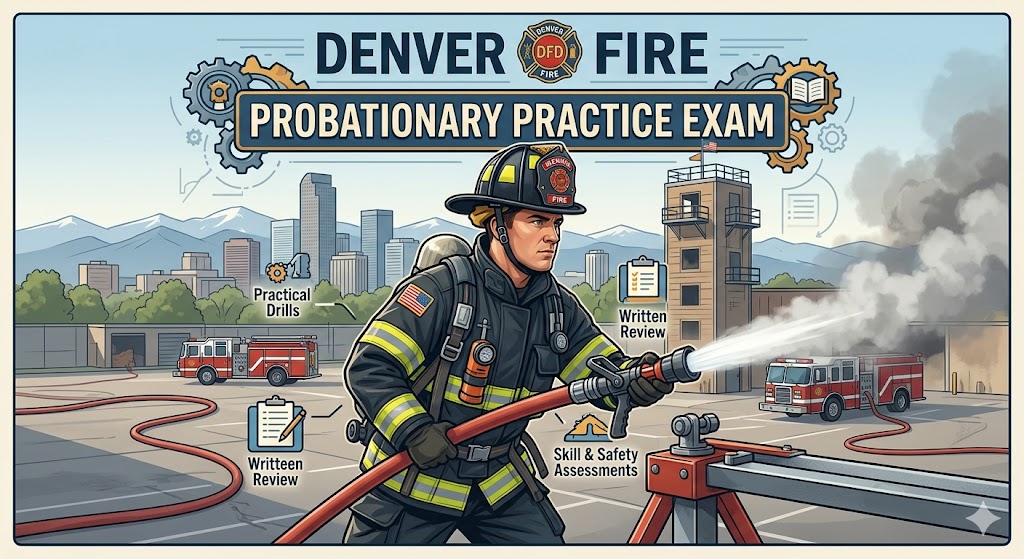
Additional Information
What the Course Entails and Exam Details
Your "course" for these probationary exams is the extensive, hands-on training and real-world experience you gain every shift. While the DFD does not release official public practice tests, the training and assessments you face will thoroughly cover the fundamental topics and practical skills required for the job.
Core Topics Often Assessed:
DFD Policies & Procedures: Mastery of local safety guidelines, operating procedures (SOPs), and general departmental rules is paramount.
Basic Firefighting Techniques: Evaluations will test your proficiency in fundamental skills such as hose deployment, ventilation, ladder operations, search and rescue, and fire suppression strategies.
Emergency Medical Services (EMS): Given that a significant percentage of calls are medical in nature, probationary firefighters are heavily assessed on their EMT-Basic or Paramedic knowledge and skills, depending on their certification.
Equipment Operation & Maintenance: You must demonstrate safe, competent, and efficient operation of various tools, apparatus, and equipment.
Physical Fitness & Ability: Continued physical readiness is critical, and you will likely undergo regular physical evaluations.
Safety Practices & Gear: Proper use of all safety equipment, including your Personal Protective Equipment (PPE) and Self-Contained Breathing Apparatus (SCBA), is non-negotiable.
Assessment Details:
Ongoing Appraisals: Expect regular performance evaluations from your commanding officers throughout your probation.
Multiple Exams: You will face numerous quizzes, smaller tests, and comprehensive exams on both written materials and practical skills.
Confidential Content: Specific exam content is typically internal to the department, but your academy training materials, DFD manuals, and hands-on practice are the ultimate study resources.
What to Expect in the Final Exam
While the exact structure of a final, comprehensive assessment, if administered, is not publicly detailed, you can anticipate a blend of evaluation types that mirrors your probationary training.
Written Tests: Expect comprehensive multiple-choice or other objective written exams. These will test your theoretical knowledge, command of procedures, and understanding of critical fire and medical concepts.
Format: Typically structured as multiple-choice questions, which may include theoretical knowledge, local geography, DFD specifics, and medical protocols.
Scoring: Passing scores for these internal exams are typically set at a high standard, often requiring a grade of 70% to 80% or higher.
Time Limits: Like entry-level tests, these exams are timed, demanding both accuracy and efficiency.
Practical Skills Evaluations: These are intensive, hands-on scenarios designed to test your proficiency in core firefighting and medical operations under realistic and often high-stress conditions.
Format: You will perform specific tasks (e.g., advancing a hose line, setting up a ladder, performing patient assessment) while being strictly evaluated on technique, safety, efficiency, and communication.
Scoring: Evaluations are typically based on practical skill check-sheets and are graded on a pass/fail basis for essential skills, with a critical focus on safety. Points can be deducted for errors, and unsafe acts are grounds for automatic failure.
Rules: There are strict rules regarding proper technique, communication with team members, and the absolute requirement to perform all tasks safely and with appropriate equipment.
Physical Ability: Elements of the assessments may incorporate physical tasks, simulating the physical demands you’ll encounter on a real scene.
The Golden Rules of Success:
Safety First, Always: Every movement, decision, and skill must prioritize your safety and the safety of your crew and the public.
Accuracy Over Speed: Do not compromise correct technique or safe procedures for the sake of speed. Proper practice builds efficient speed.
Strict Adherence to Protocols: Know and follow all DFD policies and established standards perfectly.
Remember, the goal is not just to pass but to master these critical skills and make them second nature.
How to Study and Exam Centers
Preparation for these probationary assessments is continuous. The ultimate key is to treat every shift and training session with maximum focus and dedication.
Actionable Study Strategies:
Master Your DFD Manuals: The DFD provides comprehensive manuals covering everything from standard operating guidelines to equipment operations. Treat these as your primary textbooks. Review them relentlessly.
Review Academy Training: Go back and thoroughly review all your academy notes, textbooks, and practice materials. These form the fundamental knowledge base for everything you do.
Active Practice at the Station: Take initiative at your station to regularly practice core practical skills under supervision. Practice advancing hose lines, setting up ladders, performing equipment checks, and responding to simulated scenarios.
Practice Under Time Pressure: Once you have mastered the technique, start timing your practical drills. This helps you build efficiency and replicates the timed environment of an actual assessment. Use general fire service practice questions to simulate written exams.
Seek Regular Feedback: Don't wait for formal evaluations. Actively seek input and critiques from experienced firefighters and your officers. Use their feedback constructively to improve your skills.
Form Study Groups: Organize study sessions with fellow probationary firefighters. Discuss written materials, run through drills together, and quiz each other on DFD procedures and medical knowledge. This enhances your understanding and builds critical teamwork skills.
Mental and Physical Prep: Maintain your physical fitness with a structured workout routine. Get enough rest and prepare mentally to perform under stress. Visualize yourself executing skills successfully.
Where to Take the Exams:
The probationary assessments and any final comprehensive evaluations are administered entirely within the Denver Fire Department’s official training facilities, drill grounds, and fire stations. There are no external testing centers like Pearson VUE for these internal department assessments. You will be provided with all the necessary details, locations, and schedules for all your exams during your probation. You are expected to be present, punctual, and fully prepared for every assessment. Your path to success in Denver Fire is not just through a book but through the dedicated, professional execution of the job every single day.
Job Opportunities from the Course
Successful completion of your probationary period and all associated assessments unlocks a fulfilling, challenging, and lifelong career. While precise salary and opportunities can change, here is a clear list of the specific job opportunities and career paths a permanent Denver Firefighter can pursue. This is a clear list, and not presented in a table as requested.
Permanent Denver Firefighter: Secure your full-time, stable position as a certified Denver Firefighter, complete with competitive compensation and a comprehensive benefits package.
Specialized Assignments & Opportunities: As a permanent firefighter, you can pursue additional training and certification for specialized roles within the department:
Paramedic Certification & Assignment
Hazardous Materials (Hazmat) Specialization
Technical Rescue (e.g., trench, structural, rope)
Aircraft Rescue and Firefighting (ARFF) - based at DIA
Fire Investigation & Prevention
Community Outreach & Public Education
Fire Dispatch
Future Career Progression: The Denver Fire Department offers a clear path for professional development and promotion to higher ranks and leadership positions:
Engineer
Lieutenant
Captain
Battalion Chief
Assistant Chief
Deputy Chief
Fire Chief
Frequently Asked Questions
Reviews
5.0
Based on 0 reviews
Leave a Review
No reviews yet. Be the first to review!