
Department of Defense (DoD) Aircraft Rescue and Fire Fighting (ARFF) Capability Development Center (CDC) Practice Exam
$69.00
- Buy to unlock unlimited access to all Quiz questions and Answers in this Quiz.
- After purchase you can print a PDF of the whole quiz at any point. The PDF will contain the questions and the correct answers.
About this Exam
The Department of Defense (DoD) Airport Fire Fighter (ARFF) certification is the gold standard requirement for military and civilian personnel tasked with providing fire protection and rescue services at DoD airfields globally. This specialized credential validates that first responders possess the critical knowledge, skills, and abilities necessary to manage the unique and high-risk environment of military aviation incidents. It is specifically designed for firefighters looking to specialize in aircraft emergencies, involving sophisticated military aircraft, complex fuel loads, and hazardous materials. Successfully navigating the preparation and examination process demonstrates a commitment to operational readiness and life safety in the aviation sector.
Ready to test your knowledge?
Buy Now to Access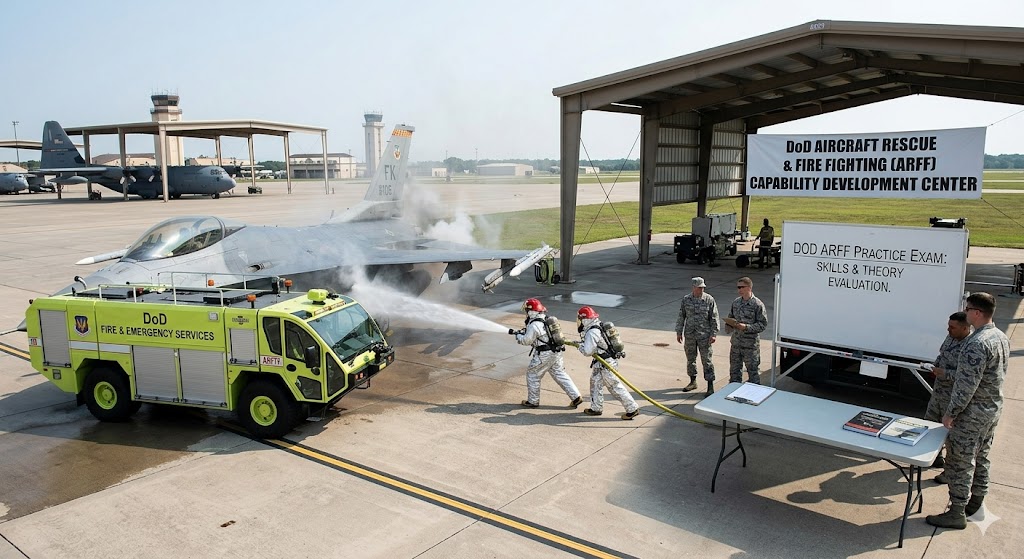
Additional Information
What the Course Entails and Exam Details
Preparation for the DoD ARFF exam involves comprehensive training, often utilizing DoD Career Development Courses (CDCs), that merges rigorous academic study with intense practical application. The core curriculum is derived from the current standards set by the National Fire Protection Association (NFPA) 1003: Standard for Airport Fire Fighter Professional Qualifications. Candidates can expect to cover deep dives into aircraft anatomy and hazardous systems specific to military inventory. They will learn advanced tactics for aircraft fire suppression, cargo fire control, and personnel rescue and extrication techniques. The course also encompasses mastery of specialized ARFF vehicles and extinguishing agents, comprehensive scene management, and mandatory safety protocols unique to the airfield environment.
What to Expect in the Final Exam
The final evaluation is a multi-part assessment designed to test both theoretical knowledge and practical competence. Candidates will first undergo a cognitive examination, typically presented in a multiple-choice format that challenges their understanding of the NFPA 1003 standard and military-specific ARFF procedures. The number of questions and the time limit can vary based on the specific certification cycle, but accurate, timely recall under pressure is expected. A passing score, often 70% or higher, is required to proceed. The second component is the manipulative skills (practical) evaluation. Here, candidates must perform crucial ARFF tasks—such as agent application using a vehicle turret, structural ventilation, or pilot rescue—while being observed by DoD-certified evaluators. Candidates must successfully complete all designated skills, adhering strictly to safety protocols and time standards, to achieve certification.
How to Study and Exam Centers
A strategic approach to studying is essential for success in this demanding certification process. Candidates are encouraged to deeply utilize their DoD CDCs or prescribed NFPA 1003 training manuals as their primary references. Active learning strategies, such as creating flashcards for aircraft hazards and extinguishing agents, and using practice exams that mimic the actual test format, can significantly enhance retention. Participating actively in hands-on drills is perhaps the most effective way to prepare for the manipulative skills evaluation. For testing centers, military members typically complete their examinations at accredited DoD Fire and Emergency Services training academies or at their assigned military installations under the supervision of qualified Test Control Officers. Civilian contractors or others may take accredited exams through state-level fire service training agencies that are accredited by ProBoard or IFSAC.
Job Opportunities from the Course
Obtaining the DoD Airport Fire Fighter certification instantly elevates a candidate's profile and opens clear career pathways within the DoD and the broader aviation industry.
DoD Civilian Airport Firefighter
Active Duty Military Firefighter (MOS/AFSC advancement)
Municipal Airport Firefighter (Major US Airports)
ARFF Training Instructor
Private Contractor ARFF Specialist (Overseas/Private Airfields)
Contractor Flight Line Safety Officer
Aviation Emergency Management Coordinator
Frequently Asked Questions
Reviews
5.0
Based on 0 reviews
Leave a Review
No reviews yet. Be the first to review!