
Department of Defense (DoD) Information Security and Insider Threat Practice Test
$69.00
- Buy to unlock unlimited access to all Quiz questions and Answers in this Quiz.
- After purchase you can print a PDF of the whole quiz at any point. The PDF will contain the questions and the correct answers.
About this Exam
The Department of Defense Information Security and Insider Threat exam is a crucial evaluation designed to ensure the safety and integrity of national security data.
This vital certification targets federal employees, military personnel, and DoD contractors who handle sensitive, classified, or controlled unclassified information.
By taking this practice test, candidates prepare themselves to confidently identify and mitigate both external cyber vulnerabilities and internal personnel risks.
Ultimately, this course is designed for anyone seeking to maintain compliance with government security protocols while safeguarding critical defense assets from unauthorized disclosure.
Ready to test your knowledge?
Buy Now to Access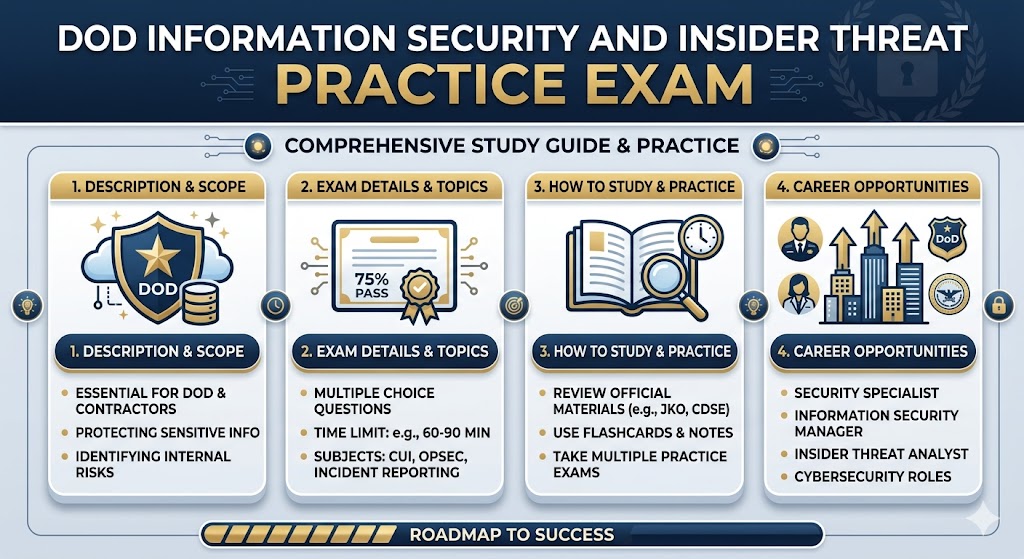
Additional Information
What the Course Entails and Exam Details
The course and practice test cover critical domains necessary for functioning within a secure DoD environment. The content focuses heavily on established regulations, including DoD Directive 5220.22-M (National Industrial Security Program Operating Manual) and relevant DoD Instructions.
Key topics covered include: The different levels of security classification (Confidential, Secret, and Top Secret). Proper procedures for marking, handling, storing, and transporting classified material. Methods for the secure destruction of sensitive documents and media. Identifying types of threats to DoD assets. Recognizing potential behavioral indicators of an insider threat. Understanding the reporting mechanisms for security anomalies and suspected insider threats. Operational Security (OPSEC) principles. Physical security protocols within DoD facilities.
What to Expect in the Final Exam
While specific assessment methods can vary slightly depending on the branch or agency administering the training, the final exam generally follows a consistent format. The test is typically administered in an unclassified computer lab or via secure online portals.
Specific expectations include:Exam Format: The test consists primarily of multiple-choice and true/false questions. Many questions are scenario-based, requiring you to apply security regulations to real-world situations.Time Limit: Candidates are usually allotted 60 to 90 minutes to complete the exam, which allows sufficient time to carefully read each scenario.Passing Score: DoD standards require a high level of proficiency. The passing score is generally 75% or 80%, depending on the specific agency requirements.Rules: The exam is closed-book, and no reference materials are permitted. Collaboration with other test-takers is strictly prohibited. Successful completion usually generates a certificate that must be retained for training records.
How to Study and Exam Centers
Effective preparation requires a thorough review of official DoD security regulations and active participation in required training modules. Consistency and repetition are key to mastering this material.
Actionable Study Strategies: Review the official course materials provided via Joint Knowledge Online (JKO) or the Security Training, Education, and Professionalization Portal (STEP). Repeatedly use practice tests to familiarize yourself with the phrasing of DoD questions and to identify knowledge gaps. Focus on understanding why a security rule exists, rather than just memorizing the rule itself, as this aids in answering scenario questions. Create flashcards for specific classification marking requirements and definitions of OPSEC and Insider Threat indicators. Study with peers to discuss scenario-based questions and reinforce proper protocols.
Exam Centers: This assessment is typically administered internally. Personnel usually take the exam online through the Joint Knowledge Online (JKO) learning management system or through the Defense Counterintelligence and Security Agency (DCSA) STEP portal. Military personnel and DoD civilians may also take the exam at authorized testing computers within their specific command or installation training centers.
Job Opportunities from the Course
A strong grasp of DoD information security and insider threat protocols is not just a training requirement; it is a vital skill that opens doors within the defense and intelligence sectors. Understanding these concepts is mandatory for positions requiring a security clearance.
The knowledge validated by this exam unlocks various career paths, including: Information Security Specialist Industrial Security Manager Contract Security Officer (CSO) Facility Security Officer (FSO) Personnel Security Specialist Cybersecurity Analyst (within DoD organizations) Security Auditor Insider Threat Program Analyst
Frequently Asked Questions
Reviews
5.0
Based on 0 reviews
Leave a Review
No reviews yet. Be the first to review!