
DEQ Radiation Safety Practice Test
$69.00
- Buy to unlock unlimited access to all Quiz questions and Answers in this Quiz.
- After purchase you can print a PDF of the whole quiz at any point. The PDF will contain the questions and the correct answers.
About this Exam
The DEQ Radiation Safety Certification is a crucial professional credential designed for individuals working in environments involving ionizing radiation. This certification is typically mandated by state-level Departments of Environmental Quality (DEQ) or corresponding regulatory agencies. It is intended for a wide range of professionals, including X-ray technicians, industrial radiographers, laboratory personnel, medical physicists, and environmental health specialists. Obtaining this certification validates your understanding of essential safety protocols, regulatory requirements, and the fundamental principles necessary to manage radiation risks and ensure public and occupational safety. It is a critical step for career advancement in fields that utilize radiation-producing machines or radioactive materials.
Ready to test your knowledge?
Buy Now to Access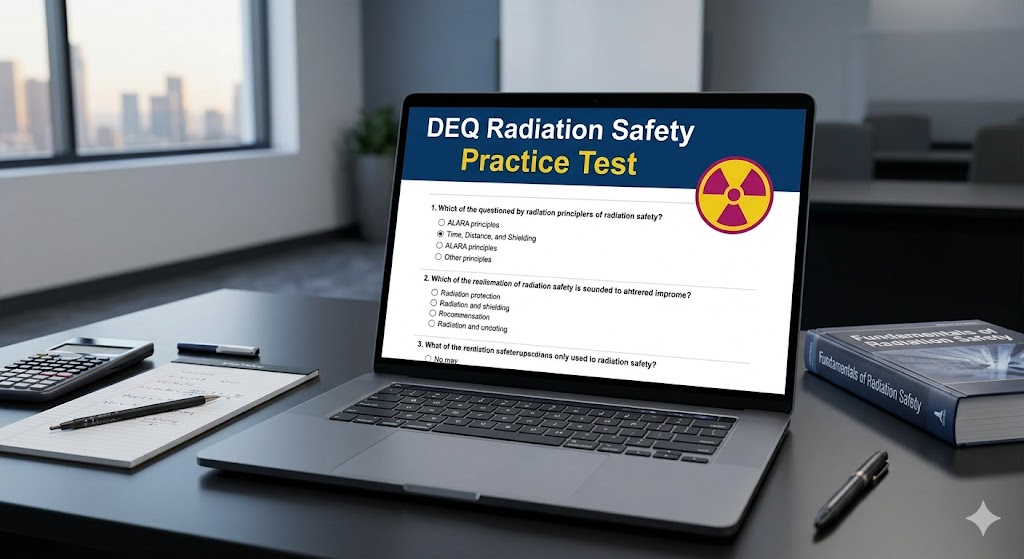
Additional Information
What the Course Entails and Exam Details
This comprehensive course covers the scientific principles, safety measures, and legal frameworks governing radiation usage. The syllabus includes the physics of radiation, encompassing radioactive decay and interactions with matter. You will study biological effects, differentiating between somatic and genetic effects of exposure. A significant focus is placed on standard safety practices, specifically time, distance, and shielding protocols. The curriculum details the proper use of radiation detection and measurement instruments like Geiger counters and dosimeters. You will gain a deep understanding of regulatory requirements, including state-specific DEQ rules, licensing, and the ALARA (As Low As Reasonably Achievable) principle.
What to Expect in the Final Exam
The final exam is a rigorously proctored assessment designed to verify technical knowledge and practical application. It typically utilizes a multiple-choice or true/false format, with some state exams including short-answer or problem-solving questions. The test generally consists of 50 to 100 questions. Candidates are usually allowed between two to four hours to complete the examination. The minimum passing score varies by jurisdiction but generally ranges from 70% to 80%. Specific rules enforce a strict environment: it is usually closed-book, and candidates must present valid government-issued identification to the proctor before testing.
How to Study and Exam Centers
Effective preparation requires a structured study plan and the use of targeted resources. Reviewing official DEQ regulatory guides, standard health physics textbooks, and participating in structured training programs are essential steps. The most impactful preparation strategy involves using a dedicated DEQ Radiation Safety Practice Test to simulate the exam environment, identify knowledge gaps, and become familiar with the questioning style. These practice tests are available through many certified training providers.
Regarding examination centers, logistics vary by state and specific DEQ program. Exams are often administered at physical locations, such as designated state government buildings (specifically DEQ offices), authorized testing centers like Pearson VUE, or approved technical schools and universities. Recently, many jurisdictions have implemented online proctoring options via secure portals, allowing candidates to take the exam remotely provided they meet specific system and environmental requirements. Candidates must consult their local DEQ or regulatory agency website for approved testing vendors and scheduling procedures.
Job Opportunities from the Course
Earning the DEQ Radiation Safety Certification significantly expands your career opportunities in medical, industrial, and regulatory sectors. The certification is highly valued by employers who prioritize safety compliance and require personnel authorized to handle radiation sources. Common job titles and career paths available to certified professionals include:
Radiation Safety Officer (RSO)
Health Physics Technician
Medical Imaging Technologist (X-ray, CT, Mammography)
Dental Hygienist (specializing in radiography)
Industrial Radiographer (Non-Destructive Testing)
Environmental Health and Safety (EHS) Specialist
Nuclear Medicine Technologist
Dosimetrist
Radiological Control Technician
Frequently Asked Questions
Reviews
5.0
Based on 0 reviews
Leave a Review
No reviews yet. Be the first to review!