
Dermatology Physician Assistant National Certifying Examination (PANCE) Practice
$69.00
- Buy to unlock unlimited access to all Quiz questions and Answers in this Quiz.
- After purchase you can print a PDF of the whole quiz at any point. The PDF will contain the questions and the correct answers.
About this Exam
Welcome to your essential study resource for the Dermatology Physician Assistant certification path and PANCE preparation practice. This specialty-focused practice regimen is designed for aspiring and current Physician Assistants who are dedicated to mastering the complexities of dermatology. It targets PA students approaching their PANCE (Physician Assistant National Certifying Examination) who wish to heavily focus their study on the dermatology content area, as well as licensed PAs seeking to transition into the competitive field of dermatology or pursue advanced specialty recognition. This guide provides the structured approach necessary to gain a deep understanding of dermatological conditions, diagnostic procedures, and evidence-based treatments.
Ready to test your knowledge?
Buy Now to Access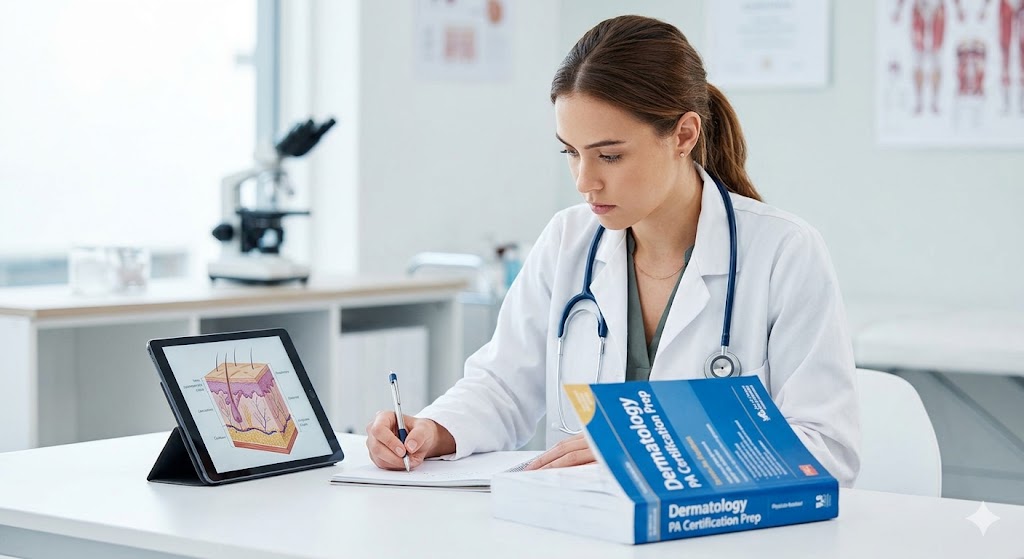
Additional Information
What the Course Entails and Exam Details
This comprehensive practice program covers the full spectrum of conditions encountered in a busy dermatology practice. The syllabus aligns closely with the dermatological components outlined in the NCCPA PANCE blueprint but provides additional depth for the specialty-focused clinician.
The core topics include:
Fundamentals of Dermatology: Detailed study of the anatomy and physiology of the skin, hair, and nails. You will master morphology terms, lesion descriptions, and the categorization of skin types.
Inflammatory and Autoimmune Disorders: In-depth review of prevalent conditions such as acne vulgaris, rosacea, psoriasis, atopic dermatitis (eczema), seborrheic dermatitis, and lichen planus.
Infectious Diseases: Diagnosis and management of bacterial (e.g., impetigo, cellulitis), viral (e.g., herpes, warts, molluscum), fungal (e.g., tinea infections), and parasitic (e.g., scabies, lice) skin diseases.
Benign and Malignant Neoplasms: Comprehensive coverage of common benign growths (seborrheic keratoses, nevi, cysts), precursor lesions (actinic keratoses), and non-melanoma skin cancers (basal cell carcinoma, squamous cell carcinoma), as well as a thorough focus on melanoma diagnosis, staging, and management.
Cutaneous Manifestations of Systemic Disease: Recognizing the skin signs of underlying conditions like diabetes, lupus, thyroid disorders, and vasculitis.
Dermatological Pharmacology: Mastery of topical and systemic treatments, including corticosteroids, retinoids, immunomodulators, and the latest biologic therapies, along with their side effects and monitoring requirements.
Diagnostic and Therapeutic Procedures: Understanding the indications, techniques, and interpretation of key procedures like skin biopsies, cryosurgery, potassium hydroxide (KOH) preps, and dermoscopy.
What to Expect in the Final Exam
While "Dermatology PANCE" refers to practice specifically focused on the dermatology content for PAs, students should anticipate a format modeled directly after the actual certifying exams (like the PANCE or CAQ specialty exam).
The practice exam typically consists of high-volume, computer-based, multiple-choice questions.
A heavy emphasis is placed on clinical vignettes, presenting real-world patient scenarios complete with history, physical findings, and often visual images (lesion photos) that require accurate diagnosis and management decisions.
You must be prepared to answer questions that assess your skills across the four NCCPA medical content categories: formulating a most likely diagnosis, health maintenance and patient education, pharmaceutical therapeutics, and applying scientific concepts.
Practice exams are usually timed, strictly mimicking the pacing required for the actual certification, which is necessary to build the speed and stamina needed on exam day.
A specific passing score for practice exams varies by the platform used, but you should aim for a benchmark significantly higher than the standard PANCE passing scaled score to ensure true readiness in this specialized area.
How to Study and Exam Centers
Effective preparation for this high-stakes specialty practice requires a strategic, multifaceted approach.
Visual Recognition Mastery: Dermatology is inherently visual. Spend significant time using medical atlases, reputable online databases, and flashcards focusing on high-quality images of every condition in the blueprint. Practice identifying the subtle differences between similar-appearing lesions.
Utilize Question Banks: Consistent practice with high-quality dermatology-specific Q-banks is essential. Analyze every question, understanding why the correct answer is right and why the distractors are wrong. This reinforces clinical reasoning and test-taking strategy.
Integrate Resources: Combine your PANCE prep books with specialized dermatology reference materials and current guidelines (such as those from the American Academy of Dermatology). Join professional organizations like the Society of Dermatology Physician Assistants (SDPA) to access their specific educational resources.
Spaced Repetition: Implement spaced repetition learning systems (like Anki) to commit the vast amount of medical information and pharmacological details to long-term memory.
Logistics of the Real Exam: While this is a study and practice regimen, the ultimate goal is the actual PANCE or a specialty certificate. The official PANCE is administered exclusively at authorized Pearson VUE testing centers located across the country. You must register through your NCCPA portal to schedule your exam at a physical testing center on a date of your choosing. For the practice exams themselves, these are typically completed in a simulated environment on online study platforms, not at brick-and-mortar testing centers.
Job Opportunities from the Course
Mastering this dermatology practice content significantly enhances your clinical readiness for the general PANCE and opens the door to lucrative and highly satisfying career paths. Specialized dermatology training is highly sought after in the healthcare market.
Pursuing this focused preparation prepares you for the following roles:
General Dermatology Physician Assistant: Working in private practice clinics, you will diagnose and treat a wide array of skin conditions, from acne and psoriasis to skin cancer screenings.
Cosmetic/Aesthetic Dermatology PA: Many practices offer a blend of clinical and cosmetic services. With enhanced knowledge, you can provide advanced treatments like laser therapies, chemical peels, and injectables (Botox, fillers).
Surgical Dermatology/Mohs Surgery First Assistant: PAs with strong dermatological backgrounds frequently assist in surgical procedures, including excisions and advanced reconstruction, or work specifically with Mohs micrographic surgeons.
Pediatric Dermatology PA: Specialize in treating skin conditions unique to children, from congenital anomalies to pediatric inflammatory disorders.
Academic or Research PA: Focus on teaching dermatology to PA students or conducting clinical trials and research on new dermatological treatments.
Frequently Asked Questions
Reviews
5.0
Based on 0 reviews
Leave a Review
No reviews yet. Be the first to review!