
Design and Manufacturing Lab (DML) Practice Exam
$69.00
- Buy to unlock unlimited access to all Quiz questions and Answers in this Quiz.
- After purchase you can print a PDF of the whole quiz at any point. The PDF will contain the questions and the correct answers.
About this Exam
Welcome to your essential preparation resource for the Design and Manufacturing Lab (DML) certification path.
This practice exam and study guide are meticulously designed for engineering students, vocational trainees, and manufacturing professionals seeking to validate their practical, hands-on competencies alongside foundational engineering theory.
The DML designation serves as a vital benchmark, proving to academic institutions and future employers that you possess the rigorous technical skills required to operate modern production machinery safely and effectively.
By mastering the concepts covered in this guide, you demonstrate your ability to bridge the gap between abstract, digital conceptualization and the physical creation of precision-engineered components.
It is an ideal resource for anyone looking to solidify their understanding of the modern product lifecycle and advance their career in advanced manufacturing sectors.
Ready to test your knowledge?
Buy Now to Access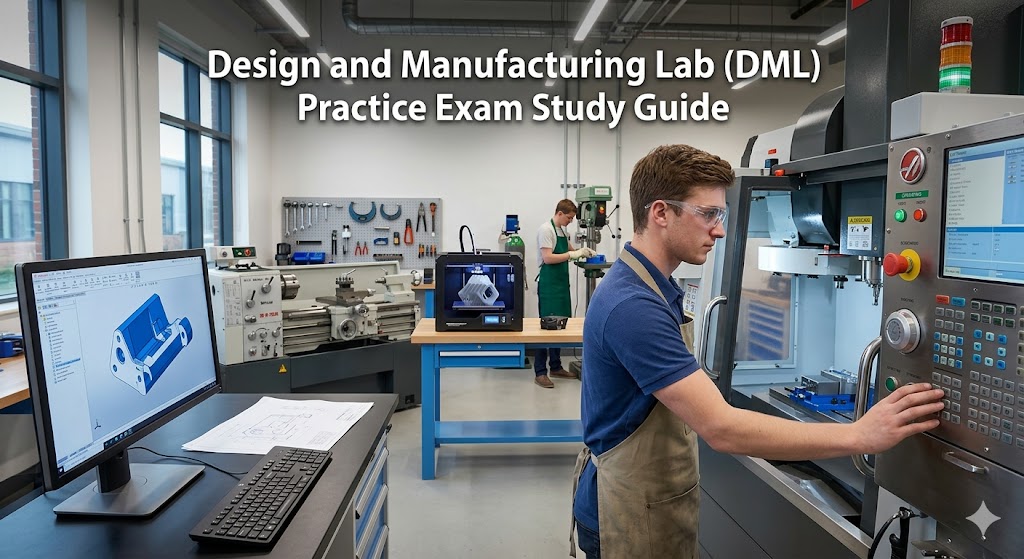
Additional Information
What the Course Entails and Exam Details
The course of study supporting the DML exam is an intensive, practical immersion into the core principles of modern design and production workflows.
It is structured to take you from a standardized engineering blueprint all the way to a finished, physical part, emphasizing both accuracy and efficiency.
Key curriculum areas usually include a deep dive into Computer-Aided Design (CAD) software proficiency and Computer-Aided Manufacturing (CAM) toolpath generation.
Furthermore, students receive rigorous training on foundational workshop equipment, mastering the operation of manual lathes and milling machines, and progressing to modern CNC (Computer Numerical Control) machining centers.
Crucial components of the syllabus also focus on Geometric Dimensioning and Tolerancing (GD&T) interpretation, comprehensive industrial safety protocols, material science fundamentals, and the use of precision metrology tools for quality control inspection.
What to Expect in the Final Exam
The Design and Manufacturing Lab final examination is famously comprehensive, structured to challenge your theoretical understanding as well as your operational dexterity.
You should prepare for a multi-stage evaluation process, which is often split over consecutive sessions to allow for both written and practical testing.
Part one typically involves a timed, computerized or written test focusing heavily on safety regulations, manufacturing formulas, blue print reading, material selection logic, and G-code/M-code programming basics.
Part two is the critical "hands-on" practical demonstration, performed directly in the lab environment.
You will be given a specific engineering drawing and raw material; you must independently set up the required machinery, select appropriate cutting tools, and produce the specified component to within the required tolerances—all while adhering strictly to a rigid time limit and passing all safety critical checks.
Passing scores generally hover around 70% for the theoretical section, but the practical section often requires a near-flawless performance regarding safety metrics to achieve a "Pass" grade.
How to Study and Exam Centers
Effective preparation for the DML exam requires a balanced approach, integrating rigorous theoretical study with repetitive, physical practice in the workshop.
First and foremost, treat the lab’s safety manual as mandatory daily reading; safety violations during the exam are the fastest way to receive an immediate failure.
You must gain extensive "machine time" before the test; schedule extra lab hours to practice standardized operations on the lathe, mill, and CNC machines until the setups become second nature.
Utilize practice exams extensively to simulate the timed pressure of the theoretical portion, focusing on the speed and accuracy of your manufacturing calculations.
Finally, familiarize yourself with the CAD/CAM software used by your certifying body, ensuring you can generate efficient, error-free toolpaths quickly.
The DML exam is typically administered at authorized physical testing centers, which are usually located within the engineering departments of accredited universities, technical colleges, or certified vocational-technical schools.
Consult your course syllabus or your instructor for direct links to schedule your exam slot at the specific designated lab facility associated with your training program.
Job Opportunities from the Course
Successfully navigating the DML course of study and passing the associated final exam unlocks numerous entry-level and mid-level career paths across diverse engineering and advanced manufacturing industries.
This certification serves as powerful evidence of your technical competence and job-readiness.
Earning this designation helps qualify you for roles such as:
Manufacturing Technician
CNC Operator / Programmer
CAD/CAM Technician
Prototype Specialist
Mechanical Engineering Technologist
Quality Control / Metrology Inspector
Product Design Assistant
Production Supervisor Trainee
Laboratory Instructor / Manager
Frequently Asked Questions
Reviews
5.0
Based on 0 reviews
Leave a Review
No reviews yet. Be the first to review!