
DHS U.S. Immigration and Customs Enforcement's (ICE) Enforcement and Removal Operations (ERO) Practice Test
$69.00
- Buy to unlock unlimited access to all Quiz questions and Answers in this Quiz.
- After purchase you can print a PDF of the whole quiz at any point. The PDF will contain the questions and the correct answers.
About this Exam
The [DHS U.S. Immigration and Customs Enforcement's (ICE) Enforcement and Removal Operations (ERO) Practice Test] serves as a comprehensive preparation guide for individuals seeking a career as a Deportation Officer within the ERO component of ICE. ERO is responsible for identifying, arresting, and removing aliens who present a danger to national security or a threat to public safety, as well as those who undermine the integrity of U.S. immigration laws. This study guide is designed for motivated candidates to prepare for the rigorous multi-stage hiring and assessment process required to secure this vital federal law enforcement position. Passing these assessments is a critical step in demonstrating the necessary logical reasoning, situational judgment, and physical capabilities.
Ready to test your knowledge?
Buy Now to Access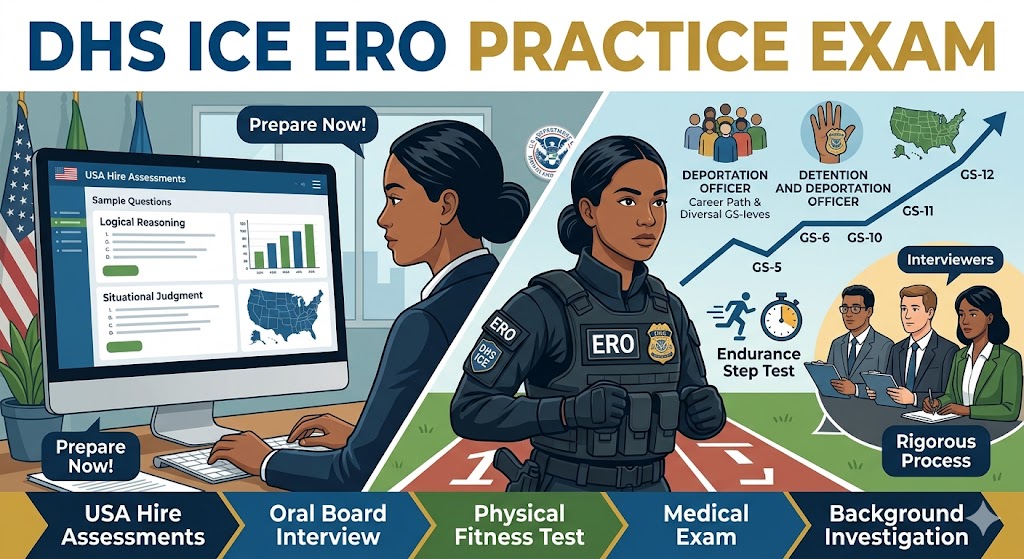
Additional Information
What the Course Entails and Exam Details
It is crucial to understand that there is not a single, static "practice test" for the ICE ERO Deportation Officer position. Instead, applicants must successfully navigate a sequential and challenging series of evaluations. The primary focus of your study and preparation should be on the following core components of the assessment process:
1. USA Hire Assessments: After an initial resume review, well-qualified applicants are often invited to complete online assessments. These may include tests for:
Logical Reasoning: Evaluating your ability to analyze complex information, identify patterns, and draw valid conclusions, often based on given paragraphs of information.
Situational Judgment: Assessing how you would respond to challenging, real-world scenarios likely to be encountered on the job.
Writing Skills: Measuring your ability to communicate clearly and effectively in a written format.
2. Oral Board Interview: A panel interview where ICE personnel will evaluate your communication skills, decision-making abilities, and suitability for a law enforcement role. You should prepare to answer situational and behavioral questions, often using the STAR method (Situation, Task, Action, Result).
3. Physical Fitness Test: Candidates must pass a demanding three-part fitness test, which typically includes:
Kneel/Stand Test: To assess flexibility and agility.
Push-ups: Measuring upper body strength.
Five-Minute Cardiovascular Endurance Step Test: A test of aerobic capacity and endurance.
4. Medical Examination: To ensure you meet the medical standards for a law enforcement position.
5. Background Investigation and Drug Test: A thorough vetting process, including security clearance and random drug testing. A polygraph exam may also be required for certain applicants.
What to Expect in the Final Exam
As this is not a single "exam," there is no unique final sit-down test. Instead, the final "exam" is the entire sequential process of evaluation. You must "pass" each stage to move on to the next.
For the physical fitness test, it is a binary pass/fail assessment; you must meet the minimum standard for every component. For the online assessments and the oral interview, your performance is scored to determine your ranking and suitability. It is important to know that while some parts of the hiring process, like a final job offer, are "tentative" until all pre-employment requirements (like the background check) are cleared, the assessments are definitive pass/fail or scored steps. Therefore, you should treat each step with the utmost importance and preparation.
How to Study and Exam Centers
Effective preparation requires a multifaceted approach focused on each critical assessment component:
Federal Resume and Interview Skills: Start by making sure your application is strong. Utilize resources on USAJOBS for "Federal Resume Training" to ensure you are effectively highlighting your relevant experience and qualifications. For the oral board, practice the STAR method for answering behavioral questions. Think of specific examples from your past experience that demonstrate critical skills.
Online Assessments: While specific "practice tests" may not be officially available, you can study logical reasoning and situational judgment concepts. Practice with generic examples of these types of questions. Reviewing a preparation manual for related federal law enforcement roles can provide insight into the types of logical reasoning required.
Physical Fitness: It is imperative that you train in advance for the specific components of the fitness test. Develop a workout routine that focuses on building endurance for the 5-minute step test, strengthening your upper body for push-ups, and improving your agility for the kneel/stand test. Consistent physical training is key to success.
Regarding exam centers, the process is blended:
Online Assessments: The USA Hire assessments are typically taken online. You will receive a unique URL and must ensure your computer system meets the technical requirements specified.
Physical Testing: The oral board interview, physical fitness test, and medical examination are held at specific physical locations, which are often federal buildings, ICE field offices, or authorized medical clinics. The exact location will be communicated to you by the hiring agency when you are scheduled for each step. There isn't a pre-defined set of Pearson VUE-like "centers" open for general registration.
Initial Training: Upon being hired, new Deportation Officers attend the 16-week ERO Basic Immigration Law Enforcement Training Program at the Federal Law Enforcement Training Center (FLETC) in Glynco, Georgia.
Job Opportunities from the Course
Successfully navigating the ICE ERO assessment process primarily unlocks opportunities for the following job titles:
Deportation Officer: This is the primary law enforcement position within ERO. The role involves identifying, locating, arresting, and processing aliens for removal, as well as managing detention and case logistics. These positions are often on a career ladder with promotion potential up to the GS-12 grade level.
Detention and Deportation Officer: Similar to the above, this role has a strong focus on the detention, management, and removal aspect of ERO operations. It also offers a distinct career ladder with opportunities for advancement.
Frequently Asked Questions
Reviews
5.0
Based on 0 reviews
Leave a Review
No reviews yet. Be the first to review!