
DIASS Social Work Practice Test
$69.00
- Buy to unlock unlimited access to all Quiz questions and Answers in this Quiz.
- After purchase you can print a PDF of the whole quiz at any point. The PDF will contain the questions and the correct answers.
About this Exam
The Disciplines and Ideas in the Applied Social Sciences (DIASS) subject in the Senior High School (SHS) curriculum of the Philippines introduces students to the practical application of social science theories.
Specifically, the Social Work module focuses on the profession dedicated to promoting social change, problem-solving in human relationships, and empowering individuals and communities to enhance their well-being.
This DIASS Social Work Practice Test is designed for Grade 12 Humanities and Social Sciences (HUMSS) students seeking to assess their understanding before their final examinations.
It is also an excellent tool for those considering pursuing a Bachelor of Science in Social Work (BSSW) and eventual licensure to become a registered social worker in the Philippines.
Ready to test your knowledge?
Buy Now to Access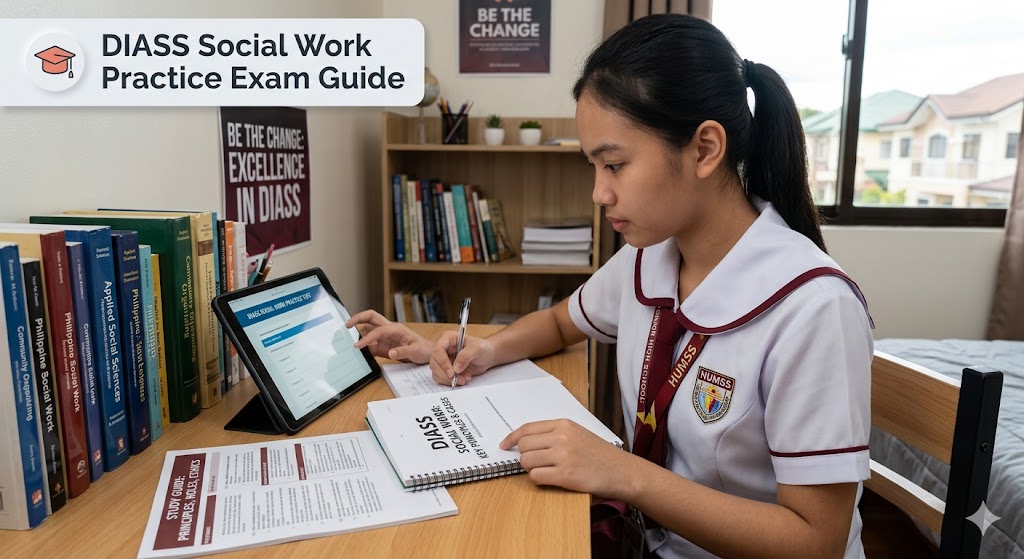
Additional Information
What the Course Entails and Exam Details
A comprehensive study of the DIASS Social Work component covers fundamental areas essential for understanding the field and its practice within the Philippine context.
Students must demonstrate comprehension of the core definition, goals, and broad scope of social work as a profession distinct from common-sense caring or charity.
The course delves deep into the inherent dignity of the human person, the importance of human relationships, integrity, and competence.
A significant portion is dedicated to the various roles, functions, and competencies of social workers, such as acting as a broker, advocate, educator, and case manager.
Furthermore, students learn about the settings of social work (e.g., medical, school, corrections, and community organizing) and the specific needs of diverse clientele, from individuals to whole communities.
Crucially, the curriculum includes a strong foundation in professional ethics, outlining the rights, responsibilities, and accountabilities of social workers.
What to Expect in the Final Exam
While actual school-based assessments may vary, a standard DIASS final exam is a multi-formatted test designed to measure both knowledge recall and higher-order thinking skills.
You should expect a combination of multiple-choice questions focusing on definitions, principles, and key concepts.
Identification and dichotomous choice (e.g., true or false) questions are common to test specific details about roles or ethical principles.
Analytical questions will require you to apply your knowledge to specific scenarios, such as determining the most appropriate social worker role or ethical action in a given case study.
Performance-based tasks, including short essays or case analyses, may also be included to assess your ability to synthesize information.
Passing requirements typically align with the standard 75% raw score minimum in Philippine SHS, although individual schools may set higher benchmarks.
How to Study and Exam Centers
Effective preparation for the DIASS Social Work Practice Test requires a dynamic study approach that goes beyond mere memorization.
Start by creating detailed concept maps that link the core principles, values, and settings of social work to specific practitioner roles and ethical considerations.
Practice with ethical scenario-based questions to sharpen your decision-making skills according to the Social Work Code of Ethics.
Make sure to review Philippine-specific contexts, including the functions of the Department of Social Welfare and Development (DSWD) and current social issues.
As this is a practice test to prepare you for your school’s actual final, you can find practice materials from your teachers, school learning management systems, or reputable online educational portals in the Philippines.
The final official exam is always administered within your authorized Senior High School during the designated examination week.
Job Opportunities from the Course
A strong performance in DIASS Social Work can lead to further studies in the field, unlocking numerous rewarding career paths dedicated to service and social justice.
Completing a Bachelor's degree and passing the licensure exam allows you to pursue careers as a:
Licensed Social Worker in government agencies, hospitals, and private non-governmental organizations (NGOs).
Community Organizer, working on grassroots projects to empower marginalized communities.
Medical Social Worker, assisting patients and families with the psychosocial aspects of illness.
School Social Worker, supporting students with behavioral, social, and emotional challenges.
Child Welfare and Development Specialist, focusing on child protection and adoptions.
Case Manager in rehabilitation centers or correctional facilities.
Social Welfare Policy Analyst, contributing to the development of better social laws and programs.
Corporate Social Responsibility (CSR) Officer, managing a company’s social and ethical programs.
Educator or Researcher in academic and research institutions focused on social issues.
Frequently Asked Questions
Reviews
5.0
Based on 0 reviews
Leave a Review
No reviews yet. Be the first to review!