
DIFS Funeral Pathology Practice Exam
$69.00
- Buy to unlock unlimited access to all Quiz questions and Answers in this Quiz.
- After purchase you can print a PDF of the whole quiz at any point. The PDF will contain the questions and the correct answers.
About this Exam
The DIFS Funeral Pathology examination is a critical certification component designed for individuals pursuing a career in the mortuary sciences, specifically those training to become licensed funeral directors or embalmers.
This specialized exam validates a candidate's comprehension of disease processes, cause-of-death determination, and the specific pathological conditions that impact dead body handling and preservation.
Pathology in a funeral service context isn't just about understanding disease; it is about public health safety, legal compliance, and the practical challenges faced during the embalming process.
By achieving this certification, candidates demonstrate they possess the essential medical knowledge required to ethically and safely manage human remains, protecting both themselves and the public from potential health hazards.
Ready to test your knowledge?
Buy Now to Access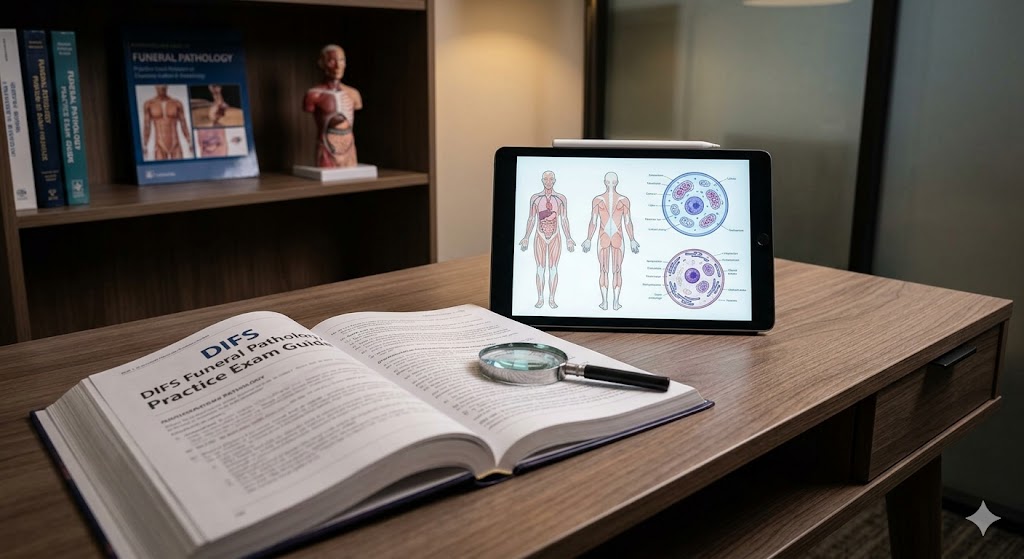
Additional Information
What the Course Entails and Exam Details
This comprehensive examination covers a wide array of topics that bridge the gap between medical pathology and mortuary science application.
The core syllabus is designed to ensure a robust understanding of how various diseases affect the human body before and after death.
Candidates must master the terminology of general pathology, including cellular reaction to injury, inflammation, and repair mechanisms.
A significant portion of the exam focuses on systemic pathology, detailing the diseases of the cardiovascular, respiratory, gastrointestinal, and nervous systems, with special emphasis on how these conditions complicate the embalming process.
Furthermore, the curriculum includes a vital focus on communicable diseases, understanding the chains of infection, and the rigid application of universal precautions within a funeral home environment.
Finally, the course addresses the principles of post-mortem chemistry, the physical and chemical changes that occur after death, and the variables affecting the rate of decomposition.
What to Expect in the Final Exam
The final examination is a rigorously monitored, computer-based test consisting of approximately 100 to 120 multiple-choice questions.
Candidates are typically allocated a time limit of two hours (120 minutes) to complete the exam.
The questions focus heavily on scenario-based applications, asking you to apply pathological knowledge to real-world funeral service situations.
A passing score of 75% or higher is generally required to achieve certification, though you should always confirm the exact threshold with the current administering body.
It is a closed-book exam; no reference materials, textbooks, or personal electronic devices are permitted in the testing area.
Rigorous security protocols, including identification verification and sometimes palm vein scanning, are standard procedure at the testing centers.
How to Study and Exam Centers
Successful preparation for the DIFS Funeral Pathology exam requires a structured and dedicated study plan.
A recommended strategy is to begin with a complete review of your primary mortuary pathology textbooks, paying close attention to glossary terms and chapter summaries.
Create detailed flashcards for medical terminology, specific diseases, and the embalming complications associated with each.
Taking the official DIFS Funeral Pathology Practice Exam repeatedly is highly encouraged, as it helps familiarize you with the question formatting and the required pacing.
Forming study groups with fellow students can also provide valuable peer support and facilitate the discussion of complex topics.
Regarding exam locations, this certification is generally administered at authorized professional testing centers.
Candidates typically register for their examination through an online portal managed by the state licensing board or a third-party testing service, such as Pearson VUE, which provides numerous physical testing locations nationally.
Some authorized mortuary science schools may also serve as designated testing sites for their students.
Job Opportunities from the Course
Achieving certification in Funeral Pathology opens several vital career paths within the bereavement care industry. This knowledge is essential for the following roles:
Licensed Embalmer
Funeral Director
Mortuary Science Educator
Pathologist's Assistant (in forensic or hospital settings, often requiring further specialized training)
Trade Embalmer (independent contractor)
Medical Examiner Transport/Investigator Aide
Frequently Asked Questions
Reviews
5.0
Based on 0 reviews
Leave a Review
No reviews yet. Be the first to review!