
Digital Design Practice Test
$69.00
- Buy to unlock unlimited access to all Quiz questions and Answers in this Quiz.
- After purchase you can print a PDF of the whole quiz at any point. The PDF will contain the questions and the correct answers.
About this Exam
The Digital Design Practice Test is an essential resource designed for aspiring visual communicators. It serves as a comprehensive simulation of a professional digital design certification exam. This practice environment is invaluable for students, entry-level designers, and career-changers aiming to validate their skills in fields like graphic design, user interface (UI) design, and general visual storytelling. By taking this test, candidates can assess their knowledge, identify critical areas for improvement, and become familiar with the structure and types of questions encountered in common industry certifications. Please note: This article describes typical elements of digital design exams and a corresponding practice test; specific certification details vary by provider (e.g., Adobe, Google UX, etc.), and students should always consult the official guidelines for their chosen exam.
Ready to test your knowledge?
Buy Now to Access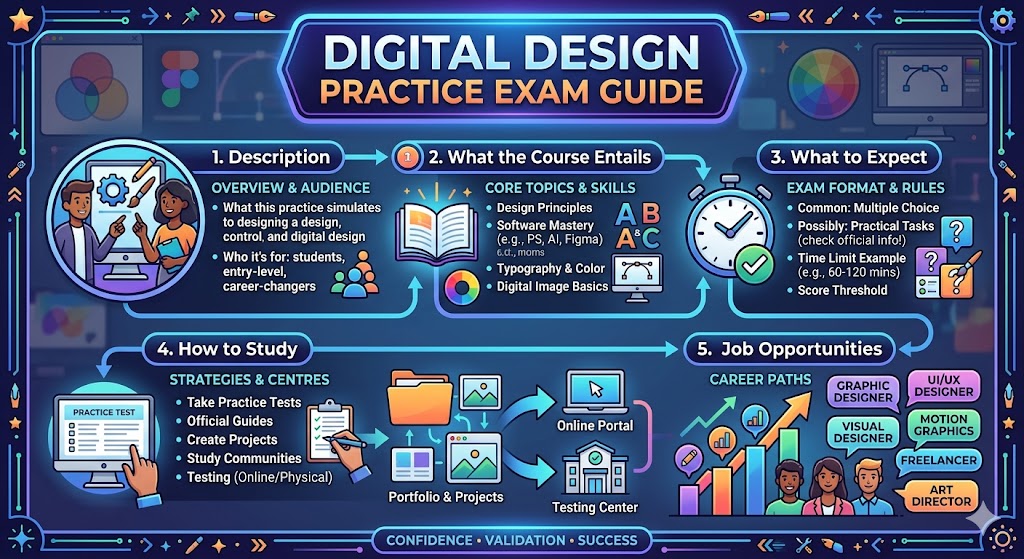
Additional Information
What the Course Entails and Exam Details
This practice test is structured to cover the core domains typically found in robust digital design courses and certification exams. These include, but are not limited to:
Design Fundamentals: Mastery of foundational principles such as balance, hierarchy, contrast, white space, and unity.
Software Proficiency: Practical and theoretical knowledge of industry-standard tools like Adobe Creative Cloud (Photoshop, Illustrator, InDesign), Figma, or similar platforms.
Typography & Color Theory: Understanding typefaces, kerning, leading, color modes (RGB vs. CMYK), color psychology, and color palettes.
Digital Image Handling: Differentiation between raster and vector graphics, proper file types (PNG, SVG, JPEG), resolution, and compression techniques.
Visual Communication: The ability to analyze project briefs, understand target audiences, and create effective visual layouts that convey specific messages.
UI/UX Basics: Introduction to user experience principles, wireframing, prototyping, and responsive design concepts.
What to Expect in the Final Exam
While specific exam formats depend entirely on the chosen certification provider, this practice test simulates common features:
Question Format: Primarily consists of multiple-choice questions (MCQs). Some advanced certifications may also incorporate performance-based or "live-in-the-app" tasks. This practice environment focuses heavily on MCQs to reinforce core knowledge.
Time Limit: Real exams are generally timed (e.g., 60 to 120 minutes for a full certification). Practice tests can often be taken in both timed and untimed modes to help you build both speed and accuracy.
Passing Score: The passing threshold varies but is typically around 70-80%. Use the practice test's scoring feedback to gauge your readiness.
Rules: Standard rules apply to the final exam (identification requirements, non-disclosure agreements, restricted materials). The practice test should be used in a simulated exam environment (quiet space, no aids) for maximum benefit.
How to Study and Exam Centers
Effective preparation for your actual certification exam involves more than just a practice test:
Utilize This Practice Test: Take the test multiple times. Review all answers, understanding not just the correct option but also why the other choices are incorrect. Focus on weak areas identified in your scores.
Official Resources: Prioritize study materials, exam objectives, and course guides from your specific certification vendor.
Practical Application: Create actual design projects. Apply the concepts you learn to build a strong portfolio – this reinforces practical skills.
Study Guides & Communities: Access textbooks, online tutorials, and design forums to broaden your understanding and learn best practices.
Testing Information: Your final certification exam will be taken through authorized channels.
Online Portals: Many certifications now offer proctored online exams that you can take from home.
Physical Testing Centers: Established centers like Pearson VUE, Certiport (for Adobe), or authorized local schools and training facilities often host these exams. Always check your specific certification provider for their approved testing methods and locations.
Job Opportunities from the Course
A recognized digital design certification, along with a solid portfolio, opens doors to a variety of exciting career paths across countless industries:
Graphic Designer: Creating visual concepts by hand or using software for logos, websites, brochures, and marketing materials.
UI/UX Designer (Junior/Entry-Level): Designing the layout and user experience of websites, apps, and software interfaces.
Visual Designer: Focusing specifically on the aesthetic elements of a product, from color and typography to overall artistic direction.
Motion Graphics Artist: Creating animations and visual effects for videos, television, and film.
Web Designer: Specifically focusing on the design, layout, and often basic coding of websites.
Art Director (Longer-Term Path): Overseeing the artistic aspect of film, television, magazines, and other visual media.
Freelance Designer: Managing your own clients and projects in any of the above capacities.Here is your comprehensive study guide, SEO-optimized and structured exactly as requested. A vibrant and informative infographic has also been generated to accompany your article.
Digital Design Practice Exam Guide
1. Description
The Digital Design Practice Test is an essential resource designed for aspiring visual communicators. It serves as a comprehensive simulation of a professional digital design certification exam. This practice environment is invaluable for students, entry-level designers, and career-changers aiming to validate their skills in fields like graphic design, user interface (UI) design, and general visual storytelling. By taking this test, candidates can assess their knowledge, identify critical areas for improvement, and become familiar with the structure and types of questions encountered in common industry certifications.
Please note: This article describes typical elements of digital design exams and a corresponding practice test; specific certification details vary by provider (e.g., Adobe, Google UX, etc.), and students should always consult the official guidelines for their chosen exam.
2. What the Course Entails and Exam Details
This practice test is structured to cover the core domains typically found in robust digital design courses and certification exams. These include, but are not limited to:
Design Fundamentals: Mastery of foundational principles such as balance, hierarchy, contrast, white space, and unity.
Software Proficiency: Practical and theoretical knowledge of industry-standard tools like Adobe Creative Cloud (Photoshop, Illustrator, InDesign), Figma, or similar platforms.
Typography & Color Theory: Understanding typefaces, kerning, leading, color modes (RGB vs. CMYK), color psychology, and color palettes.
Digital Image Handling: Differentiation between raster and vector graphics, proper file types (PNG, SVG, JPEG), resolution, and compression techniques.
Visual Communication: The ability to analyze project briefs, understand target audiences, and create effective visual layouts that convey specific messages.
UI/UX Basics: Introduction to user experience principles, wireframing, prototyping, and responsive design concepts.
3. What to Expect in the Final Exam
While specific exam formats depend entirely on the chosen certification provider, this practice test simulates common features:
Question Format: Primarily consists of multiple-choice questions (MCQs). Some advanced certifications may also incorporate performance-based or "live-in-the-app" tasks. This practice environment focuses heavily on MCQs to reinforce core knowledge.
Time Limit: Real exams are generally timed (e.g., 60 to 120 minutes for a full certification). Practice tests can often be taken in both timed and untimed modes to help you build both speed and accuracy.
Passing Score: The passing threshold varies but is typically around 70-80%. Use the practice test's scoring feedback to gauge your readiness.
Rules: Standard rules apply to the final exam (identification requirements, non-disclosure agreements, restricted materials). The practice test should be used in a simulated exam environment (quiet space, no aids) for maximum benefit.
4. How to Study and Exam Centers
Effective preparation for your actual certification exam involves more than just a practice test:
Utilize This Practice Test: Take the test multiple times. Review all answers, understanding not just the correct option but also why the other choices are incorrect. Focus on weak areas identified in your scores.
Official Resources: Prioritize study materials, exam objectives, and course guides from your specific certification vendor.
Practical Application: Create actual design projects. Apply the concepts you learn to build a strong portfolio – this reinforces practical skills.
Study Guides & Communities: Access textbooks, online tutorials, and design forums to broaden your understanding and learn best practices.
Testing Information: Your final certification exam will be taken through authorized channels.
Online Portals: Many certifications now offer proctored online exams that you can take from home.
Physical Testing Centers: Established centers like Pearson VUE, Certiport (for Adobe), or authorized local schools and training facilities often host these exams. Always check your specific certification provider for their approved testing methods and locations.
5. Job Opportunities from the Course
A recognized digital design certification, along with a solid portfolio, opens doors to a variety of exciting career paths across countless industries:
Graphic Designer: Creating visual concepts by hand or using software for logos, websites, brochures, and marketing materials.
UI/UX Designer (Junior/Entry-Level): Designing the layout and user experience of websites, apps, and software interfaces.
Visual Designer: Focusing specifically on the aesthetic elements of a product, from color and typography to overall artistic direction.
Motion Graphics Artist: Creating animations and visual effects for videos, television, and film.
Web Designer: Specifically focusing on the design, layout, and often basic coding of websites.
Art Director (Longer-Term Path): Overseeing the artistic aspect of film, television, magazines, and other visual media.
Freelance Designer: Managing your own clients and projects in any of the above capacities.
Frequently Asked Questions
Reviews
5.0
Based on 0 reviews
Leave a Review
No reviews yet. Be the first to review!