
Digital Electronics Level I Practice Test
$69.00
- Buy to unlock unlimited access to all Quiz questions and Answers in this Quiz.
- After purchase you can print a PDF of the whole quiz at any point. The PDF will contain the questions and the correct answers.
About this Exam
Digital electronics form the core foundation of modern computing and information technology. The Digital Electronics Level I Practice Test is a comprehensive assessment tool designed to evaluate foundational understanding in fundamental electronic concepts. This exam is ideal for students, aspiring technicians, and hobbyists looking to validate their knowledge before advancing in the electronics or computer engineering fields. This practice assessment prepares individuals for entry-level technician roles and acts as a gateway to more advanced digital systems certifications.
Ready to test your knowledge?
Buy Now to Access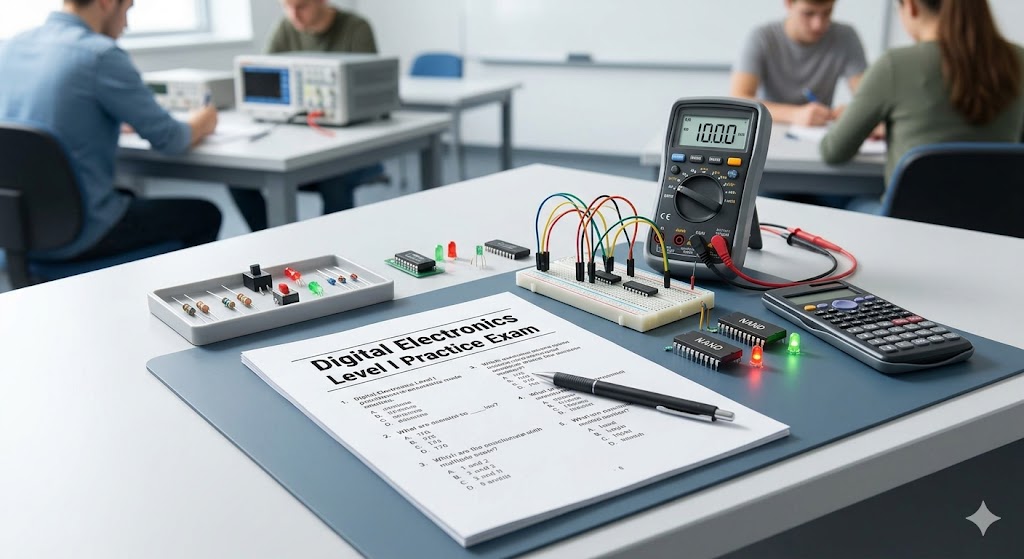
Additional Information
What the Course Entails and Exam Details
Preparing for this practice exam requires a solid grasp of the building blocks of digital logic. Key areas typically covered include the binary number system, hexadecimal notation, and logic gate operations (AND, OR, NOT, NAND, NOR, XOR, XNOR). Additionally, candidates must demonstrate a strong understanding of Boolean algebra, simplifying complex expressions, and analyzing combinatorial logic circuits. Standard digital functions, including encoders, decoders, multiplexers, and fundamental sequential logic like basic flip-flops, are also critical topics.
What to Expect in the Final Exam
This practice test is structured to mirror the format of actual industry certifications in digital systems. Expect a series of multiple-choice questions designed to test both theoretical understanding and application skills. The test is typically timed, requiring candidates to answer approximately 50 to 70 questions within a set window, such as 60 to 90 minutes. While individual institutions vary, a common passing score usually falls within the 70% to 75% range. Focus, time management, and a strong analytical approach are necessary to succeed.
How to Study and Exam Centers
Effective study begins with thorough review of standard digital electronics textbooks and comprehensive online courses. Utilize circuit simulation software to build and test logic circuits; this practical application is crucial for reinforcing theoretical concepts. Focus extensively on memorizing truth tables and mastering Boolean algebraic simplifications. Taking multiple timed practice exams like this one is the best way to assess your readiness and identify weak areas.
For the final certification, testing often takes place through established educational institutions, technical colleges, or standardized testing centers like Pearson VUE. Candidates might also access the exam via specific online portals designated by the certifying body. Always confirm the exact testing center location, fees, and online delivery requirements with your specific program coordinator or the governing organization.
Job Opportunities from the Course
Earning a foundational digital electronics certification opens doors to several entry-level technical roles in a variety of fields. Common job opportunities include:
Electronics Technician
Test and Measurement Technician
Digital Systems Assembler
Computer Maintenance Specialist
Field Service Representative
Junior Production Technician
Drafter for Digital Systems
Frequently Asked Questions
Reviews
5.0
Based on 0 reviews
Leave a Review
No reviews yet. Be the first to review!