
Digital Forensics, Investigation, and Response Practice Test
$69.00
- Buy to unlock unlimited access to all Quiz questions and Answers in this Quiz.
- After purchase you can print a PDF of the whole quiz at any point. The PDF will contain the questions and the correct answers.
About this Exam
The Digital Forensics, Investigation, and Response Practice Test is a crucial step in preparing for a professional certification that validates your knowledge and practical skills in the highly specialized fields of digital forensics and incident response (DFIR).
This practice test is designed for information technology and cybersecurity professionals, including security analysts, incident responders, law enforcement officers, forensic investigators, and IT auditors, who want to demonstrate and validate their proficiency in handling and analyzing digital evidence and responding to security incidents effectively.
The overarching goal is to prepare individuals for the real-world challenges of identifying, preserving, analyzing, and presenting digital evidence, and for coordinating a structured response to cyber attacks. This practice test likely mirrors the content and structure of industry-recognized certifications, helping you identify areas where you need more study and build confidence for the final assessment.
Ready to test your knowledge?
Buy Now to Access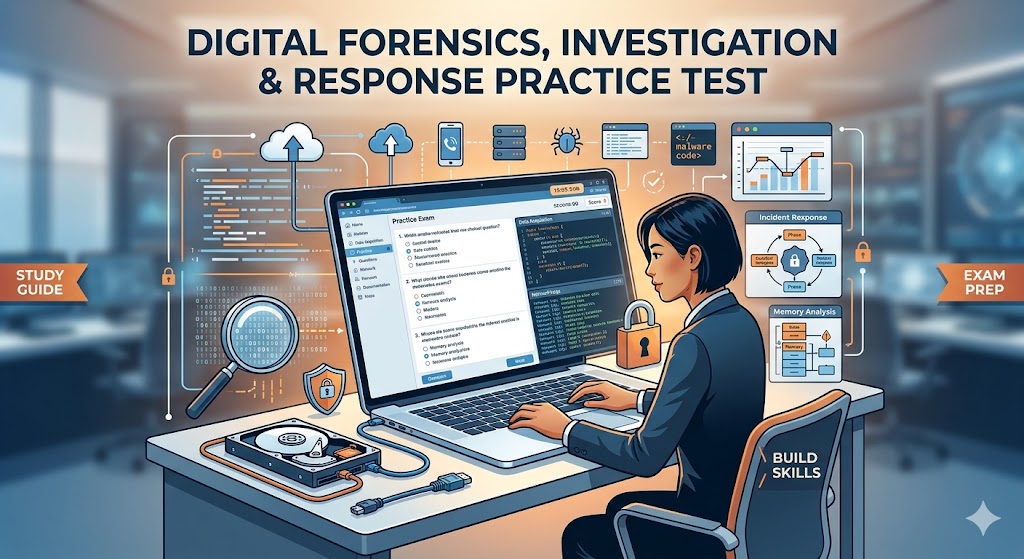
Additional Information
What the Course Entails and Exam Details
This comprehensive course and the accompanying practice test are typically structured around several core domains. Expect rigorous coverage of the entire investigation and response lifecycle:
Digital Forensics Fundamentals: Principles of forensic science, the importance of chain of custody, legal and ethical considerations, and standard investigation methodologies.
Evidence Acquisition and Preservation: Techniques for collecting volatile and non-volatile data from various sources (endpoints, servers, network devices, and potentially mobile and cloud platforms) using write-blocking technology and proper imaging procedures.
Endpoint Analysis: Advanced investigative techniques for major operating systems (e.g., Windows, Linux). Topics include analyzing file systems, registry keys, event logs, prefetch files, and other system artifacts to reconstruct user activity and attacker behavior.
Network Forensics: Capturing and analyzing network traffic using tools like Wireshark and Zeek. Understanding how to identify malicious activity, command and control (C2) communication, and data exfiltration patterns.
Memory Forensics: Techniques for analyzing volatile memory (RAM) using frameworks like Volatility. Topics include extracting process information, open network connections, and uncovering rootkits and fileless malware.
Malware Analysis Basics: Basic static and dynamic analysis of potentially malicious files to understand their functionality, identify indicators of compromise (IoCs), and determine their intent.
Incident Response: Structured approach to handling security incidents. This includes preparation, identification, containment, eradication, recovery, and lessons learned. The exam likely assesses your ability to integrate forensic investigation into the broader response process.
What to Expect in the Final Exam
While the format of the final certification exam may vary depending on the specific granting body, here is a general overview of what you should expect from a rigorous DFIR-focused exam and what a comprehensive practice test will likely prepare you for:
Exam Format: A combination of multiple-choice questions, scenario-based questions, and hands-on practical exercises or lab simulations. The practical portion is usually a significant differentiator for DFIR certifications, requiring you to use forensic tools to analyze provided evidence sets and find answers.
Time Limits: These are intensive exams, and time is often limited. You can expect a multi-hour exam, often ranging from 3 to 5 hours, depending on the number of questions and practical challenges. Practice tests are designed to help you build stamina and manage your time effectively.
Passing Score: The passing score will be a percentage defined by the certification body (e.g., typically between 70% and 80%). High-quality practice tests will provide scored feedback to let you know if you are meeting the standard.
Special Rules: Certification exams are generally proctored, either in person at a testing center or remotely. They often follow strict code of conduct and nondisclosure agreements. You are typically allowed only approved materials (which may be very minimal or include access to a specialized virtual lab environment for practical parts). Practice tests will simulate these conditions to the extent possible.
How to Study and Exam Centers
Actionable Study Strategies:
Deep-Dive into Theory: Thoroughly study the course materials, textbooks, and related industry resources. Understand the definitions, steps, legal requirements, and scientific principles behind forensic procedures and incident response phases.
Focus on the Practical (Hands-on is Key): Use a robust virtual lab environment to practice acquisition, analysis, and response tasks. Familiarize yourself with standard open-source and potentially commercial forensic tools (e.g., FTK Imager, Autopsy, Sleuth Kit, Wireshark, Volatility, Eric Zimmermann's tools). Solve Capture The Flag (CTF) challenges focused on DFIR.
Utilize Comprehensive Practice Tests (like this one): Take this practice test multiple times. Pay close attention to the explanations for both correct and incorrect answers to understand the why behind each question. Use the results to pinpoint your weak areas and revisit those topics.
Practice Time Management: During your practice, simulate exam conditions. Set a timer, minimize distractions, and work through the questions and practical exercises efficiently.
Review Real-World Reports and Write-ups: Read detailed DFIR investigation write-ups and threat intelligence reports to understand how professional investigators structure their work and present their findings.
Exam Centers and Registration:
The primary certification exams that this practice test prepares you for (e.g., from organizations like SANS/GIAC, CompTIA, EC-Council, IACIS, or platform-specific certs) are usually proctored. You can typically register and take them through:
Authorized Physical Testing Centers: Many certifications utilize large test center networks, such as Pearson VUE, allowing you to schedule your exam at a local center in major cities worldwide.
Remote Proctoring: Increasingly, certifications offer the option to take the exam remotely from your own computer, subject to strict proctoring guidelines (using a webcam, screen monitoring, etc.).
Authorized Schools or Training Providers: Sometimes, exams are offered directly through the educational institution or commercial training provider that delivered the preparatory course. Check with the official certification body or your training provider for the most current information and precise registration procedures for the final exam.
Job Opportunities from the Course
A certification in Digital Forensics, Investigation, and Response, validated by rigorous practice and testing, unlocks a wide array of career paths and opens doors to exciting and in-demand roles. Here are some of the specific job opportunities:
Digital Forensic Analyst: Specializing in the identification, extraction, and analysis of digital evidence from computer systems and storage devices to support legal and corporate investigations.
Incident Response Specialist: Acting as a first responder to security incidents, analyzing the nature and scope of a breach, coordinating containment and eradication efforts, and restoring systems.
Cybersecurity Investigator: Working within larger organizations or law enforcement to investigate cybercrimes, policy violations, and advanced persistent threats (APTs).
Malware Analyst: Focusing on reverse-engineering and analyzing malicious software to understand its behavior, origin, and potential impact.
Security Operations Center (SOC) Analyst (Advanced): Tier 2 or 3 SOC analysts with DFIR skills can handle and escalate complex incidents, perform deeper analysis, and participate in threat hunting.
Threat Hunter: Actively searching for and analyzing potential, undetected threats within a network environment.
eDiscovery Specialist: Managing the identification, preservation, collection, and analysis of electronically stored information (ESI) for legal and corporate compliance purposes.
Forensic Consultant: Providing expert forensic analysis and incident response services to clients on a contract basis, or serving as an expert witness in legal proceedings.
Frequently Asked Questions
Reviews
5.0
Based on 0 reviews
Leave a Review
No reviews yet. Be the first to review!