
Disaster Planning Adaptive Practice Test
$69.00
- Buy to unlock unlimited access to all Quiz questions and Answers in this Quiz.
- After purchase you can print a PDF of the whole quiz at any point. The PDF will contain the questions and the correct answers.
About this Exam
The Disaster Planning Adaptive Practice Test is an essential tool designed for professionals dedicated to safeguarding an organization’s critical operations during unforeseen crises. This adaptive practice exam serves as a comprehensive diagnostic, mimicking the difficulty and format of high-stakes certification assessments in the fields of Business Continuity Management (BCM), Disaster Recovery (DR), and Emergency Management.
This tool is specifically designed for a wide range of professionals, including IT managers, business continuity planners, risk managers, facilities coordinators, HR professionals, and operations leaders. It is intended for individuals who are actively preparing for standardized exams such as the Certified Business Continuity Professional (CBCP) from DRII, the Associate Member of the BCI (AMBCI), or other accredited disaster resilience certifications. Whether you are aiming to benchmark your current knowledge or identify critical gaps before your final exam day, this practice test offers a dynamic learning experience that focuses on practical, standard-based preparedness.
Ready to test your knowledge?
Buy Now to Access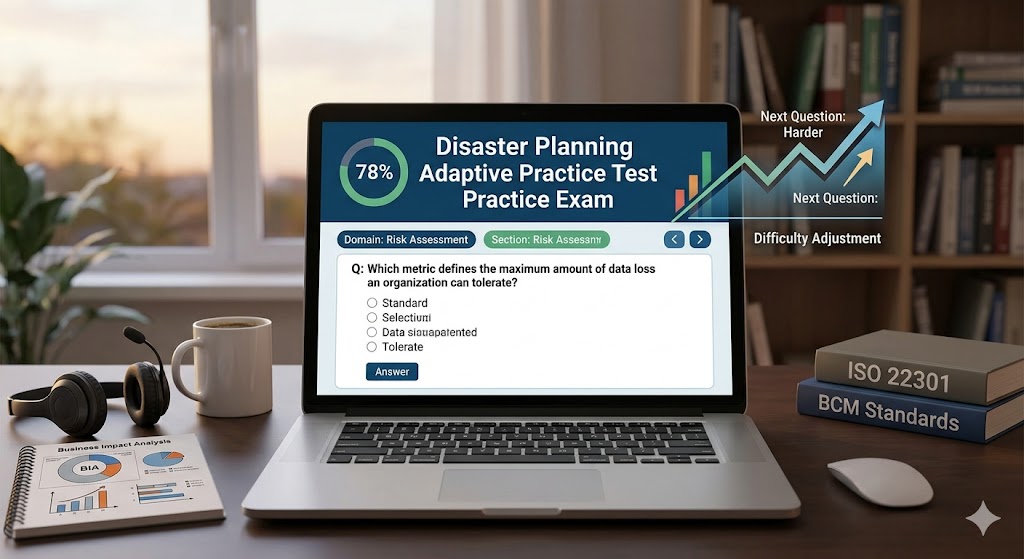
Additional Information
What the Course Entails and Exam Details
While the specific curriculum may depend on the final certification body you are targeting, this practice test covers the canonical body of knowledge recognized across global disaster planning standards, including ISO 22301 and NFPA 1600. The underlying course material focuses on developing the skills needed to design, implement, test, and maintain robust resilience plans.
Core topics you can expect to master through this adaptive learning path include:
Risk Assessment and Hazard Vulnerability Analysis (HVA): Identifying potential threats—from cyberattacks and natural disasters to supply chain disruptions—and assessing their likelihood and impact.
Business Impact Analysis (BIA): Determining critical business functions, recovery time objectives (RTOs), and recovery point objectives (RPOs) necessary for prioritizing resource allocation.
Plan Development and Implementation: Creating detailed Business Continuity Plans (BCPs), Disaster Recovery Plans (DRPs), and Crisis Communication Plans.
Testing, Exercises, and Maintenance: Designing effective drills—such as tabletop exercises, functional tests, and full-scale simulations—to validate plan effectiveness.
Incident Command and Crisis Management: Establishing leadership structures, communication protocols, and decision-making processes for effective crisis response.
Training and Awareness: Development of programs to ensure all organizational stakeholders are aware of their roles during a disruption.
What to Expect in the Final Exam
As an adaptive practice test, the format is designed to simulate the intelligence of a computer-adaptive testing (CAT) system. This means the difficulty of the questions adjusts based on your performance; answering correctly prompts more challenging questions, while answering incorrectly provides a slightly easier question to gauge your knowledge boundary precisely. This format maximizes learning efficiency by focusing your effort where you need it most.
A final, standardized exam that this test prepares you for typically adheres to the following parameters:
Format: Multiple-choice questions that require the application of concepts to scenario-based problems.
Adaptive Nature: The total number of questions might vary based on how quickly the algorithm determines your competency level (e.g., ranging from 100 to 200 questions).
Time Limit: Usually structured with a generous time allowance (often 2–4 hours) because the exam focuses on comprehension rather than speed.
Passing Score: Standardized scores are generally reported rather than a raw percentage. For instance, you may need a score of 700 out of 1000 to pass.
Immediate Feedback: Upon completing the practice exam, you will usually receive a detailed score report breaking down your performance across the core domains, helping you structure your subsequent study sessions.
How to Study and Exam Centers
Preparation for a standardized disaster planning certification requires a blended approach of theoretical knowledge and practical application.
Actionable Study Strategies:
Utilize Active Recall: Don't just read standards like ISO 22301; summarize them from memory. Create flashcards for critical definitions like RTO, RPOs, and Maximum Tolerable Period of Disruption (MTPD).
Engage with Scenario-Based Practice: Focus heavily on practice questions that ask "What would you do first?" or "Which action is most appropriate?" The final exam will test your judgment, not just your memorization.
Review Global Standards: Download and study the free executive summaries or guidelines of major standards like NFPA 1600, ISO 22301, and the DRI International Professional Practices.
Participate in Tabletop Simulations: If possible, volunteer for your own organization's BCP drills. Nothing solidifies theoretical knowledge like seeing a plan fail (and succeed) in a simulated environment.
How and Where to Take the Exam:
Because this is a practice test, it is universally accessible via standard web browsers through designated educational portals and learning management systems. Unlike the final certification exam, it does not require visiting a physical testing center or scheduling an appointment with a proctor. You can take this adaptive practice test from the comfort of your home or office at any time that suits your study schedule. Upon purchasing access, you will be given credentials to log in to the secure testing platform, where you can take the exam multiple times to measure your improvement.
Job Opportunities from the Course
Earning a standardized certification in disaster planning greatly enhances your career trajectory and marketability across virtually all industries, including finance, healthcare, government, manufacturing, and technology. Organizations globally are investing heavily in resilience to minimize the financial and reputational impact of disruptions.
Career paths this preparation unlocks include:
Business Continuity Manager
Disaster Recovery Specialist
Emergency Management Coordinator
Resilience Officer
IT DR/BC Specialist
Operations Manager (with a Focus on Resilience)
Risk Management Analyst (BCM Focus)
Corporate Security Manager
Crisis Management Lead
Frequently Asked Questions
Reviews
5.0
Based on 0 reviews
Leave a Review
No reviews yet. Be the first to review!