
Diseases of the Forestomachs Practice Test
$69.00
- Buy to unlock unlimited access to all Quiz questions and Answers in this Quiz.
- After purchase you can print a PDF of the whole quiz at any point. The PDF will contain the questions and the correct answers.
About this Exam
The Diseases of the Forestomachs Practice Exam is a comprehensive diagnostic tool designed for students, veterinary technicians, and aspiring veterinarians aiming to master the complex pathology of ruminant digestion. This exam module specifically targets the critical health challenges that affect the four-compartment stomach system—the rumen, reticulum, omasum, and abomasum—which are vital to the health and economic productivity of livestock such as cattle, sheep, and goats.
Whether you are preparing for a licensing board, a specialized certification, or a final course exam, this practice test provides an authentic simulation of the rigorous questioning you will face in the field of large animal medicine.
Ready to test your knowledge?
Buy Now to Access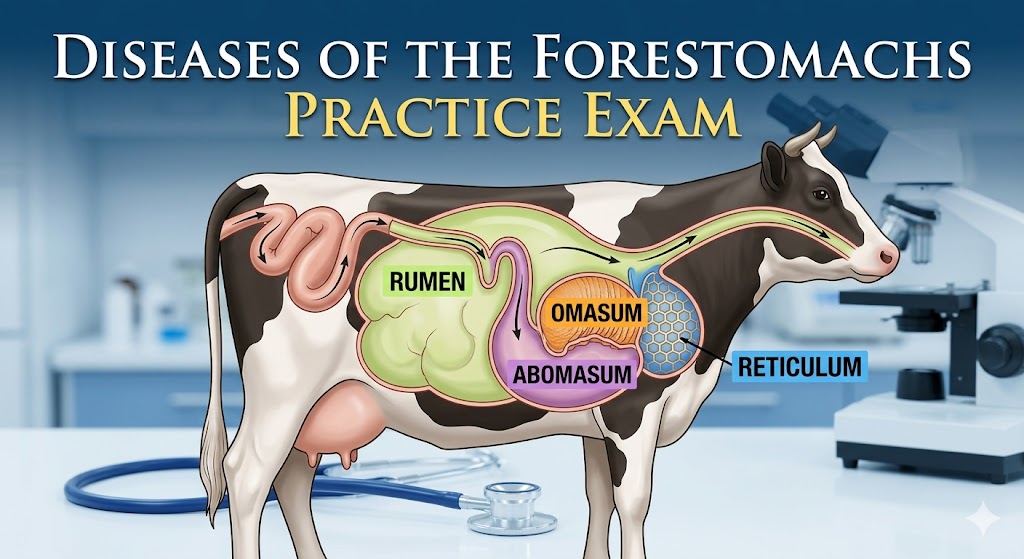
Additional Information
What the Course Entails and Exam Details
This specialized topic validates a candidate's ability to diagnose, treat, and manage disorders within the forestomachs. Mastery of this content requires a deep understanding of standard anatomy, microbial fermentation physiology, and the pathophysiology of common ailments.
Key topics covered within the practice exam typically include:
Ruminant Anatomy and Physiology: The normal structure and microbial ecosystem of the rumen, reticulum, omasum, and abomasum.
Acid-Base and Fermentation Disorders: Diagnosis and management of Acute Ruminal Acidosis (grain overload) and Simple Indigestion.
Motility and Physical Disorders: Identification of Vagus Indigestion types, Bloat (Tympany), Omasal Impaction, and Abomasal Displacements (LDA/RDA).
Infectious and Traumatic Diseases: Recognizing clinical signs and treatments for Traumatic Reticuloperitonitis (Hardware Disease) and Rumenitis.
Diagnostic Techniques: Interpreting results from rumen fluid analysis, auscultation, percussion, and ultrasonography.
What to Expect in the Final Exam
While individual testing institutions vary, a standard professional-level exam on this subject matter usually takes a computer-based, objective format. A official exam is highly rigorous, designed not just to test recall, but to evaluate clinical reasoning.
Candidates should generally expect:
Exam Format: 100–150 multiple-choice questions (MCQs), including several complex, case-based scenarios that require integrating clinical signs with diagnostic data to reach a diagnosis.
Time Limit: 2 to 3 hours is common, demanding efficient time management.
Passing Score: Standard professional certifications often require a scaled score of 70% or higher.
Specific Rules: Standardized testing protocols apply. No outside study materials are permitted, and the use of basic calculators may be restricted to specific sections.
How to Study and Exam Centers
Effective preparation for the Diseases of the Forestomachs Practice Exam demands an active, multi-faceted approach. You cannot rely on passive reading.
We recommend the following strategies:
Utilize Interactive Study Guides: Use dynamic pathology flowcharts to visualize the progression of diseases like acute acidosis and hardware disease.
Practice Diagnostic Scenarios: Dedicate time to case-based study where you must identify a disease based solely on clinical signs, history, and fluid analysis data.
Master Visual Anatomy: Familiarize yourself with diagrams showing normal anatomy versus the visual presentation of conditions like displaced abomasum or ruminal tympany.
Where to Take the Exam
Because this subject is usually a component of a larger veterinary or agricultural certification, the "final" exam locations depend on your governing body (e.g., the NBVME for veterinarians or a state agricultural board for certain technical certifications). Practice exams are typically accessed through:
Proprietary Online Portals: Licensed by veterinary schools or educational companies.
Authorized School Testing Centers: If part of a formal university or college curriculum.
Job Opportunities from the Course
Mastery of this subject matter is foundational for many lucrative and impactful careers in the agricultural and veterinary sectors. It unlocks specialized roles that are in high demand, particularly in rural and livestock-heavy regions.
The specific job opportunities unlocked by this knowledge include:
Licensed Veterinarian (Large Animal)
Veterinary Technician (Livestock Specialization)
Ruminant Nutritionist
Livestock Manager / Farm Superintendent
Animal Health Sales Representative
Agricultural Extension Agent
Veterinary Diagnostic Laboratory Technologist
Animal Welfare Inspector
Frequently Asked Questions
Reviews
5.0
Based on 0 reviews
Leave a Review
No reviews yet. Be the first to review!