
Dispensing LP-Gas Safely in Texas Practice Test
$69.00
- Buy to unlock unlimited access to all Quiz questions and Answers in this Quiz.
- After purchase you can print a PDF of the whole quiz at any point. The PDF will contain the questions and the correct answers.
About this Exam
Obtaining your certification to dispense liquefied petroleum gas is a crucial step for professionals working with propane across the state.
This certification is mandated by the Railroad Commission of Texas (RRC) to ensure that all handlers thoroughly understand the safety protocols required to prevent accidents and protect the public.
The Dispensing LP-Gas Safely in Texas certification is specifically designed for employees at hardware stores, RV parks, gas stations, and dedicated propane dealerships.
Whether you are filling DOT portable cylinders for barbecue grills or refueling ASME motor fuel containers, this exam ensures you are fully competent and legally compliant to perform your duties safely.
Ready to test your knowledge?
Buy Now to Access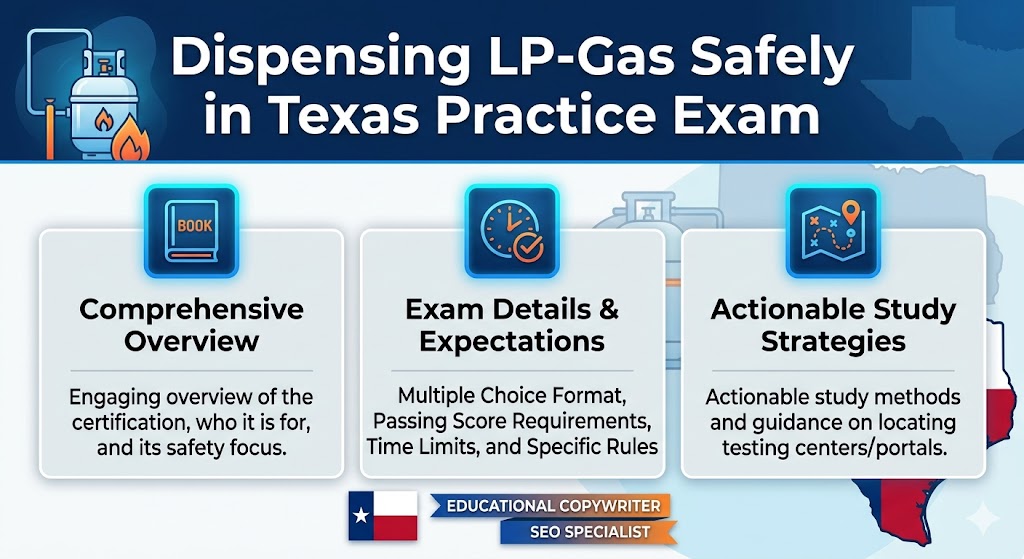
Additional Information
What the Course Entails and Exam Details
The coursework leading up to this exam is highly focused on hazard prevention and regulatory compliance.
Students will dive into the unique chemical and physical properties of LP-Gas, learning how temperature and pressure affect the liquid and vapor states of propane.
A major portion of the syllabus covers the meticulous, step-by-step filling procedures required for both DOT cylinders and ASME tanks.
Furthermore, the course entails comprehensive training on conducting visual inspections.
You will learn how to identify outdated, damaged, or illegally modified cylinders that must be rejected prior to filling.
The syllabus also encompasses emergency response procedures, safe storage requirements, and an in-depth review of the Texas Railroad Commission’s strict rules regarding LP-Gas handling.
What to Expect in the Final Exam
When you sit down for the final RRC examination, you can expect a rigorous but straightforward assessment of your safety knowledge.
The exam format is multiple-choice, designed to test both your recall of Texas regulations and your practical understanding of safe dispensing procedures.
To successfully earn your certification, candidates are typically required to achieve a passing score of 75% or higher.
The exam usually imposes a strict time limit, frequently set around two hours, which is more than enough time for well-prepared students to carefully read and answer each question.
Depending on the specific tier of the RRC exam you are taking, it is generally administered as a closed-book test, meaning you cannot bring outside notes or reference manuals into the testing area.
How to Study and Exam Centers
Success on this exam requires consistent study and familiarization with official state guidelines.
Your primary study strategy should revolve around reading the Railroad Commission of Texas LP-Gas Safety Rules, specifically Chapter 9 of the Texas Administrative Code.
Taking practice exams is highly recommended, as they simulate the testing environment and help you identify areas where your knowledge might be lacking.
Flashcards can also be an excellent tool for memorizing specific requalification dates, valve types, and safety clearances.
When it comes time to test, exams are formally administered through the Railroad Commission of Texas.
You can register to take the exam via the RRC's online testing portal, which offers convenient computer-based testing from approved locations.
Alternatively, you can schedule an in-person exam at designated regional RRC testing centers located in major cities throughout Texas.
Job Opportunities from the Course
Earning this certification unlocks numerous immediate employment opportunities across a wide variety of industries in Texas.
Propane Dispenser / Cylinder Filling Station Operator: This is the most direct career path, working at dedicated propane refill stations handling daily customer transactions.
Hardware Store Associate: Many home improvement and hardware stores require certified staff on hand to refill consumer barbecue tanks.
RV Park and Campground Attendant: Recreational facilities rely on certified personnel to safely refill the propane tanks of visiting motorhomes and travel trailers.
Forklift Refueler: Industrial warehouses and manufacturing plants need certified individuals to safely refuel liquid-draw propane tanks used to power heavy warehouse equipment.
Agricultural Fuel Handler: Farms and agricultural businesses frequently use LP-Gas for crop drying and heating, requiring certified workers to manage the fuel dispensing safely.
Frequently Asked Questions
Reviews
5.0
Based on 0 reviews
Leave a Review
No reviews yet. Be the first to review!