
District of Columbia Physical Therapy Jurisprudence Practice Exam
$69.00
- Buy to unlock unlimited access to all Quiz questions and Answers in this Quiz.
- After purchase you can print a PDF of the whole quiz at any point. The PDF will contain the questions and the correct answers.
About this Exam
Welcome to your comprehensive guide for the DC PT Jurisprudence Practice Exam, the essential stepping stone to achieving physical therapy licensure in the vibrant District of Columbia. This specialized practice exam is designed specifically for Physical Therapists (PTs) and Physical Therapist Assistants (PTAs) who have completed their required education and are aiming to legally practice within DC. Its primary function is to equip you with the knowledge and confidence to successfully navigate the specific laws and regulations that govern physical therapy in the nation's capital. Think of it as a crucial rehearsal for the final hurdle—the official jurisprudence examination mandated by the DC Board of Physical Therapy. Our detailed practice material ensures you are not just familiar with, but proficient in, the unique legal and ethical landscape of your future profession in the District.
Ready to test your knowledge?
Buy Now to Access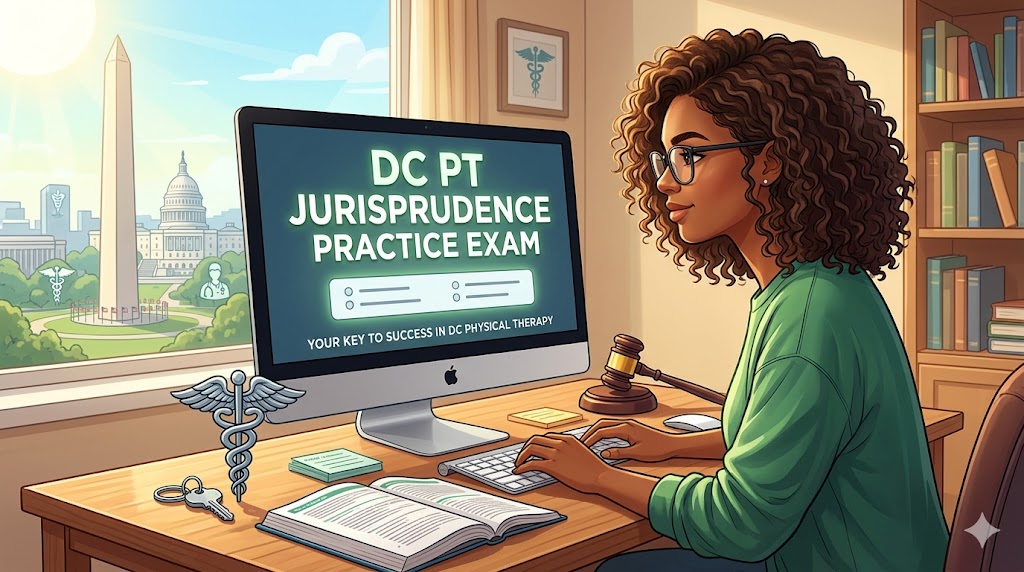
Additional Information
What the Course Entails and Exam Details
This practice experience isn't just about answering random questions; it's a guided tour through the critical legal and professional standards that define physical therapy practice in DC. The core of this material focuses directly on the District of Columbia Physical Therapy Regulations and Ethical Standards.
Topics Covered in This Study Resource:
District of Columbia Official Code Title 3, Chapter 12: Known as the Health Occupations Revision Act (HORA), this is the foundation of health professional regulation in DC, detailing the overarching rules for all health occupations.
Title 17, District of Columbia Municipal Regulations (DCMR), Chapter 67: These are the specific, detailed regulations applicable only to physical therapists and assistants in DC, covering everything from practice scope and licensure requirements to continuing education and disciplinary procedures.
APTA Code of Ethics: The national standards of professional conduct and moral principles established by the American Physical Therapy Association, which are incorporated by reference and heavily emphasized.
Licensure and Practice Requirements: Specific details on how to obtain, maintain, and renew your license, including relevant documentation and continuing competence expectations.
Scope of Practice for PTs and PTAs in DC: Clarity on what PTs can independently do and what tasks PTAs can perform under supervision, within the boundaries of the law.
Disciplinary and Ethical Guidelines: Understanding prohibited acts, reporting requirements, and the processes and consequences of ethical or professional misconduct.
Please note: While often referred to as a "course" in preparatory contexts, the DC PT Jurisprudence Practice Exam is a structured series of study modules and practice questions derived from the actual legislative texts and board guidelines. It is not a separate taught class, but a powerful self-study and practice tool.
What to Expect in the Final Exam
The official jurisprudence exam in the District of Columbia is a formal, proctored test designed to ensure your minimal competence in the relevant laws and regulations. You should anticipate the following format and rules:
Exam Format: The test consists of multiple-choice questions. It is a computer-based exam (CBT).
Scored & Pre-test Items: Typically, the exam will contain 50 questions. Among these, around 40 will be scored, and 10 will be non-scored "pre-test" questions used for future test development, indistinguishable from the scored questions. You are encouraged to answer every question.
Time Limit: Applicants generally have one hour (60 minutes) to complete the entire exam. Proper time management is crucial.
Passing Score: The official passing score for the jurisprudence exam is determined by the DC Board of Physical Therapy. Self-Correction on Score: Search results indicate the board receives the results and notifies the applicant of their result, rather than stating a specific numerical score in the public handbook snippet. Prepare thoroughly to meet the board's requirements.
Specific Rules: The examination is strictly proctored. It is explicitly illegal and unethical to memorize, reproduce, or share any part of the examination content with others. Cheating will result in severe penalties and can disqualify your licensure application.
Delivery: The exam is typically administered through a professional testing service and scheduled at recognized testing centers (like Prometric sites) or via approved secure online delivery methods, as specified by the board's candidate handbook. Clarification from Search: Snippet 1.2.2 and 1.3.1 mention Prometric and scheduling through a testing site.
How to Study and Exam Centers
Effective preparation is key to mastering the jurisprudence exam. Here are actionable strategies to help you succeed:
Study Strategies:
Obtain and Master the Source Material: The DC Board of Physical Therapy Candidate Handbook explicitly links to the relevant legislation and regulations. Go to the primary sources! This includes the HORA and DCMR Chapter 67 on the DC Health website, and the APTA Code of Ethics. Print or access these documents directly and dedicate significant time to detailed reading.
Focus on DC-Specific Nuances: While you know the national standards, pay special attention to anything that is unique to DC regulations—licensure fees, precise supervision requirements, continuing education hours, and specific definitions of prohibited acts. These often form the basis of the most critical questions.
Utilize Practice Questions Regularly: Use this DC PT Jurisprudence Practice Exam and other reputable sources of practice questions. Taking timed practice exams will help you become comfortable with the multiple-choice format and the types of concepts tested, and helps you identify areas where your knowledge is weakest.
Create Your Own Study Guides and Flashcards: Actively engage with the material by summarizing key points, regulation numbers, definitions, and ethical principles into your own study guides or digital flashcards. This reinforces learning much more effectively than passive reading.
Review the Candidate Handbook Thoroughly: The board's official candidate handbook contains vital information, potentially including sample questions and advice on test-taking, as well as crucial security guidelines and administrative procedures.
Exam Centers & Registration:
Official Registration: You will need to register for the jurisprudence exam through the DC Board of Physical Therapy's specified process, which is often done online or through a partner organization. Refer to the current candidate handbook or the DC Department of Health (DOH) Health Professional Licensing Administration website for specific registration details, fees, and timelines.
Delivery Locations: The exam is primarily delivered as a computer-based test. Historically, candidates have scheduled and taken the exam at third-party professional testing centers like Prometric. The specifics (online vs. physical testing centers) can change, so always confirm with the latest board information for the currently authorized method and locations.
Job Opportunities from the Course
Successfully passing the jurisprudence exam and achieving licensure as a physical therapist or physical therapist assistant in DC opens doors to a wide array of career paths within the District. Your professional landscape, as a fully licensed DC practitioner, could include opportunities such as:
Clinical Physical Therapist (various settings): Working directly with patients in settings like:
Hospitals and Medical Centers
Outpatient Clinics and Practices
Rehabilitation Centers
Home Health Agencies
Skilled Nursing Facilities
School Systems (DC Public Schools or private schools)
Sports Clinics
Corporate Wellness Programs
Specialized PT Roles: Pursuing advanced practice or specialization (e.g., orthopedic, pediatric, geriatric, neurological, cardiovascular PT).
Physical Therapist Assistant (various settings): Providing essential support and delivering treatments under the supervision of a licensed PT.
Clinical Director / Clinic Manager: Progressing to leadership roles in clinical operations.
Educator or Mentor: Teaching in PT/PTA programs or supervising students and new graduates.
Consultant: Offering specialized expertise to organizations, businesses, or sports teams within the DC area.
Policy & Advocacy Roles: Utilizing your knowledge of DC regulations to work with professional organizations or government agencies on practice and healthcare policy in the capital.
Frequently Asked Questions
Reviews
5.0
Based on 0 reviews
Leave a Review
No reviews yet. Be the first to review!