
DIVE Earth Science Quarterly Exam 1 Practice
$69.00
- Buy to unlock unlimited access to all Quiz questions and Answers in this Quiz.
- After purchase you can print a PDF of the whole quiz at any point. The PDF will contain the questions and the correct answers.
About this Exam
The DIVE Earth Science course is a video-based science curriculum tailored for middle school students, typically in 7th or 8th grade, though it can be adapted for high school credit. It offers a thorough, biblically-based exploration of the natural world, teaching all standard Earth Science concepts from a creationist perspective, with a special emphasis on flood geology. This Quarterly Exam 1 is the first major milestone for students, assessing their understanding of the initial eight weeks of material. It is designed to evaluate foundational knowledge and scientific reasoning skills as taught in the unique DIVE format. Students who successfully navigate these quarterly exams build a strong foundation for future science studies.
Ready to test your knowledge?
Buy Now to Access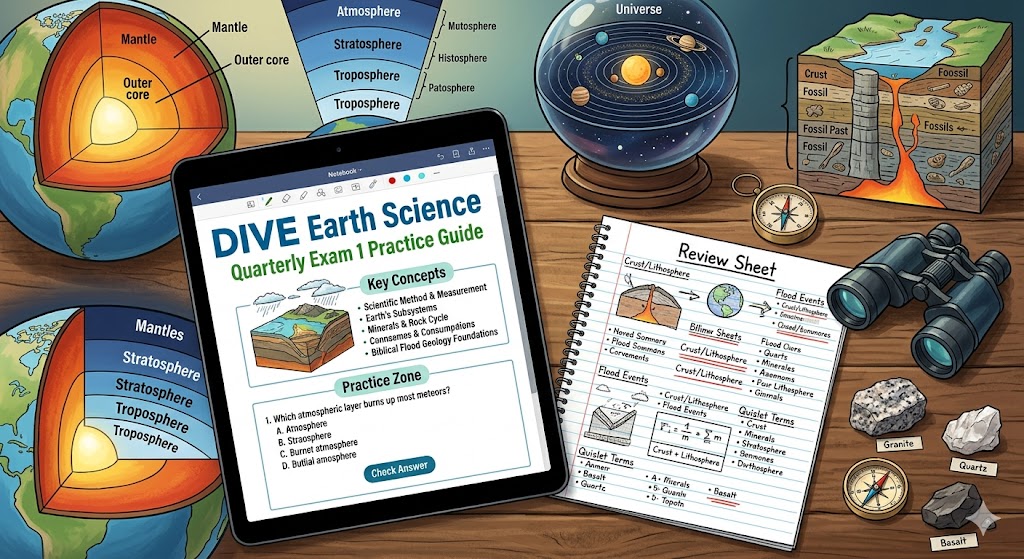
Additional Information
What the Course Entails and Exam Details
The full DIVE Earth Science course is a 32-week program that covers four major divisions: Earth Science Basics, Flood Geology, Limnology and Oceanography, and Astronomy and Meteorology. Quarterly Exam 1 specifically targets the curriculum covered in the first eight weeks.
Students can expect questions to be drawn from the initial topics, which typically include:
Earth Science Basics: The scientific method, measurement, and the foundational concepts of matter.
The Structure of Earth: An overview of Earth’s spheres (atmosphere, lithosphere, hydrosphere, and biosphere).
Minerals and Rocks: Identification and classification of minerals, and an introduction to the rock cycle.
Introduction to Flood Geology: A key aspect of the DIVE approach, introducing the biblical perspective on Earth history and the impact of the global flood.
What to Expect in the Final Exam
While "Practice Exam" implies a trial, understanding the actual Quarterly Exam 1 format is crucial for targeted study. For students enrolled in the digital eLearning course, the quarterly review acts as the exam.
Here are the standard details for the official DIVE Earth Science Quarterly Exam 1:
Format: The exam is typically administered online through the DIVE eLearning portal. It consists of multiple-choice questions.
Question Count: For students taking the course for high school credit (the "Advanced" or "Honors" track), the exam contains 100 questions.
Rules: A crucial rule for the quarterly exams is that students are often permitted to use a single, student-created "review sheet" during the test, which encourages active preparation rather than passive memorization. Advanced students are expected to complete it without the sheet.
Passing Score: A specific "passing" percentage is determined by the teaching parent or the school administering the DIVE curriculum. However, the online system provides immediate feedback and records the score, which forms a key part of the student's final course grade.
Time Limits: While the course is self-paced, individual exams may have a suggested time limit within the eLearning system to mirror a real-world testing environment.
How to Study and Exam Centers
Effective preparation for a DIVE Quarterly Exam requires active engagement with the material, not just passive reading.
Actionable Study Strategies:
Re-take the Review Questions: This is the single most effective study method for DIVE exams. Do not just read over your previous answers. Reprint or reopen the Review Questions for all lessons covered and complete them again. Treat it like a real test, making calculations and answering without your notes, and then correct your work to identify weaknesses.
Create Your Review Sheet: Use the permission to create a one-page review sheet to your advantage. The process of deciding what is critical enough to include is a form of powerful active study. Focus on formulas, key scientific definitions, diagrams of Earth's layers, and the unique flood geology concepts.
Use Quizlet: DIVE provides digital flashcards and Quizlets for definitions and facts practice (like rock and mineral identification). Use these for 10-15 minutes a day to make memorization fun and efficient.
Rewrite Your Notes: Don't just re-read your video lecture notes. Rewrite them, focusing on organizing the information logically and making connections between concepts.
Review Labs: While quarterly exams are primarily multiple-choice, they may include questions that test your understanding of the concepts demonstrated in the weekly video labs. Review your lab worksheets and key takeaways.
Exam Centers:
It is essential to understand that there are no physical "DIVE Exam Centers" like you might find for standard professional certifications. The DIVE Earth Science Quarterly Exams are:
Administered locally: They are given in the home (for homeschoolers) or at the participating school that has adopted the DIVE curriculum.
Taken online: If you are using the eLearning version, the exams are taken within the digital portal provided with your subscription. There are no external testing centers like Pearson VUE involved.
Job Opportunities from the Course
DIVE Earth Science is an educational foundation course; it is not a terminal professional certification that grants a job title. However, by sparking interest and building competence, it acts as the initial step on a path toward various careers in the Earth Sciences and related fields. Students who excel can leverage this knowledge to pursue higher-level science in high school and college, leading to the following ultimate career paths:
Geologist
Meteorologist
Oceanographer
Environmental Scientist
Paleontologist
Hydrologist
Seismologist
Natural Resource Manager
Science Educator
Geographic Information Systems (GIS) Specialist
Museum Curator
Frequently Asked Questions
Reviews
5.0
Based on 0 reviews
Leave a Review
No reviews yet. Be the first to review!