
Dive Master Practice Exam
$69.00
- Buy to unlock unlimited access to all Quiz questions and Answers in this Quiz.
- After purchase you can print a PDF of the whole quiz at any point. The PDF will contain the questions and the correct answers.
About this Exam
The Divemaster certification is the first professional level in the world of scuba diving. It bridges the gap between recreational diving and becoming a diving instructor, focusing on leadership, supervisory skills, and a deep understanding of diving theory.
This certification is designed for individuals who have a passion for scuba diving, possess advanced skills, and desire to lead others, manage dive activities, and assist instructors in training student divers. Whether you want to work at a tropical resort or simply sharpen your leadership abilities, the Divemaster course is the critical first step in your professional diving career.
Ready to test your knowledge?
Buy Now to Access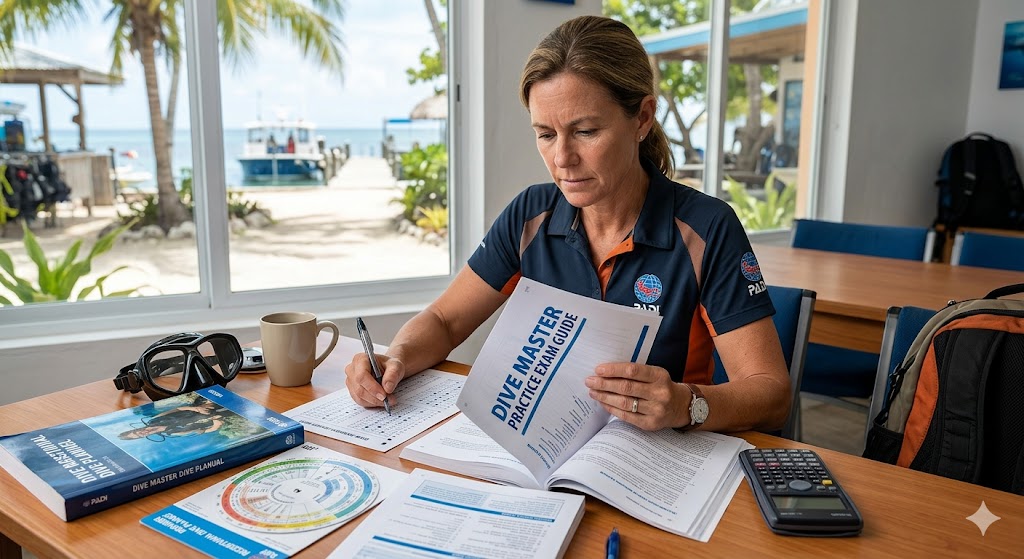
Additional Information
What the Course Entails and Exam Details
The comprehensive Divemaster course involves extensive knowledge development, stamina exercises, and practical application. Candidates will cover several core areas crucial for effective leadership:
Role and Characteristics of a PADI Divemaster: Understanding duties, safety responsibilities, and professional ethics.
Supervising Dive Activities: Learning to supervise both training and non-training-related diving activities.
Assisting with Student Divers: Safely managing and guiding students through various courses.
Dive Safety and Risk Management: Mastering emergency procedures and accident prevention.
Divemaster Conducted Programs: Gaining the ability to independently conduct specific programs like ReActivate and Skin Diver.
Specialized Skills and Activities: This includes search and recovery, deep diving, and supervising specialized diving activities.
The Business of Diving: Understanding the operational aspects of dive centers and resorts.
Diving Physics and Physiology: In-depth knowledge of how pressure affects the body and equipment.
Decompression Theory and the RDP: Mastering dive tables and decompression principles.
To successfully complete the course, candidates must also complete stamina and watermanship exercises, rescue assessments, practical skills application, and workshop scenarios.
What to Expect in the Final Exam
The formal assessment for the knowledge development portion of the Divemaster course consists of a two-part final exam. Candidates must demonstrate proficiency in all areas of diving theory and standards to pass.
The exam usually includes multiple-choice questions that cover all of the knowledge development topics mentioned in Section 2. Candidates must achieve a passing score of 75% or higher on each part of the final exam to be successful.
The exam has a time limit, and candidates are typically given ample time to complete each section (e.g., 60-90 minutes). The practical applications and assessments (skills, stamina, leading) are ongoing throughout the course rather than a single 'final exam' style, requiring consistent effort and mastery. These practical parts are assessed by a qualified PADI Instructor.
How to Study and Exam Centers
Effective preparation for the Divemaster course is key. Utilize a variety of strategies to ensure success:
Review Your Materials Thoroughly: Dive deep into the PADI Divemaster Manual and accompanying materials. Pay close attention to the review questions at the end of each chapter.
Use PADI eLearning or Touch: Engage with online interactive content, which often includes practice questions and quizzes that mimic the exam format.
Practice Exams and Quizzes: Utilize official PADI practice exams or reputable third-party practice tests to identify knowledge gaps and get comfortable with the multiple-choice format. This is critical for success in the final written exams.
Visualize Leading Dives: Mentally practice organizing groups, giving briefings, and managing potential underwater scenarios.
Hands-on Practice: Spend as much time as possible assisting instructors during real courses. Practical experience is invaluable for understanding theory.
Exam Centers: The final written exam for your Divemaster certification is not administered at general testing centers like Pearson VUE. It is conducted directly by the PADI authorized Dive Center, Resort, or by the PADI Instructor who is conducting your training course. The practical assessments also take place at the specified dive locations used by your training facility.
Job Opportunities from the Course
Upon achieving your Divemaster certification, you unlock a wide range of professional opportunities within the scuba diving industry globally:
Divemaster / Dive Guide: Supervising and leading certified divers on underwater tours in resorts or on liveaboards.
Assistant Instructor: Assisting PADI Instructors in training and supervising student divers.
Dive Center Staff: Managing daily operations, equipment rentals, and sales within a dive center or resort.
Dive Safety Officer: Overseeing safety protocols at dive operations, resorts, or for scientific research diving teams.
Dive Resort Manager: Transitioning into management roles responsible for staff, operations, and guest experiences in dive-focused hospitality.
Recreational Dive Supervisor: Supervising non-training-related diving activities.
Frequently Asked Questions
Reviews
5.0
Based on 0 reviews
Leave a Review
No reviews yet. Be the first to review!