
Diver Life Support System (DLSS) Maintenance Practice Exam
$69.00
- Buy to unlock unlimited access to all Quiz questions and Answers in this Quiz.
- After purchase you can print a PDF of the whole quiz at any point. The PDF will contain the questions and the correct answers.
About this Exam
The Diver Life Support System (DLSS) Maintenance Certification is a crucial credential for maritime professionals responsible for the operational integrity of commercial diving systems.
This exam validates the knowledge and technical skills required to maintain hyperbaric chambers, gas handling systems, and associated vital equipment.
It is specifically designed for marine engineers, commercial diving technicians, and maintenance personnel who support saturation or surface-supplied diving operations.
Achieving this certification demonstrates a commitment to the highest safety standards in life-critical underwater environments.
Ready to test your knowledge?
Buy Now to Access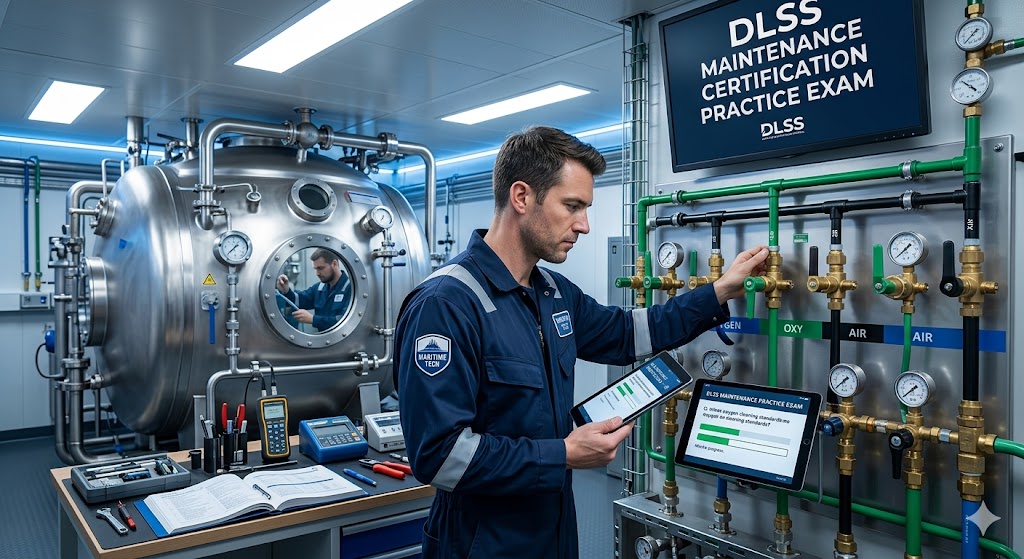
Additional Information
What the Course Entails and Exam Details
The comprehensive DLSS maintenance curriculum focuses on the technical aspects of keeping complex diving systems fully operational and safe.
Key core topics typically include the maintenance of saturation chambers, medical locks, and decompression facilities.
You will cover complex piping systems, pressure-reducing valves, gas analyzers, and moisture separators.
A significant portion of the course is dedicated to strict quality assurance (QA) protocols, including Re-Entry Control (REC) procedures.
Technicians must also master cleanliness standards for high-oxygen environments to prevent hazardous contamination.
Additionally, the syllabus covers the maintenance of gas storage flasks, compressor systems, and the dynamic diver handling equipment used on dive support vessels.
What to Expect in the Final Exam
Candidates should expect a rigorous assessment that blends theoretical knowledge with practical maintenance scenarios.
The final examination is usually delivered as a timed, proctored test, often in a multiple-choice format.
It generally consists of approximately 60 to 80 questions covering the full spectrum of DLSS maintenance topics.
While standard durations vary, you are usually given between 90 and 120 minutes to complete the test.
A standard passing score is frequently set at 75% or higher.
The exam requires a deep understanding of standard operating procedures (SOPs) and emergency protocols relevant to system failure.
How to Study and Exam Centers
Preparation is paramount for this exam, and a combination of theoretical study and practical familiarity is recommended.
Start by thoroughly reviewing the technical manuals for standard DLSS equipment, paying close attention to maintenance schedules.
Utilizing a dedicated DLSS Maintenance Practice Exam is one of the most effective ways to identify knowledge gaps.
Create flashcards for vital procedures, cleanliness standards, and pressure relief valve settings.
If possible, gain hands-on experience under the guidance of a senior technician to solidify your understanding of REC documentation.
Authorized testing is typically managed through specific commercial diving schools, industry bodies, or naval training facilities.
While many theoretical exams can be taken through secure online proctoring portals, some components might require attendance at a specific physical testing center.
Job Opportunities from the Course
Completing this certification unlocks several highly specialized and lucrative career paths within the commercial diving and hyperbaric industries.
Job Opportunities Include:
Commercial Diving System Technician
Saturation Life Support Technician (LST)
Hyperbaric Facility Maintenance Engineer
Dive Support Vessel (DSV) Maintenance Supervisor
Quality Assurance (QA) Inspector for Diving Systems
Offshore Installation Manager for Diving Operations
Civil Engineering Tunneling Life Support Technician
Frequently Asked Questions
Reviews
5.0
Based on 0 reviews
Leave a Review
No reviews yet. Be the first to review!