
Diversity, Human Needs and Development Practice Exam
$69.00
- Buy to unlock unlimited access to all Quiz questions and Answers in this Quiz.
- After purchase you can print a PDF of the whole quiz at any point. The PDF will contain the questions and the correct answers.
About this Exam
The "Diversity, Human Needs and Development Practice Exam" serves as a crucial benchmark for professionals and students aspiring to excel in fields focused on human services, social work, community development, and educational psychology. It is specifically designed to validate a candidate's comprehensive understanding of complex human behaviors, societal structures, and developmental stages. This practice exam is aimed at individuals seeking certification, advanced academic placement, or professional verification of their capability to navigate, understand, and address the nuanced needs of diverse populations. By bridging theoretical frameworks with practical scenarios, this assessment ensures candidates possess the vital awareness and skill set required to foster inclusive environments and support individual and community growth effectively in today’s complex society.
Ready to test your knowledge?
Buy Now to Access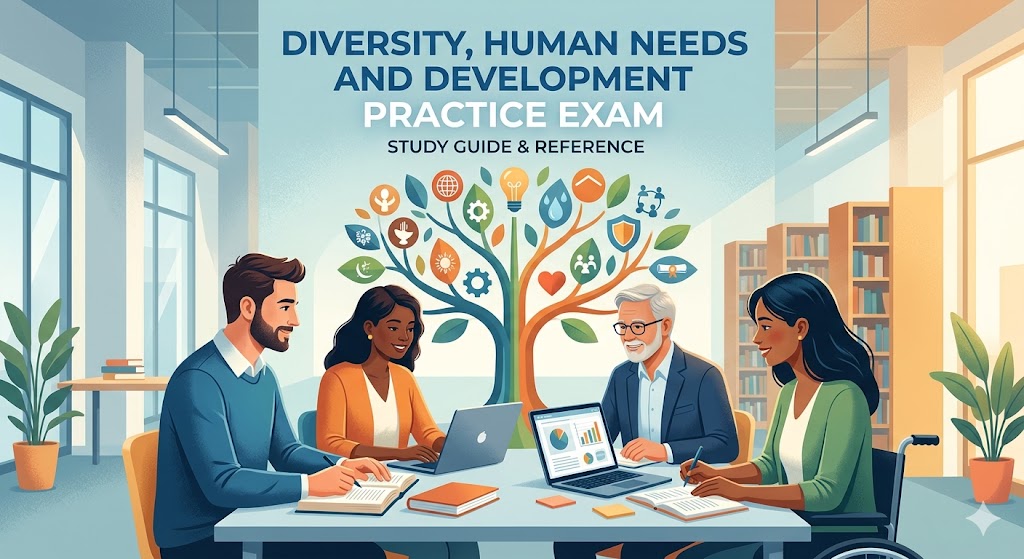
Additional Information
What the Course Entails and Exam Details
The material covered in preparation for this exam is comprehensive, encompassing several interdisciplinary pillars of human understanding. The core syllabus begins with an in-depth exploration of Diversity and Inclusion, analyzing cultural competence, intersectionality, the impact of bias, and strategies for promoting equity across various identity groups. It heavily emphasizes Human Needs Theories, delving into foundational concepts such as Maslow’s Hierarchy of Needs, analyzing how psychological, social, and physiological needs motivate human behavior and interaction. Furthermore, a substantial portion of the exam is dedicated to Lifespan Development, covering cognitive, emotional, and social milestones from infancy through late adulthood. Candidates are expected to demonstrate proficiency in identifying risk and protective factors that influence developmental trajectories. The curriculum also integrates social policy and ethical considerations, requiring an understanding of how systemic issues affect individual development and community well-being.
What to Expect in the Final Exam
Candidates preparing for the final exam should anticipate a rigorous assessment designed to evaluate both theoretical knowledge and practical application through scenario-based questioning. The standard exam format is usually multiple-choice, which may include matching and true/false questions, but often places a heavy emphasis on "best practice" scenarios where candidates must analyze a situation and select the most culturally competent or developmentally appropriate response. The exam is typically comprised of approximately 100 to 150 questions, though this varies by the specific testing institution. A precise time limit, often ranging between 2 to 3 hours, is enforced, requiring efficient time management. To secure a passing score, candidates generally need to achieve a result within the 70% to 80% range, depending on the difficulty and psychometric scaling of the specific exam version. It is crucial for candidates to review the specific guidelines provided by their certifying body for the most accurate details.
How to Study and Exam Centers
Effective preparation requires a structured and multifaceted study approach. Candidates should begin by conducting a thorough review of academic textbooks on social work, developmental psychology, and sociology. Utilizing spaced repetition techniques with flashcards for key theories (e.g., Erikson’s stages of psychosocial development, Piaget’s stages of cognitive development) is highly effective. However, the most critical element of preparation is leveraging practice exams. These simulations not only familiarize candidates with the question format but also help identify areas of weakness and improve pacing. Formulating study groups to discuss case studies and diverse perspectives can also enhance critical thinking. Regarding the examination administration, these tests are generally offered through secure, proctored environments. Testing methods often include authorized physical test centers (such as Pearson VUE centers) or secure online proctoring portals that allow candidates to take the exam from their own location. Registration and scheduling are usually managed directly through the official website of the credentialing organization or the educational institution offering the certification.
Job Opportunities from the Course
Successfully preparing for and passing this exam validates essential competencies that are highly sought after across numerous sectors dedicated to human well-being and social equity. This certification unlocks career paths in government agencies, non-profit organizations, educational institutions, and private healthcare. Common job opportunities include:
Social Worker
Community Outreach Coordinator
Child Development Specialist
Human Resources Diversity Manager
School Counselor
Non-Profit Program Manager
Advocacy and Policy Analyst
Mental Health Case Manager
Rehabilitation Counselor
Early Childhood Educator
Substance Abuse Counselor
Frequently Asked Questions
Reviews
5.0
Based on 0 reviews
Leave a Review
No reviews yet. Be the first to review!