
DJJ Protective Action Response (PAR) Practice Test
$69.00
- Buy to unlock unlimited access to all Quiz questions and Answers in this Quiz.
- After purchase you can print a PDF of the whole quiz at any point. The PDF will contain the questions and the correct answers.
About this Exam
The DJJ Protective Action Response (PAR) certification is a vital credential for individuals working within or aspiring to join the Department of Juvenile Justice (DJJ) or affiliated youth services organizations. It is designed specifically for juvenile justice officers, youth counselors, direct care staff in residential facilities, and other professionals responsible for the care, custody, and supervision of youth. The primary goal of the PAR program is to provide staff with a continuum of essential skills to manage difficult situations safely and effectively, emphasizing verbal de-escalation techniques over physical intervention. This certification ensures that all staff can create and maintain a secure and therapeutic environment while upholding the dignity and safety of both the youth and themselves.
Ready to test your knowledge?
Buy Now to Access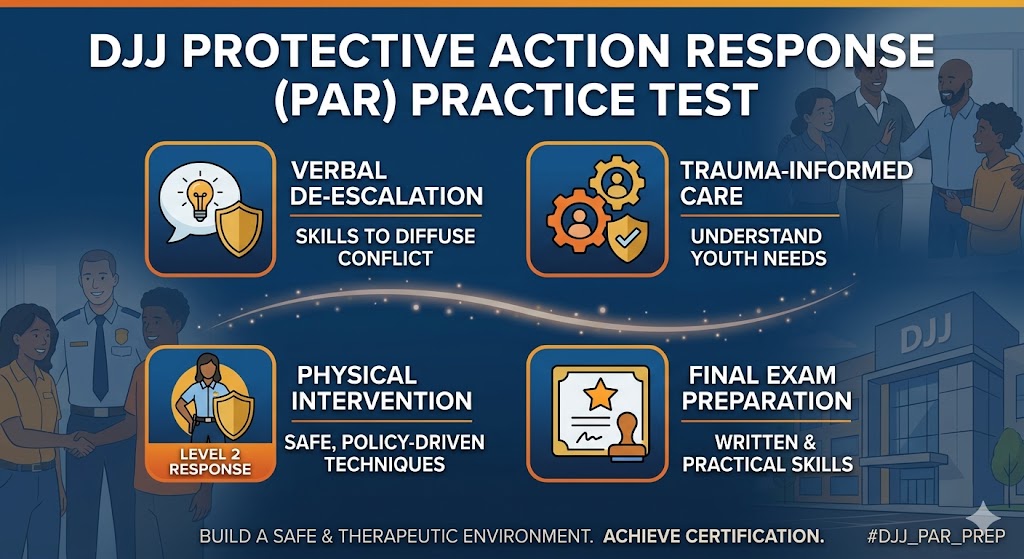
Additional Information
What the Course Entails and Exam Details
The PAR course provides comprehensive training on a multi-level response model. The curriculum is meticulously structured to move from the least intrusive methods to more restrictive ones, with physical intervention viewed as a last resort. Core topics covered in the course and tested in the examination include:
PAR Policy and Ethics: A deep understanding of the official guidelines governing the use of force, required documentation, and the ethical principles behind protective actions.
De-escalation and Communication: Mastery of verbal and non-verbal communication techniques to diffuse conflict, resolve crisis, and build positive rapport with youth.
Youth Development and Trauma: Knowledge of adolescent brain development and the impact of trauma on behavior, which is crucial for choosing appropriate intervention strategies.
Situational Awareness: Training on assessing risk, recognizing warning signs of escalating behavior, and maintaining proper positioning and body language, known as the "reactionary gap."
Levels of Resistance and Response: Understanding the five levels of youth resistance (Verbal, Passive, Active, Combative, Aggravated) and the corresponding authorized staff responses.
Defensive and Physical Interventions (Level 2): Practical instruction and testing on approved non-pain compliance techniques, countermoves, control holds, and, when absolutely necessary, safe takedowns.
Mechanical Restraints (Level 3): If applicable to the role, training on the proper and safe application of approved restraints, such as handcuffs, following strict protocols.
Recovery and Discussion: The process of de-briefing with youth after an incident to explore alternative behaviors and restore the therapeutic environment.
What to Expect in the Final Exam
The final PAR certification exam is a comprehensive, two-part assessment that evaluates both cognitive understanding and practical proficiency. You must achieve a passing score on both components to receive your certification.
Part 1: Written Examination This section typically consists of a timed, multiple-choice, or true/false test. It focuses on your knowledge of the PAR policy, de-escalation models, levels of response, and the legal and ethical framework of juvenile justice. It assesses how well you can recall and apply the theoretical concepts learned during training.
Part 2: Physical Skills Evaluation This is a hands-on, practical assessment conducted by a certified PAR instructor. Candidates must physically demonstrate the correct application of authorized verbal and physical intervention techniques in real-world scenarios. This includes demonstrating proper defensive stances, control techniques, and, if required, restraint application. You will be evaluated on your ability to execute these techniques safely, effectively, and in full compliance with the PAR policy, paying close attention to the safety of all individuals involved.
How to Study and Exam Centers
Effective preparation is key to succeeding on the PAR exam. Utilize a combination of official study materials and practical practice:
Review Official Policy: The cornerstone of your study should be the complete and current DJJ Protective Action Response (PAR) policy manual. Pay special attention to definitions, authorization levels, and prohibited actions.
Study Guides and Practice Tests: Use all provided study guides and take advantage of any official practice tests to familiarize yourself with the written exam format and identify areas needing improvement.
Practice with Scenarios: With a partner, practice verbal de-escalation and physical techniques. Role-play different levels of youth resistance and test your ability to choose the appropriate response level.
Focus on Body Positioning: Rehearse the interview stance, maintaining a proper reactionary gap, and non-verbal cues.
Attend All Training Sessions: Be an active participant in all PAR training, ask questions, and seek feedback from instructors on your physical technique.
Exam Centers: PAR testing is not conducted at public testing centers like Pearson VUE. It is administered directly by the Department of Juvenile Justice (DJJ) within their state facilities or by authorized contract providers. For new hires, the exam is typically a mandatory part of the pre-service training academy. Existing staff take their annual re-certification exams at their respective worksites or approved training locations.
Job Opportunities from the Course
A DJJ Protective Action Response (PAR) certification is not just a job requirement; it’s a career-unlocking credential within the fields of juvenile justice, youth social services, and specialized education. This certification is a prerequisite for many positions where your role is to mentor, supervise, and secure the well-being of at-risk youth. The skills you gain in de-escalation and crisis intervention are highly valued and lead to numerous career paths, including:
Juvenile Justice Officer / Juvenile Detention Officer: Managing the security and safety of youth in secure detention facilities.
Youth Counselor / Youth Counselor Technician: Providing guidance, mentorship, and supervision in residential or community programs.
Direct Care Staff: Working in group homes or specialized therapeutic centers for youth.
Juvenile Probation Officer / Juvenile Court Counselor: Supervising adjudicated youth and guiding them through the legal system.
Juvenile Transportation Driver: Safely transporting youth between facilities, courts, and service providers.
Behavioral Specialist: Focusing on behavioral modification and intervention strategies within juvenile programs.
Instructional Aide in Alternative Education: Supporting teachers and managing the classroom environment for students with specialized needs.
Frequently Asked Questions
Reviews
5.0
Based on 0 reviews
Leave a Review
No reviews yet. Be the first to review!