
DNA History, Replication, and Protein Synthesis Practice Test
$69.00
- Buy to unlock unlimited access to all Quiz questions and Answers in this Quiz.
- After purchase you can print a PDF of the whole quiz at any point. The PDF will contain the questions and the correct answers.
About this Exam
The "DNA History, Replication, and Protein Synthesis Practice Exam" is a foundational competency assessment designed for students pursuing studies in biology, biotechnology, pre-medicine, and related life science fields.
Acing this fundamental competency assessment, or a similar module within a larger course, demonstrates a deep and robust understanding of the core molecular mechanisms that form the basis of all life. This study material is an indispensable tool for anyone preparing to demonstrate their knowledge of the discovery of the genetic material, how it accurately replicates, and how that information is used to create essential proteins.
This practice test is ideal for high school students in advanced biology classes (like AP or IB), first-year college biology students, and individuals preparing for science-focused certifications or entrance exams.
Ready to test your knowledge?
Buy Now to Access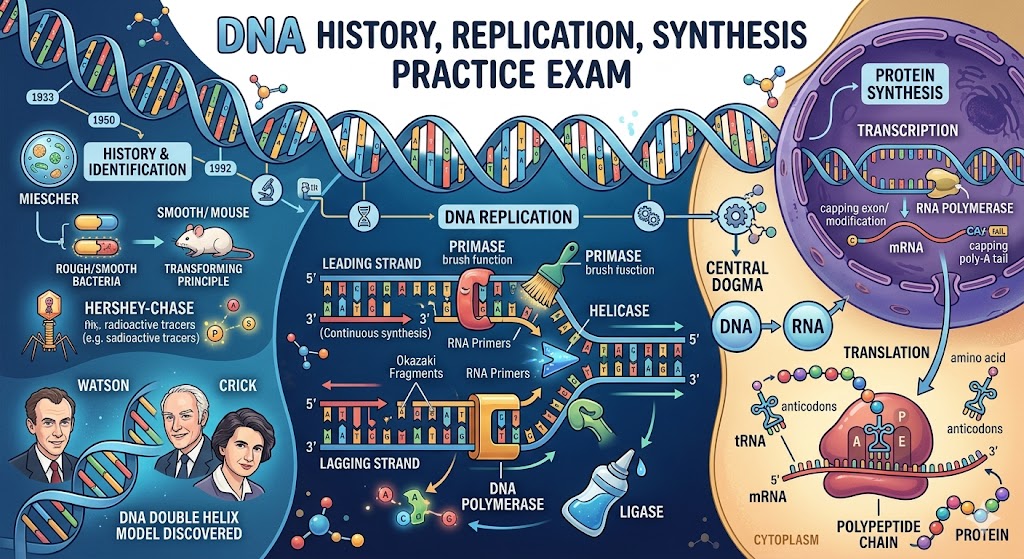
Additional Information
What the Course Entails and Exam Details
This comprehensive area of study, often a key module within a biology or molecular genetics course, dives deep into three pivotal areas. Acing the associated assessments, which can sometimes be administered through a variety of official testing channels (depending on your specific educational context and provider), requires a strong grasp of the following core concepts:
Core Topics and Syllabus
DNA History & Identification: Chronological understanding of key historical experiments and figures. Discoveries by Friedrich Miescher, Frederick Griffith’s transformation experiments, Avery, MacLeod, and McCarty’s work, Hershey and Chase’s proof, Chargaff’s rules, Franklin’s work, and Watson and Crick’s model.
DNA Replication: Detailed molecular mechanism of semi-conservative replication. Role of key enzymes (Helicase, Primase, DNA Polymerase, Ligase, Topoisomerase), leading and lagging strands, replication forks, Okazaki fragments, primers, proofreading.
Protein Synthesis: Comprehensive coverage of transcription and translation. Transcription (DNA to mRNA, processing), translation (mRNA, tRNA, ribosomes, codons, genetic code), central dogma, introduction to mutations.
Illustrative Exam Details (Check with Your Specific Provider)
While these specific numbers and rules are examples common in standardized educational and certification exams, you must confirm the exact details from your official exam body or course syllabus:
Format: Typically a robust series of questions, which can be delivered through online portals or at designated testing locations. Expect a dominant number of multiple choice, with possibilities of short answer and diagram analysis.
Time Limit: Often range from 1.5 to 2.5 hours.
Passing Score: Frequently set between 70% and 80%, depending on the specific curriculum and high-stakes nature.
Attempts: Policies vary; some tests allow multiple attempts, while high-stakes certification assessments may have strict limits and cool-down periods.
What to Expect in the Final Exam
You can expect a serious, comprehensive test that moves beyond simple recall. Prepare to encounter a significant number of multiple-choice questions designed to assess your understanding of detailed processes, historical contexts, and experimental interpretations. Be ready to analyze diagrams representing the replication fork or the ribosome during translation, identifying key molecules, enzymes, and directions of synthesis. Practice interpreting the genetic code table to determine amino acid sequences from mRNA or DNA templates. While often multiple-choice focused, some final assessments, particularly in advanced courses, may include short-answer or even diagrammatic drawing questions. The test is likely to be proctored if administered formally, with typical rules regarding the use of resources. Some online versions may involve secure browsers and remote proctoring, while physical testing centers might have strict entry requirements and no personal belongings policies in the test room.
How to Study and Exam Centers
Effective preparation is key to mastering this challenging and essential subject matter.
Understand, Don't Just Memorize: Grasp the 'why' and 'how' of each step. Why is an RNA primer necessary? How do tRNA molecules decode the mRNA? Understanding the processes makes recalling facts much easier and more robust. Spacing your study sessions for each topic helps in long-term retention.
Use Visuals & Diagrams: Draw out and label the replication fork, the process of transcription, and translation. Visualizing the molecules and machinery will solidify your understanding. Label the components and steps. The proper spacing between your visual guides can help you mentally organize the complexity.
Practice, Practice, Practice: Use a wide range of practice questions, mock exams, and yes, even flashcards. Our designated practice test and other online and textbook resources are your best friends. Space out your practice tests to simulate exam-day fatigue.
Form a Study Group: Teaching a concept to someone else is one of the best ways to master it yourself. Form a study group and discuss processes, experiments, and tricky questions. Ensure there is good communication spacing among group members to keep discussions focused and productive.
Review Historical Experiments: Be sure to understand not just the conclusion but the method and experimental design of each major historical discoverer. The spacing of the development of these ideas over time is a fascinating story itself.
Where and How to Take the Final Exam
The location and method for taking your definitive assessment can vary significantly depending on whether you are taking it as part of a high school class (like AP or IB), a college course, or a broader science competency or certification program.
Authorized Educational Institutions: Most commonly, if this material is part of a course or an AP/IB program, the test will be administered directly within your high school or college by authorized teachers or proctors.
Online Proctored Portals: For many online courses and some certification programs, you may be able to take the exam from home via a secure online testing portal. These typically require a webcam and special proctoring software.
Specialized Testing Centers: For high-stakes standardized tests or certain professional certifications, the exam could be administered at official physical testing centers. Common examples include Pearson VUE and Prometric centers. Be sure to check which local test delivery center partners with your specific exam provider.
Crucially, always verify the correct delivery method, required identification, scheduling procedure, and specific location for your final assessment from your official course coordinator or the exam provider’s website.
Job Opportunities from the Course
A strong foundation in these core biological principles is not just an academic achievement; it is an invaluable asset that prepares you for numerous rewarding career paths, primarily when combined with further specialized education and degrees. This fundamental module or certification demonstrates a high level of competency that is respected in various professional environments.
Biotechnology Laboratory Technician: Work in a private or research lab, often with foundational roles in molecular biology, sample preparation, and testing.
Research Assistant (Academic or Private Sector): Support scientists in cutting-edge research in genetics, genomics, or drug discovery.
Genetic Counselor (requires advanced Master's degree): Advise individuals and families on genetic conditions and testing, using your deep understanding of the genetic material as a foundation.
Bioinformaticist (often requires additional computer science skills and degrees): Analyze large biological datasets, such as genomic sequences, applying your molecular knowledge.
Pharmaceutical Development Associate: Contribute to the research and development of new drugs.
Educational Roles (High School Science Teacher or College Instructor, requires degrees/licenses): Inspire the next generation of scientists.
Healthcare Support Roles: The knowledge is beneficial for a wide range of roles including lab assistants, medical scribes, and preparatory positions for deeper medical study.
Frequently Asked Questions
Reviews
5.0
Based on 0 reviews
Leave a Review
No reviews yet. Be the first to review!