
DoD Foreign Disclosure Training Practice Test
$69.00
- Buy to unlock unlimited access to all Quiz questions and Answers in this Quiz.
- After purchase you can print a PDF of the whole quiz at any point. The PDF will contain the questions and the correct answers.
About this Exam
The Foreign Disclosure Training for DoD is a crucial eLearning course (GS160.16) primarily designed for all DoD personnel who make or are involved in foreign disclosure determinations. This includes security professionals, acquisition experts, intelligence officers, program managers, active duty military personnel, and foreign affairs specialists. Its core purpose is to equip these individuals with the standard level of knowledge and understanding regarding DoD foreign disclosure policies and processes, ensuring that the critical practice of sharing information is conducted securely, appropriately, and in alignment with national interests.
Ready to test your knowledge?
Buy Now to Access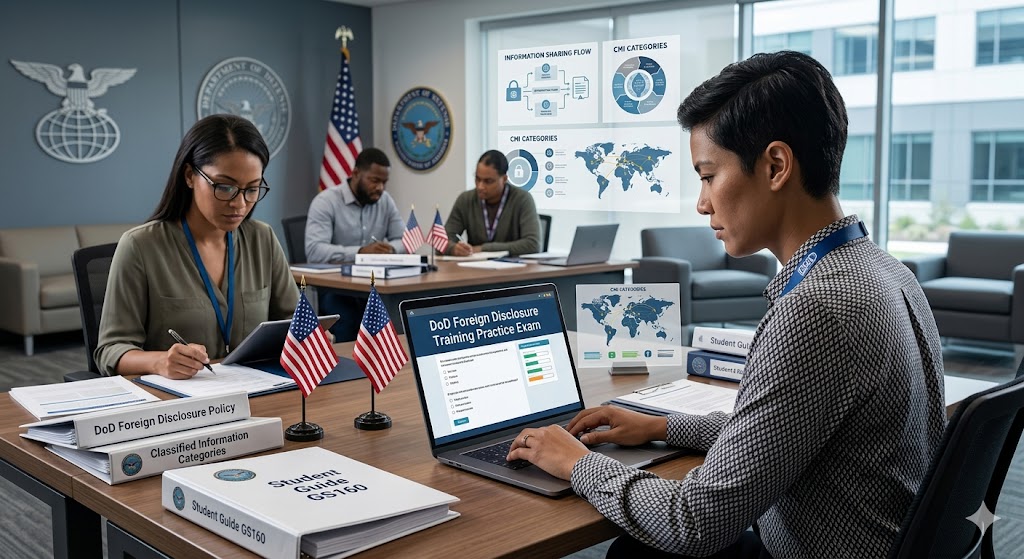
Additional Information
What the Course Entails and Exam Details
This eLearning course, typically lasting approximately 2.5 hours, dives deep into the intricate world of foreign disclosure. It is structured to provide students with foundational knowledge across several key areas:
Categories of Classified Military Information (CMI): You will learn to identify and define the different categories of CMI and understand the specific policies that govern each, ensuring accurate classification and protection. These categories include information about the organization, training, and employment of military forces; military materiel and munitions; applied research and development; production information; combined military operations, planning, and readiness; among others.
Governing Policies: A significant focus is placed on understanding the key policies and directives that dictate how and when information can be disclosed. This includes the major DoD Directive (DoDD) 5230.11, which delegates disclosure authority and requires the appointment of disclosure authorities, as well as policies related to international agreements (DoDD 5530.3), and visits and assignments of foreign nationals (DoDD 5230.20).
Disclosure Criteria, Limitations, and Requirements: You will explore the criteria and conditions for determining eligibility for foreign disclosure, the limitations imposed by policy and law, and the strict requirements that must be met before any sharing can occur, including understanding the roles of entities like the National Military Information Disclosure Policy Committee.
Means of Foreign Disclosure: The course covers the various oral, visual, and documentary methods through which CMI can be shared.
Disclosure Process Determinations: Students learn the fundamental process and steps involved in making and adjudicating foreign disclosure decisions, applying principles to specific request scenarios.
Information Protection Principles: Critical principles related to the protection and release of classified information are covered throughout, ensuring national security remains paramount.
Successfully completing this training and passing the final exam demonstrates competency in these crucial areas and is a prerequisite for many roles involving international engagements or technology control.
What to Expect in the Final Exam
The final exam for the Foreign Disclosure Training for DoD is administered entirely online as part of the eLearning course delivery. Here's what you can expect:
Format: The exam typically consists of multiple-choice and potentially other structured question formats designed to test your comprehension and application of the course material.
Duration & Time Limit: While the course itself is about 2.5 hours, the specific exam duration is not always explicitly detailed in all public descriptions; however, it is taken directly within the eLearning system upon course completion.
Passing Score: To successfully complete the training and earn a certificate, you must achieve a passing score of 75 percent.
Rules: The exam is closed-book, meaning you are expected to answer questions based on the knowledge gained from the course without referencing external materials, notes, or policies during the test. For online proctored exams through systems like STEPP, you must also follow specific browser configuration, identity verification, and non-disclosure rules. Note: For this specific CDSE eLearning course, the exam is taken directly through the STEPP portal and is not proctored in the traditional physical sense, although standard online testing integrity is expected.
How to Study and Exam Centers
Effective study strategies and understanding where the actual final exam is taken are crucial.Actionable Study Strategies:
Master the CDSE Student Guide: The Center for Development of Security Excellence (CDSE) provides a comprehensive Student Guide (such as the GS160.pdf) that mirrors the course content. Study this guide meticulously. Highlight key concepts, definitions of CMI categories, specific policy names (DoDDs, NPD-1), and the steps in disclosure adjudication.
Complete All Review Activities: The Student Guide often contains review questions and activities at the end of each lesson. Do not skip these. They are excellent practice and mimic the knowledge application required for the exam. An answer key is typically included at the end of the guide for self-assessment.
Engage Fully with the eLearning Course: While you can study the guide beforehand, the interactive elements and scenario-based examples within the eLearning module itself offer unique learning experiences. Pay close attention to all modules, videos, and practical exercises.
Focus on Categories & Policies: Make sure you can confidently identify which type of information falls into each CMI category and which major policies govern different aspects of foreign disclosure, as this knowledge is fundamental.
Practice with this Guide: Use the description of course topics to create your own summaries, flashcards, or even multiple-choice questions for peer review or personal testing. Simulate the closed-book exam environment as you approach test day. Look for any official practice resources or simulations that might be available within the STEPP portal, although the student guide reviews are likely your best source for official-style practice.
Where to Take the Final Exam: Unlike some certifications requiring specific physical testing centers like Pearson VUE (which is mentioned for other government tests in search results, but not this CDSE eLearning course), the final exam for the Foreign Disclosure Training for DoD is taken directly online within the Security Training, Education, and Professionalization Portal (STEPP).
You must access the course and complete the learning modules first.
Upon completing all course content, the final exam becomes accessible within the STEPP platform.
Ensure your computer system meets all specified requirements for using STEPP, and ideally, take the exam on a stable connection without complex firewalls, as institutional firewalls can sometimes cause issues with online testing platforms. No physical testing centers are utilized for this specific eLearning course's final exam.
Job Opportunities from the Course
Completion of the DoD Foreign Disclosure Training enhances your qualifications and performance in many professional roles within the Department of Defense. While not a standalone career series, it unlocks and improves opportunities in job titles where foreign disclosure expertise is critical:
Foreign Disclosure Officer (FDO): The most direct application, FDOs are explicitly tasked with making and managing foreign disclosure decisions. This role is crucial across military services and agencies. Actual job listings often mandate or strongly encourage this training.
Security Personnel: This includes roles like Security Specialists, Industrial Security Professionals, and Information Security Specialists, where protecting CMI while facilitating necessary sharing is paramount.
Acquisition Personnel: Professionals involved in foreign military sales, cooperative development programs, and international acquisition initiatives must understand the complex rules of disclosing technical data and military materiel information.
Intelligence Professionals: Intelligence analysts and officers who handle and potentially share sensitive intelligence with allies must be versed in disclosure policy.
Program Managers: Managers of DoD programs with international components, such as joint exercises or technology sharing agreements, need this knowledge to navigate critical disclosure determinations.
Active Duty Military Personnel: Military members across all branches, especially those in leadership, operational planning, or international engagement roles, benefit from understanding foreign disclosure rules, especially during combined operations.
Foreign Affairs Personnel: Advisors and specialists focused on international relations and cooperation within the DoD context will find this training essential for daily tasks and negotiations.
Frequently Asked Questions
Reviews
5.0
Based on 0 reviews
Leave a Review
No reviews yet. Be the first to review!