
DoD Incident Safety Officer Practice Test
$69.00
- Buy to unlock unlimited access to all Quiz questions and Answers in this Quiz.
- After purchase you can print a PDF of the whole quiz at any point. The PDF will contain the questions and the correct answers.
About this Exam
The DoD Incident Safety Officer certification is designed for experienced fire and emergency services personnel operating within the Department of Defense. It signifies that an individual has met the core competencies and possesses the knowledge and skills to function as an Incident Safety Officer (ISO). This role is part of the Command Staff within the Incident Command System (ICS) and is critical for monitoring operations, identifying hazards, and taking action to ensure the health and welfare of all responders. The certification, often administered through authorized organizations like the Fire Department Safety Officers Association (FDSOA) and accredited by Pro Board, demonstrates commitment to a proactive and professional safety culture.
Ready to test your knowledge?
Buy Now to Access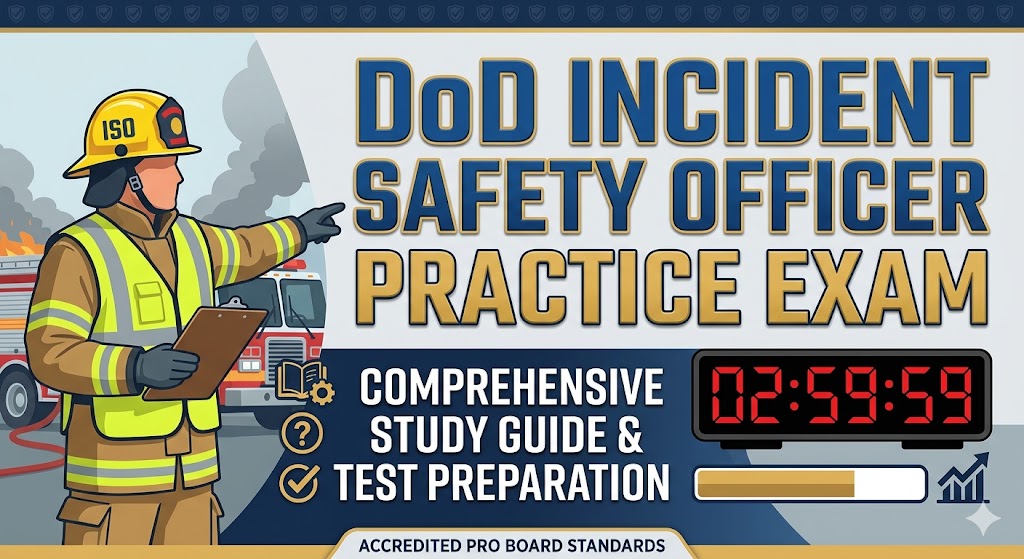
Additional Information
What the Course Entails and Exam Details
This comprehensive course, or the knowledge and experience leading up to the exam, covers a broad spectrum of safety management principles. Candidates are expected to be well-versed in the Incident Command System, with a focus on integrating safety into the incident action plan.
Key topics included in the exam syllabus are:
Roles and responsibilities of the Incident Safety Officer
Advanced knowledge of the Incident Command System (ICS) and National Incident Management System (NIMS)
Risk management principles and application
NFPA standards, particularly NFPA 1500 (Occupational Safety, Health, and Wellness Program) and NFPA 1521 (Standard for Fire Department Safety Officer Professional Qualifications)
DoD Instruction 6055.06 (DoD Fire and Emergency Services Program)
Hazard recognition, including specialized focus on structural, wildland, and hazardous materials incidents
Building construction and its impact on responder safety
Personal Protective Equipment (PPE) standards and inspection
Post-incident analysis and reporting
The exam itself is a multiple-choice assessment, often consisting of 100 questions. It is designed to evaluate a candidate’s understanding of these core competencies and their ability to apply them to real-world scenarios.
What to Expect in the Final Exam
The final exam is a significant hurdle that tests your comprehension and decision-making abilities. It is not merely a memory test, but an examination of your situational awareness and judgment.
Here is what you can expect:
Format: The exam is typically composed of 100 multiple-choice questions, each with four possible answers.
Time Limit: While the specific time allowed may vary by the testing authority, candidates are generally given 2 to 3 hours to complete the examination.
Passing Score: To successfully achieve the certification, a candidate must obtain a minimum passing score of 70%.
Content and Question Type: Expect a combination of knowledge-based questions (e.g., "What is the key difference between HSO and ISO?") and scenario-based questions (e.g., "Given a scenario with an identified hazard, what immediate action should the ISO take?").
Testing Procedures: It is an individual exam, so external assistance or notes are not permitted. The exam is typically proctored to ensure academic integrity.
How to Study and Exam Centers
Preparation for the DoD Incident Safety Officer exam requires a mix of self-study, formal education, and practical application.
Here is a recommended study plan and information on testing logistics:
Step 1: Obtain Authority Having Jurisdiction (AHJ) ApprovalBefore you can sit for the exam, you must have approval from your AHJ, validating that you have at least five years of fire service experience and meet company officer-level qualifications.
Step 2: Complete and Document Practical Skill SheetsThe certification process requires the completion of several (e.g., six randomly assigned) skill sheets, demonstrating that you have performed the roles and duties of an ISO in practice. This is a critical component that can often be completed in your home jurisdiction before testing.
Step 3: Master the Core Study MaterialsYour study should center on the required NFPA standards, specifically NFPA 1500 and 1521, along with key DoD instructions. Reviewing course materials from the National Fire Academy (NFA) on the Incident Safety Officer role can also be invaluable.
Step 4: Take Practice Tests Utilize reputable online practice tests, such as the one described in this study guide. These practice exams are essential for familiarizing yourself with the type of questions asked, managing your time, and identifying areas where you need further study.
Step 5: Select a Testing Option and LocationThe ISO exam is often not taken at a public testing center like Pearson VUE. Instead, it is usually coordinated through one of two methods:
Individualized or Departmental Testing: Candidates can arrange to take the exam at their own location under the supervision of a locally approved proctor. The proctor must register with the testing authority (e.g., FDSOA).
FDSOA Academy: The exam is sometimes administered on the final day of a two-day FDSOA Incident Safety Officer Academy, which are offered at various locations throughout the year.
Job Opportunities from the Course
A DoD Incident Safety Officer certification is a hallmark of professional growth and unlocks various advanced roles, primarily within the fire and emergency services sector of the Department of Defense. It is also highly respected in civilian municipalities.
Common job opportunities and career paths this certification unlocks include:
DoD Civilian Firefighter (All Ranks): Possession of this certification can be a prerequisite or significant advantage for promotion to higher ranks, from Captain to Fire Chief.
Military Firefighter (Officer): For military personnel, this certification can improve promotional standing within the Fire Protection career field and lead to leadership roles.
Fire Officer (all levels): The knowledge gained is essential for all levels of supervisory roles within any fire department.
Safety Manager/Officer (Emergency Services): This certification directly prepares individuals to lead safety programs within complex emergency service organizations.
Incident Commander: An ISO certification is a key component for anyone aiming to assume top-level command during major incidents, showing a deep commitment to responder welfare.
Fire Service Instructor: Having the credential qualifies individuals to teach ISO courses and shape the next generation of safety-conscious responders.
Emergency Management Specialist: The focus on ICS and risk management is highly transferable to broad emergency management and disaster response roles.
Frequently Asked Questions
Reviews
5.0
Based on 0 reviews
Leave a Review
No reviews yet. Be the first to review!