
DPA Appraisal Fundamentals Workshop Practice Test
$69.00
- Buy to unlock unlimited access to all Quiz questions and Answers in this Quiz.
- After purchase you can print a PDF of the whole quiz at any point. The PDF will contain the questions and the correct answers.
About this Exam
The DPA Appraisal Fundamentals Workshop and its associated practice test represent a critical stepping stone for individuals aspiring to excel in the field of real estate appraisal. This comprehensive workshop is designed to provide a solid grounding in the core principles, methodologies, and ethical considerations inherent to property valuation. Tailored for prospective appraisers, real estate analysts, loan officers, and other professionals requiring a deep understanding of market value, the course offers a structured learning path. The practice test serves as a crucial tool, allowing you to gauge your understanding, build familiarity with the examination format, and enhance your confidence before tackling the final, official assessment. Succeeding in this fundamentals course demonstrates a commitment to professional excellence and a mastery of the essential tools required to provide accurate, unbiased appraisals.
Ready to test your knowledge?
Buy Now to Access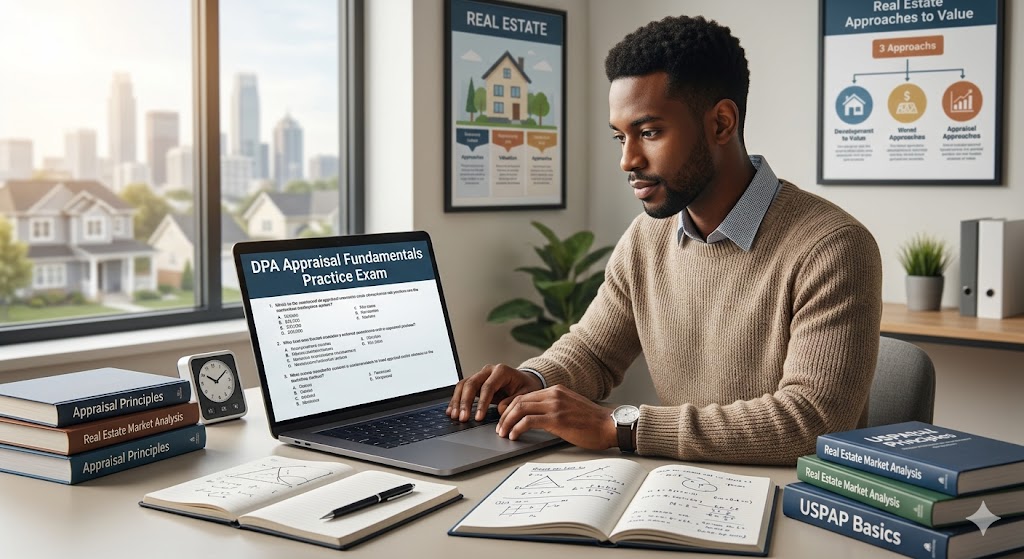
Additional Information
What the Course Entails and Exam Details
The DPA Appraisal Fundamentals Workshop delves into the fundamental concepts and practical skills crucial for effective real estate valuation. Participants will explore a wide range of topics, including defining various types of value, understanding the factors influencing real estate markets, and learning how to properly describe a property. Key valuation methodologies are a cornerstone of the curriculum, with detailed instruction on the three standard approaches: the Cost Approach, the Sales Comparison Approach, and the Income Capitalization Approach. You will also gain an introductory understanding of data collection, market analysis, mathematical concepts relevant to appraisal, and the core tenets of the Uniform Standards of Professional Appraisal Practice (USPAP), which govern professional ethics and conduct. The final exam, for which this practice test is designed to prepare you, directly assesses your comprehension and application of these topics across various scenarios.
What to Expect in the Final Exam
Understanding the structure and requirements of the final, official exam is essential for effective preparation. The actual examination typically features a substantial number of multiple-choice questions, which may include case study scenarios or data analysis tasks, testing both your knowledge of terminology and your ability to apply core principles. You can expect a defined passing score, often around 70% or 75%, and a reasonable time limit, generally ranging from two to three hours, depending on the specifics of your course provider. The exam will require calculations (so bring an approved calculator!), so solidifying your mathematical proficiency is key. It's important to remember that the exam is designed to be comprehensive and requires not only memorization but a fundamental grasp of the concepts. The practice test you are preparing for is designed to mirror this experience, with a similar question style, coverage, and potentially even a timed element to provide you with the most realistic rehearsal possible.
How to Study and Exam Centers
Effective preparation for both the practice and final exams involves a multi-faceted approach. Utilize the practice test strategically: simulate real exam conditions by timing yourself, take it multiple times, and thoroughly review both correct and incorrect answers to understand the logic behind them. Do not rely solely on the practice test, however. Review all workshop materials, notes, and any recommended textbooks. Focus on understanding the core valuation methods, key terminology, and ethical guidelines. Forming study groups can also be beneficial for discussing complex concepts. As for where and how to take the exams, both are often offered through online portals provided by the organization or institution that administers the workshop. Check your course details and the administering body's website for specifics. For the final, official exam, some providers also offer options to take it at physical, authorized test centers (such as professional testing services or educational institutions). When you are ready to schedule, you will typically register through the same organization where you took the workshop.
Job Opportunities from the Course
Successfully completing the DPA Appraisal Fundamentals Workshop and its final exam unlocks diverse career paths within the real estate and financial sectors. Mastering these fundamental skills positions you for various roles, including:
Licensed or Certified Real Estate Appraiser Commercial or Residential Property Appraiser Real Estate Analyst Property Tax Assessor Mortgage Loan Officer (with valuation focus) Real Estate Reviewer/Review Appraiser Right-of-Way Agent Real Estate Consultant Banking Policy or Credit Analyst (with property valuation expertise) Claims Adjuster for Property Insurance
Embarking on this course of study is a significant step towards a rewarding and impactful career in property valuation. Take advantage of the practice test and other resources to ensure your success!Here is a comprehensive study guide article and an accompanying image for the DPA Appraisal Fundamentals Workshop Practice Test.
Frequently Asked Questions
Reviews
5.0
Based on 0 reviews
Leave a Review
No reviews yet. Be the first to review!