
DPS Third Party Skills Testing (TPST) Practice Test
$69.00
- Buy to unlock unlimited access to all Quiz questions and Answers in this Quiz.
- After purchase you can print a PDF of the whole quiz at any point. The PDF will contain the questions and the correct answers.
About this Exam
The DPS Third Party Skills Testing (TPST) program offers a convenient and accessible way for eligible Texans to take their driving skills test. Administered by authorized driving schools and organizations rather than at a Texas Department of Public Safety (DPS) office, TPST allows you to complete this crucial final step in obtaining your driver’s license with a certified examiner from your chosen provider. This comprehensive guide and practice exam are designed to help you prepare effectively, build confidence, and demonstrate the safe driving skills required to pass. Whether you’ve completed traditional driver education or parent-taught courses, understanding and practicing the core maneuvers and safety principles is key to your success.
Ready to test your knowledge?
Buy Now to Access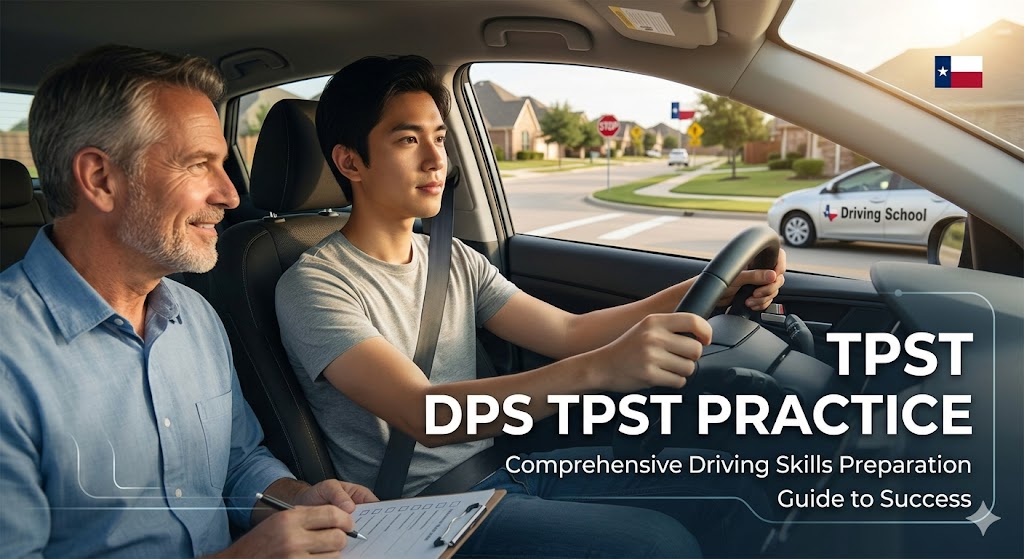
Additional Information
What the Course Entails and Exam Details
This practice guide is structured to mirror the practical skills and safety evaluations you will face during your actual TPST driving test. It is not a course with traditional syllabus sections but rather a practical preparation tool focusing on:
Observation Skills: Consistently scanning your surroundings, checking mirrors (rear-view and side), and checking blind spots before any maneuvers.
Vehicle Control: Smooth acceleration, braking, steering, and maintaining a constant and appropriate speed.
Signaling: Correct and timely use of turn signals for all turns and lane changes.
Traffic Laws: Full understanding and obedience to all traffic signs, signals, and pavement markings.
Specific Maneuvers: You will be required to perform key driving tasks, including:
Parallel Parking: Correcty positioning and maneuvering the vehicle into a designated space.
Backing in a Straight Line: Reversing smoothly over a specific distance without weaving.
Making Left and Right Turns: Executing turns correctly, checking for traffic and pedestrians, and ending in the proper lane.
Lane Changes: Safely and smoothly changing lanes with proper observation and signaling.
Intersection Approaches: Approaching intersections with caution, checking both ways, and understanding right-of-way rules.
Safe Following Distance: Maintaining a safe distance from other vehicles using the two-second rule or appropriate distance for conditions.
What to Expect in the Final Exam
Your actual TPST driving test will be a practical, in-vehicle evaluation, not a multiple-choice or written exam. Here is what you can expect:
Format: You will drive a road test route, typically taking 20-30 minutes, in a vehicle provided by the authorized school or your own qualifying vehicle. A DPS-certified examiner will sit in the passenger seat and give you directions.
Evaluation: The examiner will score your performance based on your ability to safely and correctly perform the required maneuvers, obey traffic rules, and demonstrate overall defensive driving habits. You will be evaluated on factors like your observation, control, positioning, signaling, and decision-making.
Scoring and Passing: While there isn't a publicly detailed, exact numerical scoring system like a written test, it is a pass/fail assessment. Significant errors (such as dangerous actions, violating traffic laws, or causing an accident) will result in automatic failure. Accumulating too many minor errors (like missing a signal, improper lane positioning, or infrequent mirror checks) can also cause you not to pass based on the cumulative evaluation of your safe driving. The specific pass/fail criteria are aligned with Texas DPS standards for new drivers.
Specific Rules: All standard traffic laws and safe driving practices must be strictly followed. Use of mobile devices is prohibited. You may not receive assistance or coaching during the test. For teen drivers, parent-taught logs and driver education certificates must be presented, and all prerequisites must be completed before the test can proceed.
How to Study and Exam Centers
Effective preparation for your TPST driving test is all about consistent, practical application of safe driving skills. Here are actionable study strategies:
Practice, Practice, Practice: Dedicate considerable time behind the wheel with a licensed adult. Practice in varying conditions—different times of day, light and moderate traffic, and diverse types of roads (residential streets, multi-lane roads). Focus on mastering each specific maneuver mentioned in section 2.
Use Practice Checklists: Find or create checklists for each maneuver and have your practice supervisor evaluate you, pointing out mistakes and areas for improvement. Reviewing resources like the Texas Driver Handbook is essential for understanding the rules and expected behaviors.
Get Professional Instruction: Consider taking a few private driving lessons from a licensed instructor who is familiar with the requirements of the Texas driving test. They can provide expert drills, feedback, and dual-control safety that matches official evaluation expectations.
Mock Tests: Ask your practice supervisor or instructor to conduct mock driving tests on potential routes or by giving realistic directions for a full evaluation.
Where and How to Take the Exam (Exam Centers): TPST driving tests are only administered at authorized Third Party Skills Testing locations across Texas. These are typically driving schools or related organizations that have been certified by the DPS. You cannot simply walk in to take the test; you must contact an authorized TPST provider directly to schedule your appointment and clarify their specific scheduling, required documentation (driver education certificates, permit, completed logs for teens, etc.), and vehicle requirements. Many providers require candidates to have completed their driver education with them, but some may accept external applicants—check with individual schools. You will take the exam with that school’s examiner, utilizing their approved test routes.
Job Opportunities from obtaining your Driver's License
Successfully completing your driving skills test and obtaining your standard Texas driver’s license (Class C) opens up numerous job opportunities that require operating a standard motor vehicle. Here is a clear list of specific job titles and career paths you can pursue:
Gig Economy Driver (Rideshare for companies like Uber, Lyft)
Gig Economy Delivery Driver (Food delivery for Uber Eats, DoorDash, local services)
Professional Courier or Delivery Driver (Amazon, local courier companies, parcel delivery)
Sales Representative (Requiring extensive travel to client locations)
Residential or Commercial Service Technician (Plumber, Electrician, HVAC Technician – many positions require vehicle operation for transport and equipment)
Field Service Technician (Various industries requiring on-site customer service or equipment maintenance)
Real Estate Agent
Valet Parking Attendant (Contract or company-employed)
Shuttle Bus Driver (Hotel, university, or company shuttles – check for specific size/passenger requirements and if endorsements are needed)
Non-Emergency Medical Transport Driver
Paratransit or Elderly Transport Driver
Parts Delivery Driver (Auto parts, supply delivery)
Landscape Crew Member / Driver
Construction Crew Member / Driver
Local Moving Truck Driver (Often standard license is sufficient for smaller trucks)
Appliance or Furniture Delivery Helper / Driver
Frequently Asked Questions
Reviews
5.0
Based on 0 reviews
Leave a Review
No reviews yet. Be the first to review!